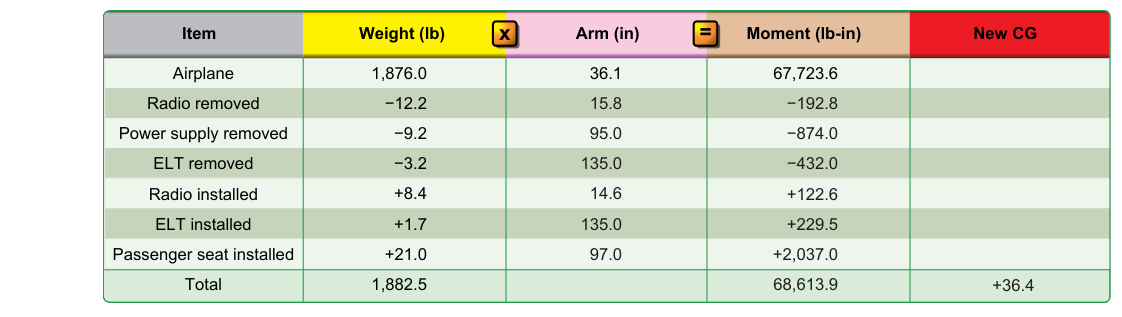
Every time an aviation maintenance technician (AMT) bolts on a new piece of avionics, replaces a structural component, or performs a major alteration, the aircraft's weight and balance change. Those changes may be small or significant, but they are never trivial. An airplane that exceeds its maximum gross weight or whose center of gravity (CG) falls outside the approved limits becomes unpredictable and potentially uncontrollable in flight. Understanding how to calculate, record, and evaluate the weight-and-balance impact of maintenance work is therefore a core AMT competency — and a recurring subject on the FAA General knowledge test.
This article walks through the principles behind weight and balance changes caused by repairs, alterations, and equipment additions or removals, the math involved, and the documentation requirements that keep the aircraft legal and the logbook accurate.
Foundational Concepts
Before tackling the effects of maintenance changes, it helps to have the vocabulary firmly in place.
- Weight is the total force the aircraft exerts downward due to gravity, measured in pounds.
- Center of gravity (CG) is the single point at which the aircraft's entire weight is considered to act. It is expressed as a distance — in inches — measured aft from a reference point called the datum.
- Datum is an imaginary vertical reference plane chosen by the manufacturer; all arm measurements originate from it.
- Arm is the horizontal distance (in inches) from the datum to any given item. Arms forward of the datum are negative; arms aft are positive (in most designs).
- Moment is weight multiplied by arm (W × A). Moments are expressed in pound-inches (lb-in).
- CG location is found by dividing total moment by total weight: CG = ΣMoments ÷ ΣWeights.
The aircraft must be operated with its CG inside the forward and aft limits published in the Type Certificate Data Sheet (TCDS) and the Airplane Flight Manual (AFM). These limits exist because the pilot must maintain adequate pitch authority throughout the entire flight envelope.
How Repairs, Alterations, and Equipment Changes Shift Weight and Balance
Every change to an aircraft falls into one of three basic categories from a weight-and-balance perspective: addition, removal, or substitution. Each is handled with the same fundamental math, just applied differently.
Adding Equipment or Material
When an item is installed — a new GPS unit, an additional battery, a cargo tie-down ring — the aircraft's empty weight increases by the weight of that item, and the new moment arm determines how the CG shifts. If the item's arm places it aft of the current CG, the CG will move aft. If the item is forward of the current CG, the CG moves forward.
For example, suppose the current empty weight is 1,620 lb and the empty-weight CG is at +42.0 inches. A technician installs a new ELT weighing 3.2 lb at an arm of +85 inches. The new moment is 3.2 × 85 = 272 lb-in. The new total weight is 1,623.2 lb and the new total moment is (1,620 × 42.0) + 272 = 68,040 + 272 = 68,312 lb-in. The new CG is 68,312 ÷ 1,623.2 = 42.08 inches — barely aft, but the change is documented and the new figures replace the old empty-weight and CG values in the aircraft records.
Removing Equipment
Removal is the mathematical inverse of addition. The weight of the removed item is subtracted from total weight, and its moment (weight × arm) is subtracted from total moment. The resulting new CG is calculated from those reduced figures. A common example is removing an older, heavier radio and not replacing it. The aircraft gets lighter, but the CG also shifts — toward which direction depends entirely on where that radio was relative to the original CG.
Substitution (Replacing One Item with Another)
A substitution is treated as a removal followed by an addition. Remove the old item (subtract weight and moment), then add the new item (add its weight and moment). This is the most common scenario in avionics upgrades and structural repairs using replacement materials. Even replacing rivets with slightly heavier hardware counts as a weight change and must be evaluated, though for very minor repairs the change may be negligible enough to document without a full revised weight-and-balance calculation if it falls within the scope of minor repairs.
Structural Repairs and Material Changes
Structural repairs deserve special attention. When a technician splices a damaged spar, patches sheet metal, or replaces corroded structural tubing, added repair material increases weight. The repair material's weight and its arm must be calculated and added to the running empty-weight record. Conversely, if damaged material is removed during repair (e.g., grinding away corroded metal before welding), the weight of that removed material is subtracted. The net change — new material added minus old material removed — is what actually changes the empty weight.
Major repairs that materially affect weight and balance must be recorded in the aircraft maintenance records, and the revised weight-and-balance data must be placed in the aircraft. For major alterations (which require FAA Form 337), the new weight-and-balance computation must accompany the 337 form or be referenced within it.
Why It Matters: Safety and Airworthiness
A CG that migrates outside approved limits creates serious flight hazards. An aft CG reduces pitch stability — the aircraft becomes increasingly difficult or impossible to recover from a stall. In the extreme case, the pilot may lack sufficient forward elevator authority to push the nose down at all. An excessively forward CG increases the download on the horizontal tail required to maintain level flight, raising stall speed and reducing climb performance; in severe cases, the pilot may not be able to raise the nose for landing flare.
Exceeding maximum gross weight compounds every performance problem: longer takeoff roll, reduced climb rate, higher stall speed, longer landing distance, and increased structural stress on every component. These are not theoretical concerns — they are directly responsible for accidents.
From a regulatory standpoint, an aircraft whose weight or CG falls outside the approved envelope is not airworthy. Operating it violates 14 CFR Part 91, and any AMT who signs off maintenance without correctly evaluating and documenting weight-and-balance changes may face certificate action.
Key Numbers and Rules
- The basic formula: CG = Total Moment ÷ Total Weight. Moment = Weight × Arm.
- Major alteration documentation: FAA Form 337 is required; revised weight-and-balance data must be included or referenced.
- Empty weight CG range: Some aircraft have an empty-weight CG range published. If the computed empty-weight CG falls outside this range, loading combinations alone cannot bring the loaded CG within limits.
- Ballast: Temporary ballast (removable) or permanent ballast (fixed) may be added to bring the CG back within limits after alterations, but it adds to empty weight and must be documented.
- Record placement: Updated weight-and-balance data must be kept in the aircraft at all times (14 CFR 91.9 and aircraft operating handbook requirements).
- TCDS and AFM authority: CG limits and maximum weights are set by the TCDS; no maintenance action may expand those limits without FAA approval (Supplemental Type Certificate or amended TC).
- Weighing requirement: Not every minor repair requires reweighing, but any time there is doubt about the accuracy of existing weight-and-balance records, the aircraft should be weighed. Reweighing is also required after major alterations and may be required after major repairs.
Practical Calculation Workflow
When faced with a weight-and-balance change on the job, follow this sequence: First, obtain the current empty-weight and CG data from the aircraft records. Second, identify the weight and arm of every item being added, removed, or substituted. Third, compute the moment of each change (weight × arm). Fourth, algebraically sum all weight changes and all moment changes with the current figures to find the new total weight and total moment. Fifth, divide new total moment by new total weight to find the new CG. Sixth, compare the new CG and weight against the TCDS limits. Seventh, if within limits, enter the new data in the aircraft records. If out of limits, do not return the aircraft to service until the problem is corrected — either through repositioning equipment, adding ballast, or seeking engineering approval for a different solution.
Common Test Traps
- Confusing arm sign conventions: Arms forward of the datum are negative in most aircraft; forgetting the sign reverses the direction the CG moves and gives a wrong answer.
- Forgetting to account for removed material in a repair: Candidates often add the repair material weight but forget to subtract the damaged material that was cut away, overstating the new empty weight.
- Assuming a small weight change means no CG change: A light item installed far from the CG can cause a surprisingly large CG shift because of the long arm.
- Mixing up major repair vs. major alteration documentation: Both require FAA Form 337 when they are "major," but the categories are defined differently; alterations change the design, repairs restore it.
- Forgetting to update aircraft records: Performing a correct calculation but failing to place the revised data in the aircraft is still a regulatory violation and a test question target.