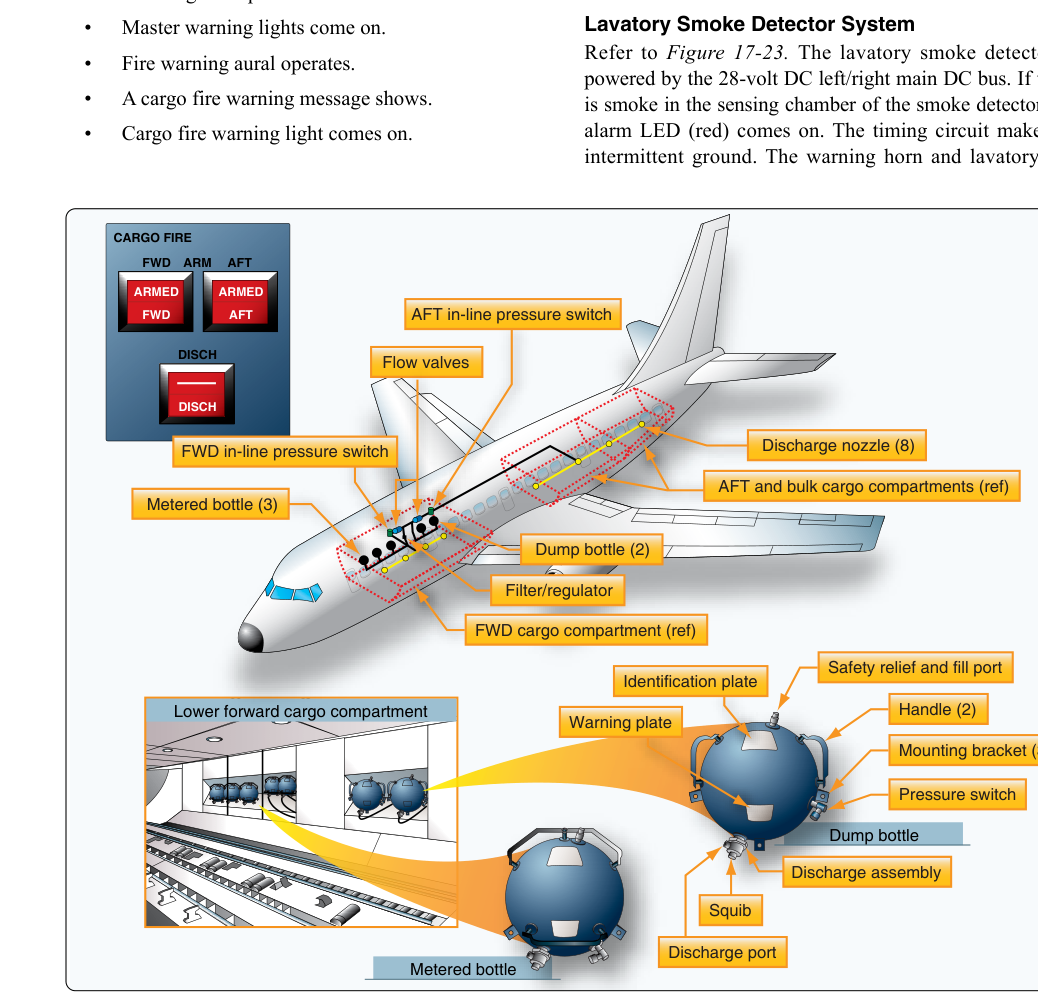
Fire in a cargo or baggage compartment is one of the most dangerous emergencies an aircraft can face. Unlike a cockpit or cabin fire, a cargo bay fire may go undetected for several minutes without a reliable smoke detection system — long enough for flames to compromise structural integrity, flight controls, or pressurization systems. For this reason, the FAA mandates specific smoke or fire detection equipment in transport and commuter category aircraft cargo and baggage compartments, and airframe maintenance technicians must understand the operating principles, inspection requirements, and common failure modes of these systems.
This article covers the three primary smoke detection technologies used in aircraft cargo and baggage compartments — ionization, photoelectric (optical), and visual (continuous-loop or visual inspection) methods — along with the regulatory basis, system architecture, testing procedures, and the key facts an AMT must know to maintain these systems correctly.
Regulatory Foundation
The certification requirements for cargo compartment fire protection are found in 14 CFR Part 25 (for transport category airplanes). Section 25.857 classifies cargo compartments into Class A through Class E based on crew accessibility and liner configuration, and Section 25.858 specifies performance requirements for smoke or fire detection systems. Class A compartments, where a crew member can see and reach into the entire volume, may rely on visual detection. Class B, C, D, and E compartments — which are less accessible — require installed smoke or fire detectors that alert the crew on the flight deck. Maintenance technicians must always verify which class a compartment belongs to before making changes to or approving the detection system on a particular aircraft.
Ionization Smoke Detectors
Ionization detectors respond primarily to invisible combustion particles — the submicron aerosol products of fast-burning, flaming fires. Inside the detector housing are two electrically charged plates and a tiny quantity of a radioactive material (typically americium-241) that ionizes the air between the plates, allowing a small but measurable electrical current to flow continuously. When smoke particles enter the sensing chamber, they attach to the ionized air molecules, disrupting the flow of current. The detector's circuitry senses this drop in current and triggers a warning on the flight deck.
Because ionization detectors respond best to the small particles produced by open flames and fast-burning fires, they are slightly less sensitive to the larger particles associated with slow, smoldering fires. This characteristic is important for an AMT to understand: a slow-burning cardboard or fabric fire in a baggage compartment might produce heavy visible smoke before an ionization detector activates. In practice, most aircraft do not rely on a single detector type alone; many modern systems combine ionization sensors with photoelectric sensors to cover both fast-flaming and slow-smoldering scenarios.
Ionization detectors must be handled carefully during maintenance. The radioactive source, though extremely small, subjects the detector to certain transportation and disposal regulations. Technicians should follow manufacturer's maintenance manual (MM) procedures and applicable regulatory guidance before removing or replacing these units.
Photoelectric (Optical) Smoke Detectors
Photoelectric detectors use a light-scattering or light-obscuration principle to sense smoke. In the most common aircraft configuration — the forward-scatter type — a light-emitting diode (LED) or small lamp shines a beam across a dark sensing chamber. A photoelectric receiver is positioned off-axis from the beam so that, under normal (smoke-free) conditions, the receiver sees no light. When smoke particles enter the chamber, they scatter light in multiple directions; some of this scattered light strikes the receiver, producing an electrical signal that triggers the smoke warning.
An alternative configuration, the light-obscuration (or beam-type) design, positions the receiver directly in the beam's path. Smoke particles obscure (block) the beam, reducing the signal at the receiver and triggering the alarm. Beam-type detectors are well suited to long, open cargo areas where a single transmitter-receiver pair can monitor a large volume.
Photoelectric detectors are particularly sensitive to the larger particles produced by slow, smoldering fires — exactly the scenario most likely in a packed baggage hold where clothing or cardboard smolders with restricted airflow. This makes them highly complementary to ionization detectors. Maintenance checks of photoelectric units should include verifying that the optical surfaces are free of contamination; a dirty lens or smoke-stained chamber can cause both nuisance alarms and reduced sensitivity.
Visual Detection — Class A Compartments
In a Class A cargo compartment, a flight crew member can see into every part of the compartment from the passenger cabin during flight. The FAA allows the crew's direct visual observation — without installed detectors — to satisfy the smoke detection requirement for this class. In practice, this means the compartment has a transparent door or inspection window and adequate lighting. The maintenance technician's responsibility is ensuring the window remains clear, the lighting is functional, and the compartment's Class A status has not been inadvertently changed by structural modifications or liner additions that block the line of sight.
System Architecture and Flight Deck Annunciation
Regardless of sensor type, aircraft smoke detection systems share a common architecture. Individual detectors are wired into a detection loop monitored by a smoke detection control unit (sometimes called the smoke detector controller or fire detection control unit). The control unit evaluates signals from the detectors and, upon sensing an alarm condition, illuminates a dedicated smoke warning light on the flight deck — typically amber or red — and may activate an audio alert. On many transport aircraft, separate warning lights indicate which specific compartment (forward cargo, aft cargo, bulk) is affected, helping the crew choose the correct response.
Modern systems include a fault monitoring function. If a wiring break, sensor failure, or power interruption occurs, the system generates a distinct fault or inoperative annunciation so the crew knows the detection system is degraded. This is a key maintenance point: an intermittent fault in a cargo smoke detection loop must be investigated and corrected promptly because a degraded system can mask a real smoke event or generate nuisance alarms that lead crews to discount valid warnings.
Testing and Inspection Requirements
Maintenance and inspection of smoke detection systems generally encompasses the following tasks, always in accordance with the aircraft's approved Maintenance Manual and the Instructions for Continued Airworthiness (ICA):
- Functional (operational) test: Applying a test aerosol, simulated smoke, or the manufacturer's approved test method to confirm each detector activates the flight deck warning within the specified response time. Some detectors have an integral self-test button that checks internal circuitry but does not verify the optical or ionization path — the manufacturer's MM will specify whether a full aerosol test is also required.
- Continuity and resistance checks: Using a multimeter to verify proper wiring continuity, insulation resistance, and connector integrity throughout the detection loop.
- Contamination inspection: Examining detector chambers and optical surfaces for dust, oil, moisture, or corrosion that could impair sensitivity or cause false alarms.
- Sensitivity verification: Some installations require periodic sensitivity checks with calibrated test equipment to confirm the detector responds within approved threshold limits.
- Control unit test: Verifying that the control unit correctly interprets detector signals, generates proper annunciations, and activates fault warnings when a fault condition is introduced.
Why It Matters — Safety and Airworthiness
Cargo compartment fires have caused fatal accidents. The rapid detection of smoke, followed by crew activation of halon (or halon-alternative) suppression agents and an emergency descent, is the established defense against catastrophic in-flight fire. A smoke detection system that fails to alarm because of contaminated optics, a broken wire, or an improperly installed replacement detector negates the entire protective chain. Equally dangerous is a system prone to nuisance alarms: crews who experience repeated false warnings may hesitate to take emergency action when a real fire occurs, a phenomenon sometimes called alarm complacency. Maintaining accurate, reliable smoke detectors is therefore a direct flight safety responsibility.
Key Numbers and Rules
- 14 CFR 25.857 defines cargo compartment classes (A through E) and the accessibility basis for detection requirements.
- 14 CFR 25.858 sets performance standards: smoke detectors must provide a warning with a sufficient margin above background to be unambiguous to the crew.
- Class A compartments may use visual observation in lieu of installed detectors — all other classes require installed equipment.
- Class D compartments were designed to contain a fire and starve it of oxygen within a sealed liner, without requiring an installed smoke or fire detection system or a built-in extinguishing system. However, FAA Amendment 25-93 eliminated the Class D classification for newly certificated designs — compartments must now meet Class C or Class E requirements, which mandate installed detection and suppression equipment.
- Detectors are typically checked on the continuous airworthiness maintenance program (CAMP) interval specified in the manufacturer's Maintenance Planning Document (MPD).
- Photoelectric detectors excel at detecting slow, smoldering fires; ionization detectors excel at detecting fast-flaming fires.
- Americium-241 source detectors are subject to NRC and DOT handling regulations for radioactive materials, even though the quantities are extremely small.
Common Test Traps
- Confusing detector strengths: Many students incorrectly apply ionization detector sensitivity to slow, smoldering fires — remember, ionization detects fast-flaming fires best; photoelectric detects smoldering fires best.
- Forgetting Class A exception: Class A compartments do not require installed detectors if a crew member has direct visual access. Assuming all cargo compartments need hardware detectors is a common mistake.
- Misidentifying the test method: An integral self-test button confirms circuitry, not full optical or ionization sensitivity. A complete functional test uses a manufacturer-approved smoke or aerosol method.
- Ignoring fault annunciation: A smoke detection system showing a fault indication is an airworthiness item — it does not simply mean the system is working in a degraded but acceptable mode. An inoperative or faulted detector loop must be addressed before flight in accordance with the Minimum Equipment List (MEL) and approved procedures.
- Overlooking compartment reclassification: Adding acoustic insulation, cargo liners, or partitions can change a compartment's classification, altering the required detection method. Always verify the compartment class has not changed after any structural or interior modification.