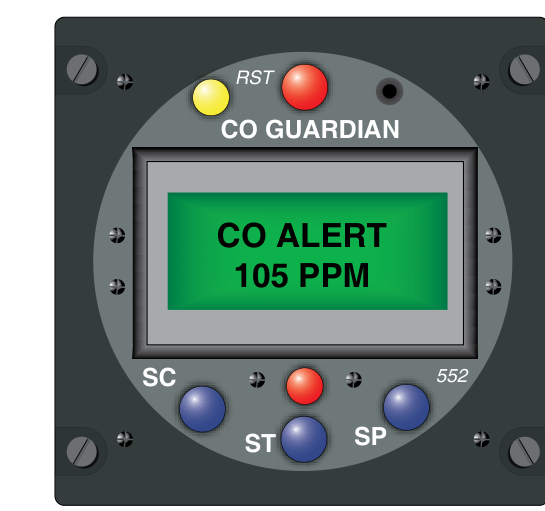
Carbon monoxide (CO) poisoning is one of the most insidious hazards in general aviation because the gas that causes it cannot be seen, smelled, or tasted. It can render a pilot progressively incapacitated while they feel only mildly unwell — or even while they feel nothing at all. Every year, incidents and accidents are attributed, at least in part, to CO exposure in the cockpit. For the private pilot student, understanding what produces CO, how it harms the body, and what immediate actions to take is not just an exam topic — it is a genuine life-safety skill.
The subject appears in the FAA's Pilot's Handbook of Aeronautical Knowledge (PHAK) under the human factors and aeromedical sections, and it ties directly into aeronautical decision-making (ADM) and the preflight risk assessment process. A pilot who understands CO poisoning will take simple precautions that virtually eliminate the risk.
Where Carbon Monoxide Comes From
CO is produced whenever a carbon-based fuel burns incompletely. In light piston-engine aircraft, the primary source is the engine exhaust. The typical combustion process in an aircraft engine creates exhaust gases that are rich in CO, particularly during cold starts, rich mixture operation, or any time combustion is inefficient.
The danger enters the cabin through the cabin heat system. Most single-engine light aircraft use a combustion-type heater — a shroud or muff that wraps around the engine exhaust pipes or muffler. Outside air passes over the hot exhaust components, warms up, and flows into the cabin. This design is economical and effective, but it depends entirely on the exhaust system being sealed and intact. If a muffler develops a crack, a weld fails, or an exhaust gasket deteriorates, exhaust gases — including CO — can leak directly into the airstream being routed to the cabin. The pilot and passengers then breathe what is essentially diluted engine exhaust.
Additional sources include: a malfunctioning or improperly adjusted cabin heater on aircraft equipped with combustion heaters that burn avgas or jet fuel directly; operating with windows or doors partially open in the wrong configuration, which can create low-pressure areas that draw exhaust gas forward into the cabin; and extended ground running or runup in a poorly ventilated area. It is worth noting that turbojet and turbofan aircraft use bleed air from the compressor section for heat, which carries its own contamination risks, but for piston-powered private pilot operations, the exhaust shroud system is the predominant concern.
How Carbon Monoxide Harms the Body
Understanding the physiology of CO poisoning makes it easier to recognize the symptoms and appreciate why they are so dangerous. CO is harmful because it binds to hemoglobin — the molecule in red blood cells that normally carries oxygen — with an affinity the PHAK describes as more than 200 times greater than oxygen itself. When CO attaches to hemoglobin it forms carboxyhemoglobin (COHb). Hemoglobin that is carrying CO cannot carry oxygen. As more hemoglobin becomes saturated with CO, the blood progressively loses its ability to deliver oxygen to body tissues, including the brain and heart.
The insidious aspect is that CO poisoning does not produce the same sensation of air hunger or breathlessness that hypoxia from altitude does, so a poisoned pilot may feel no particular respiratory distress even as their blood oxygen delivery collapses. Furthermore, because CO symptoms (headache, confusion, impaired judgment) overlap with fatigue, dehydration, and motion sickness, pilots often misattribute what they are experiencing.
The PHAK identifies a progression of symptoms that roughly tracks increasing carboxyhemoglobin saturation. At low levels, a pilot may notice a slight headache, fatigue, or mild dizziness. As exposure continues or concentrations rise, the headache intensifies, vision may dim or narrow, cognitive function degrades — affecting the very judgment and decision-making skills a pilot needs most — and nausea or drowsiness can set in. At high carboxyhemoglobin levels, a person can lose consciousness with little warning. Death can result from sustained high-level exposure. Crucially, impaired judgment means a poisoned pilot may not recognize their own deterioration; this is analogous to the effect of hypoxia at altitude and is one reason CO poisoning is so deadly in an aviation context.
Another complicating factor is that COHb clears slowly from the blood. Even after leaving the contaminated environment, it takes the body several hours to eliminate CO from hemoglobin when breathing normal air (although breathing 100% oxygen dramatically accelerates elimination). A pilot who had significant CO exposure the evening before a flight may still carry elevated COHb into the cockpit, meaning rest alone is not always a complete remedy.
Prevention: The Best Medicine
Prevention is far more effective than recognition and response. Several practical habits significantly reduce CO risk:
- Preflight the exhaust system: During preflight inspection, visually examine the exhaust stacks, muffler, and any accessible portions of the exhaust system for cracks, holes, rust-through, or signs of heat damage on surrounding structures. Discoloration or soot near heat shroud outlets is a warning sign.
- Use a CO detector: Inexpensive electrochemical or colorimetric CO detectors are available for the cockpit, including passive color-change card types and battery-powered digital detectors that sound an alarm. A functioning CO detector provides an essential early warning that no amount of visual inspection can replace.
- Use heat judiciously: If you notice any symptom that could be CO-related, turn off cabin heat immediately. Many aircraft POHs explicitly include this guidance in their emergency checklists.
- Ventilate: Open fresh air vents or a window. Fresh outside air dilutes any CO that has entered the cabin and helps clear the pilot's bloodstream faster.
- Be aware during runup: Avoid extended ground operation in enclosed hangars or in positions where your own exhaust can recirculate into the air intake or cabin.
Immediate In-Flight Actions
If CO poisoning is suspected — any combination of headache, dizziness, nausea, or visual changes, especially after cabin heat has been in use — the FAA recommends a specific sequence of actions. First, turn off the cabin heat immediately. Second, open all available fresh air sources: vents, windows, or doors if the aircraft is equipped and conditions permit. Third, if supplemental oxygen is on board, don breathing oxygen at 100% concentration without delay. Breathing 100% oxygen accelerates the displacement of CO from hemoglobin significantly compared to breathing fresh air alone. Fourth, land as soon as possible. Even if symptoms improve after ventilating, CO poisoning can recur if any residual source remains, and the pilot's judgment and cognitive function may be more impaired than they realize. After landing, seek medical evaluation; pure oxygen therapy (and in severe cases, hyperbaric oxygen therapy) may be indicated.
Key Numbers and Rules
- CO binds to hemoglobin more than 200 times more readily than oxygen, forming carboxyhemoglobin that cannot carry O₂.
- Symptoms begin at relatively low carboxyhemoglobin saturation and worsen progressively — early recognition is critical because judgment degrades before gross incapacitation occurs.
- Breathing 100% oxygen is the most effective field remedy; it dramatically reduces the half-life of CO in the blood compared to breathing ambient air.
- The primary in-aircraft source is a cracked or leaking exhaust system combined with use of combustion-type cabin heat.
- CO detectors are strongly recommended equipment for any aircraft with a combustion heat system.
- Even after apparent recovery, a pilot who suffered significant CO exposure should be evaluated medically before acting as pilot-in-command again.
Memory Aid
HALT — a simple sequence for suspected CO poisoning in flight:
- H — Heat off: Turn off cabin heat immediately to stop the source.
- A — Air in: Open fresh air vents and windows to ventilate the cabin.
- L — Land now: Declare an emergency if necessary and land as soon as practicable.
- T — Treatment: Seek medical evaluation and oxygen therapy on the ground.
HALT is a practical memory framework rather than an official FAA acronym — it does not appear in the PHAK or any other FAA publication, so do not expect to see it referenced on the knowledge test by name. It is offered here only as a personal aid, and it reflects the general response steps described in FAA guidance, giving a pilot a pre-loaded mental checklist to activate under cognitive stress — exactly when CO impairment makes complex thought most difficult.
Common Test Traps
- Confusing CO with hypoxia: Both impair judgment and cause similar symptoms, but CO poisoning typically presents with headache as an early, prominent symptom, and it is associated with use of cabin heat — not altitude. The FAA knowledge test may ask you to distinguish these two conditions.
- Assuming fresh air solves everything: Ventilation helps, but if the CO source remains active (heat still on, cracked exhaust still present), it may overwhelm the fresh air. Always turn off the heat first.
- Thinking the body quickly recovers: COHb clears slowly on room air. A pilot should not assume a brief exposure with quick recovery means they are fully fit to continue. The correct answer on the exam — and in real life — is to land and get evaluated.
- Underestimating the role of exhaust system inspection: Some students focus only on recognizing symptoms and neglect that prevention starts with a thorough preflight of the exhaust system and using a CO detector.
- Overlooking CO risk on the ground: Running the engine in an enclosed hangar or during a long runup in a tailwind can bring exhaust gases into the cabin even before takeoff. CO risk is not limited to cruise flight with the heater on.