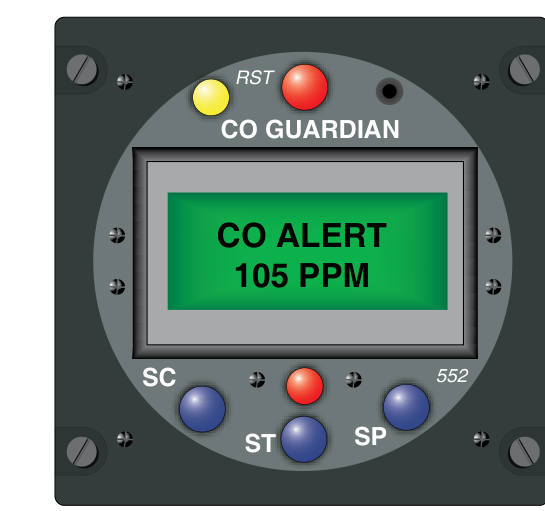
Of all the physiological threats a pilot faces in the cockpit, carbon monoxide (CO) poisoning stands out for its deceptive nature. The gas is colorless, odorless, and tasteless — you cannot detect it with your senses alone. During instrument flight in IMC, when your attention is divided among avionics, ATC communications, and procedural tasks, CO poisoning can reduce your cognitive and physical capacity long before you realize anything is wrong. By the time obvious symptoms appear, your ability to execute an emergency descent, communicate with ATC, or even read an approach plate may already be severely compromised. Understanding where CO comes from, how it affects your body, how to recognize it early, and exactly what to do about it is not optional knowledge for IFR pilots — it is a survival skill.
Carbon monoxide is produced by the incomplete combustion of carbon-containing fuels. In a piston-engine aircraft, the primary source is exhaust gas from the engine. Most light aircraft heat their cabins through a combustion air heater or, more commonly, a heat exchanger — a metal shroud surrounding a section of the exhaust manifold or muffler. Outside air passes over the hot exhaust component and is then routed into the cabin. When the exhaust system develops a crack, hole, or failed weld — as it inevitably does with age, vibration, and thermal cycling — exhaust gases can leak directly into this airflow and enter the cabin. Using cabin heat in an aircraft with a compromised exhaust system is essentially piping engine exhaust into the cockpit.
How Carbon Monoxide Affects the Body
Oxygen is carried through the bloodstream by hemoglobin, a protein in red blood cells. Hemoglobin's affinity for carbon monoxide is commonly cited as roughly 200 to 250 times greater than its affinity for oxygen, a figure widely used in aeromedical education, though exact values vary somewhat by source. When CO is inhaled, it binds to hemoglobin to form carboxyhemoglobin (COHb), effectively locking that hemoglobin molecule out of the oxygen-transport business. The result is functional hypoxia — your blood is circulating, your lungs are breathing, but your tissues, including the brain, are being starved of oxygen. This process is described in the FAA's Pilot's Handbook of Aeronautical Knowledge in the context of hypoxia caused by factors other than altitude.
What makes CO poisoning particularly dangerous for instrument-rated pilots is the correlation between COHb levels and cognitive impairment. At relatively low COHb saturation levels — levels that might produce only mild headache at rest — the higher-order mental functions required for IFR flight begin to degrade. Decision-making, short-term memory, spatial reasoning, and reaction time are impaired. An instrument pilot managing an approach in IMC is performing complex cognitive work; the margin for cognitive degradation is essentially zero. Further increases in COHb cause worsening headache, dizziness, nausea, confusion, and ultimately unconsciousness and death. Unlike alcohol intoxication, a person experiencing CO poisoning often does not realize their impairment is growing — a classic feature of hypoxic states in general.
Recognizing CO Poisoning in the IFR Environment
The early symptoms of CO poisoning are easy to dismiss or misattribute, especially during a busy IFR flight. A mild frontal headache, slight dizziness, or a vague sense of fatigue can be rationalized away as dehydration, anxiety, or workload-related stress. This is exactly the trap. The FAA's Pilot's Handbook of Aeronautical Knowledge lists the symptoms of CO poisoning as including headache, dizziness, drowsiness, and impaired judgment — all of which overlap with other conditions common in aviation.
There are several contextual clues that should heighten your suspicion during IFR flight:
- Symptoms onset after activating cabin heat: If any symptom appears or worsens shortly after you turned on the cabin heater, CO must be your first assumption, not your last.
- Smell of exhaust or burnt odor: CO itself is odorless, but other combustion byproducts present in exhaust gas can have a faint smell. Any exhaust odor in the cockpit is an immediate emergency indicator, even if you feel fine.
- CO detector alarm: Many aircraft are now equipped with electrochemical CO detectors or passive spot-type detectors. If your detector changes color (passive) or sounds an alarm (electronic), treat it as an emergency immediately.
- Worsening symptoms over time: CO poisoning is cumulative during exposure. If you feel progressively worse throughout a flight — especially in cruise — do not wait to take action.
- Other occupants affected: If a passenger complains of headache or nausea, especially in combination with any symptom you are experiencing, CO poisoning is the leading differential.
Immediate Pilot Actions
The emergency response to suspected CO poisoning in flight is straightforward but must be executed decisively. Every second of continued exposure worsens your condition. The standard emergency response includes the following steps, consistent with guidance in the FAA's Airplane Flying Handbook and Pilot's Handbook of Aeronautical Knowledge:
- Close the cabin heat immediately. This removes the source of contaminated air entering the cabin.
- Open fresh air vents and windows (if aircraft design permits). Flooding the cabin with uncontaminated outside air begins to flush CO from the environment.
- Don oxygen if available. Supplemental oxygen accelerates the elimination of COHb from your blood. Breathing 100% oxygen is commonly cited as reducing the half-life of COHb from approximately four to five hours (breathing ambient air) to roughly sixty to ninety minutes. On supplemental oxygen, the body's recovery from CO poisoning is far faster.
- Declare an emergency with ATC (121.5 MHz or your assigned frequency). Declare Mayday and state your situation. ATC can provide radar vectors, priority handling, and emergency services at your destination. Do this early — before your cognitive function degrades further.
- Descend and land as soon as possible. Do not continue to your planned destination if a closer airport is available. Request the nearest suitable airport from ATC. Landing safely and getting medical evaluation is the only correct outcome.
- Seek medical attention after landing. Even if you feel better after fresh air and landing, COHb levels in your blood require medical assessment. CO poisoning can cause delayed cardiac and neurological effects.
Why This Matters During IMC
In visual meteorological conditions, a pilot suffering from CO poisoning might recognize a deteriorating situation and execute a precautionary landing by visual reference to terrain and airports. In IMC, this option is removed. The pilot must maintain instrument scan, execute a possibly complex procedure in ATC-controlled airspace, communicate coherently on the radio, and manage the aircraft — all while physiologically impaired. This is why early recognition and immediate action are so much more critical during IFR flight than in VFR operations. Delaying action by even a few minutes can mean the difference between a successful emergency landing and controlled flight into terrain or incapacitation.
The IFR pilot must also recognize that CO poisoning and hypoxia from altitude have overlapping symptoms. On a high-altitude IFR flight, a headache and cognitive fog might be attributed to hypoxia alone, delaying the recognition of a simultaneous CO problem. When supplemental oxygen does not relieve symptoms as expected, or when symptoms appear after cabin heat is activated rather than at altitude, CO poisoning should immediately move to the top of the differential.
Key Numbers and Rules
- CO has an affinity commonly cited as ~200–250 times greater for hemoglobin than oxygen, per general aeromedical education materials.
- Cabin heat exchangers are the most common CO source in piston aircraft; cracks in the exhaust muffler or manifold are the failure mode.
- Breathing 100% O₂ is commonly cited as reducing COHb half-life from ~4–5 hours (room air) to approximately 60–90 minutes.
- Any exhaust odor in the cockpit = treat as CO emergency, even without other symptoms.
- 14 CFR 91.3(b) authorizes the PIC to deviate from any rule of Part 91 to the extent required to meet an emergency, and 91.3(c) may require a report to the Administrator if requested — declare early, deviate as needed, land as soon as possible.
- Post-landing medical evaluation is mandatory — CO poisoning can have delayed cardiovascular and neurological effects even after apparent recovery.
- Passive CO detector cards should be checked before flight and replaced per manufacturer guidance; their sensitivity degrades with age.
Memory Aid
A simple way to organize the CO emergency response sequence is to remember these actions in order:
- Close the cabin heat
- Open fresh air vents
- Find oxygen (don supplemental O₂ if available)
- Alert ATC (declare an emergency)
- Set course for the nearest suitable airport and land
Work through this sequence as soon as CO poisoning is suspected — do not wait for certainty. In CO poisoning, waiting for certainty means waiting until you may no longer be capable of acting.
Common Test Traps
- "CO is detectable by smell." False. CO is odorless. Other exhaust components may produce a smell, but CO itself gives no sensory warning. Relying on smell alone is dangerous.
- "Opening the fresh air vent is enough." While ventilation helps, it is insufficient without also closing the heat source. If the heat shroud is cracked and the heater remains on, contaminated air continues to enter no matter how many vents are open.
- "Symptoms will improve quickly without supplemental oxygen." COHb has a long half-life on room air (roughly 4–5 hours). Simply feeling better in fresh air does not mean the hazard is resolved — blood levels remain elevated and impairment continues.
- "CO poisoning only matters at high altitude." CO poisoning occurs at any altitude. In fact, because most cabin heat use occurs during lower-altitude cruise or descent in cold weather, it is very much a low-altitude threat.
- "I should continue to my destination and then see a doctor." This is a fatal error pattern. Land at the nearest suitable airport. Medical evaluation cannot wait, and flying further increases exposure time and risk of incapacitation.