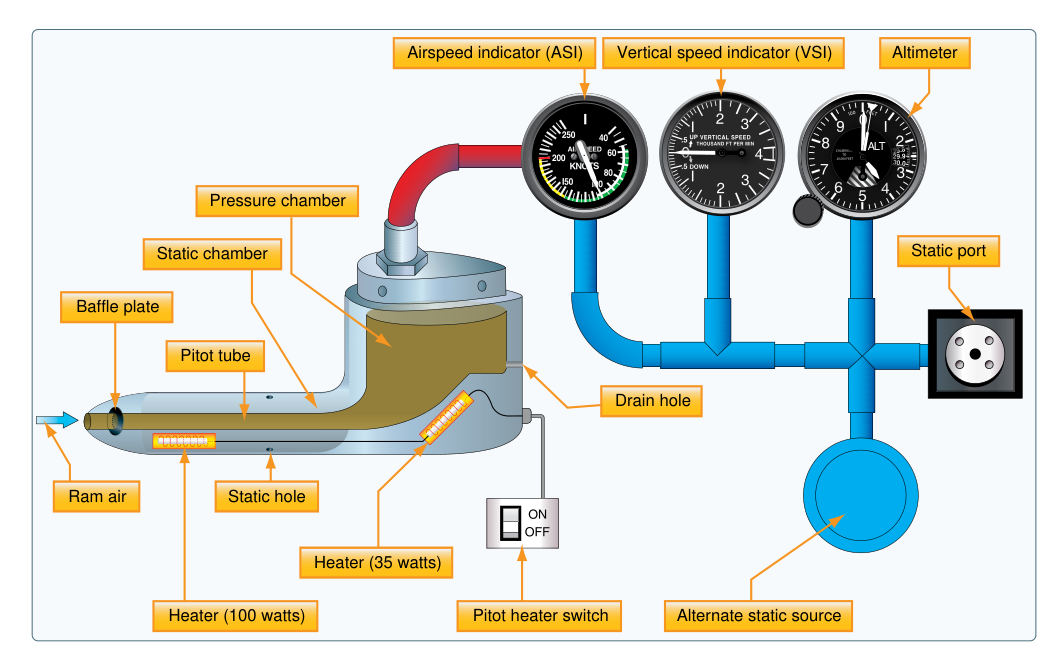
On a clear VFR day, a faulty airspeed indicator is an inconvenience. In IMC, it can be fatal. The pitot-static system feeds three of the six primary flight instruments—the airspeed indicator (ASI), the altimeter, and the vertical speed indicator (VSI)—and any blockage or leak in that system silently corrupts the data pilots depend on for every phase of flight. Understanding exactly how the system works, how each type of failure manifests, and what to do about it in the cockpit is a cornerstone of IFR emergency training and a reliably tested topic on the FAA Instrument Rating knowledge exam.
This article walks through the plumbing behind the pitot-static system, the failure modes that matter most, and the disciplined cross-check technique that allows a sharp pilot to catch the problem before it causes an accident.
How the Pitot-Static System Works
The pitot-static system uses two types of pressure to derive flight information. Ram air pressure (also called pitot or impact pressure) is collected by the pitot tube, which points directly into the relative wind. Static pressure (ambient atmospheric pressure) is collected through one or more static ports, usually flush-mounted on the fuselage sides to minimize disturbance from airflow. A few designs combine both into a single pitot-static probe, but the functional principle is identical.
The three instruments use these pressures as follows:
- Airspeed Indicator (ASI): Measures the difference between pitot (ram) pressure and static pressure. Greater airspeed compresses more air into the pitot tube, increasing that differential.
- Altimeter: Measures static pressure only, converting it to an altitude reading via a calibrated aneroid wafer stack. Lower static pressure = higher indicated altitude.
- Vertical Speed Indicator (VSI): Measures the rate of change of static pressure. A calibrated leak inside the instrument lets it sense how quickly static pressure is rising or falling.
Because the altimeter and VSI run only on static pressure, while the ASI uses both, the two lines—pitot and static—can fail independently, and each failure produces a distinctly different set of instrument errors.
Failure Mode 1: Blocked Pitot Tube (Static Port Open)
The pitot tube can become blocked by ice, insects, water, or debris. If only the pitot tube opening is blocked but the static port remains clear, the ASI is the only instrument directly affected. Here is the critical insight that confuses many students: the effect on the ASI changes depending on whether the aircraft is climbing, descending, or holding altitude.
When the pitot tube is blocked, the ram air pressure trapped inside the pitot line stays frozen at whatever value existed at the moment of blockage. Meanwhile, static pressure continues to update normally. As the aircraft climbs above the blockage altitude, ambient static pressure decreases. Because the ASI measures the difference between (frozen) pitot pressure and (decreasing) static pressure, that difference grows—so the ASI indicates increasing airspeed even though actual airspeed may be constant or even decreasing. Conversely, during a descent below the blockage altitude, static pressure rises, narrowing the differential, and the ASI indicates decreasing airspeed—potentially all the way to zero if the descent is large enough. At the exact altitude of blockage, the ASI freezes and shows a constant reading regardless of actual speed changes.
The altimeter and VSI remain accurate because they are connected only to the static line, which is unaffected.
Failure Mode 2: Blocked Static Port (Pitot Tube Open)
A blocked static port is arguably more insidious because it corrupts all three instruments simultaneously, and two of those instruments—the altimeter and VSI—are often thought of as rock-solid references.
- Altimeter: Freezes at the altitude where the port became blocked. No matter how much the aircraft climbs or descends, the altimeter reads the same number. In IMC, this can lead a pilot to fly into terrain while the altimeter confidently shows a safe altitude.
- VSI: Drops to zero and stays there. With no change in static pressure reaching the instrument, the VSI has nothing to measure.
- ASI: Because the static pressure inside the ASI case is now trapped, the ASI becomes sensitive only to changes in ram air pressure. As the aircraft climbs, ram air (pitot) pressure decreases as true airspeed's dynamic pressure component drops with altitude and the trapped static pressure inside the instrument no longer reflects the falling ambient pressure, so the ASI will under-read—showing less airspeed than actually exists. During descent, the trapped static pressure is relatively low compared to the rising ambient pressure, so the ASI over-reads. At the blockage altitude, the ASI reads accurately.
Static port blockage is the scenario that makes the alternate static source so important. Most certified aircraft have an alternate static port, typically located inside the cockpit where pressure is slightly lower than ambient due to airflow over the fuselage. Selecting alternate static introduces a small but predictable error: the altimeter will read slightly high, the ASI will read slightly high, and the VSI will momentarily show a brief climb before stabilizing. Pilots must account for these errors, and the aircraft's Pilot's Operating Handbook (POH) or Airplane Flight Manual (AFM) will contain the correction values.
If no alternate static source is available, the emergency procedure in many aircraft is to break the glass of the VSI. Because the VSI case is vented to the cockpit (through its calibrated leak mechanism), breaking it opens the static system to cabin air, restoring approximate static pressure to the altimeter and ASI at the cost of the VSI.
Failure Mode 3: Pitot Heat and Ice Accumulation
In IMC, supercooled water droplets can freeze in the pitot tube even at temperatures slightly above 0°C (32°F) due to the aerodynamic cooling effect. The FAA recommends—and many aircraft require under IFR operations—activating pitot heat before entering visible moisture or when outside air temperature is near freezing. Note that pitot heat protects only the pitot tube; static ports are usually not heated on light aircraft. Pitot heat should generally be checked for proper function during the run-up by verifying that the ASI temporarily fluctuates slightly (indicating the heater is warming and expanding the trapped air) or by checking the ammeter for increased electrical draw.
Why It Matters: The Safety Case
Accidents caused by pitot-static failures are well-documented and have affected everything from light training aircraft to transport-category jets. The common thread is spatial disorientation combined with conflicting instrument indications that the crew did not correctly interpret. In IMC, a pilot who trusts a frozen altimeter without question may unknowingly fly a controlled-flight-into-terrain profile. A pilot who sees a wildly climbing ASI during a climb after a pitot blockage may instinctively reduce power and pitch down—exactly the wrong response if actual airspeed is already low.
The remedy is a disciplined instrument cross-check: never fly any single instrument in isolation. The attitude indicator, turn coordinator, and engine instruments provide independent information that can expose a pitot-static anomaly. If the altimeter, VSI, and ASI all tell a consistent but implausible story, something is wrong with the common source—the static system.
Key Numbers and Rules
- Pitot heat requirement: for IFR operations, refer to 14 CFR 91.205 equipment requirements, applicable Part 25 certification standards for transport category aircraft, and the aircraft's POH and equipment list. Best practice is to use pitot heat any time in visible moisture or near-freezing temperatures.
- Alternate static source errors: Altimeter reads slightly high; ASI reads slightly high; VSI shows a momentary false climb. Check the POH for exact correction values.
- Blocked pitot, climbing: ASI over-reads (can indicate dangerously high airspeed).
- Blocked pitot, descending: ASI under-reads (can indicate dangerously low airspeed or even zero).
- Blocked static, all altitudes: Altimeter and VSI freeze; ASI under-reads in climb, over-reads in descent.
- VSI glass-break procedure: Acceptable emergency procedure when alternate static is unavailable—restores static to remaining instruments at the cost of VSI function.
Common Test Traps
- Confusing which instrument is affected by which blockage. A blocked pitot affects only the ASI (static open). A blocked static affects all three. Know this cold.
- The climbing ASI trap. Students often think a blocked pitot means the ASI freezes. It only freezes at the exact blockage altitude—above that it over-reads; below it under-reads.
- Alternate static errors. Many students assume alternate static gives perfect accuracy. It does not. Expect a slight high-reading on both the altimeter and ASI when using cabin alternate static.
- Assuming pitot heat prevents all icing issues. Pitot heat protects the pitot tube only. Static ports, lines, and the drain hole can still be affected by ice or contamination.
- Trusting the VSI as an independent backup. The VSI shares the static line with the altimeter. A blocked static port kills both simultaneously—they are not independent cross-checks of each other.