Losing an engine in instrument meteorological conditions (IMC) is among the most demanding emergencies a pilot can face. Unlike a VFR engine failure where the pilot can visually scan for a suitable landing area, an IFR engine failure strips away the ability to see terrain, obstructions, and airports. The pilot must simultaneously fly the aircraft by reference to instruments, execute the appropriate checklists, communicate with ATC, and navigate to a safe landing — all while managing the emotional weight of a genuine emergency. Understanding how to think, what to do, and in what order is what separates a survivable outcome from a tragic one.
This article examines engine failure during IFR flight from a practical and regulatory standpoint: the immediate actions, the decision-making framework, the communication requirements, and the navigational considerations that define a well-executed emergency response.
Immediate Actions: Aviate, Navigate, Communicate
Every emergency in aviation begins with the same priority order: aviate first, navigate second, communicate third. This principle, reinforced throughout the FAA's Airplane Flying Handbook (FAA-H-8083-3) and the Risk Management Handbook (FAA-H-8083-2), is even more critical in IMC because spatial disorientation can develop within seconds if instrument scan breaks down.
When an engine fails in IMC, the first task is to maintain aircraft control. If the aircraft is at cruise altitude, pitch attitude may need to be adjusted to establish best glide speed — the speed that maximizes the distance traveled per unit of altitude lost. Every aircraft has a specific best glide speed (VG) published in the Pilot's Operating Handbook (POH); this is the speed you want immediately. A second or two of distraction to fumble with the radio while still in a bank or abnormal pitch attitude can quickly lead to a dangerous spiral.
Once control is established, the pilot applies memory-item emergency procedures. Most aircraft checklists call for a sequence similar to: confirm the engine has actually failed (not a fuel selector or mixture issue), switch fuel tanks if applicable, activate boost pump, attempt a restart if conditions are appropriate, and configure the aircraft for best glide. These memory items exist because, in IMC, looking down at a checklist for too long can break the instrument cross-check. Know your aircraft's emergency procedures cold before flying IFR.
Declaring an Emergency
Once the aircraft is under control and the immediate threat is managed, declare the emergency. Under 14 CFR 91.3, the pilot in command holds emergency authority to deviate from any rule necessary to meet the emergency. There is no penalty for declaring an emergency that later turns out to be unnecessary, and the benefits are substantial: ATC will immediately provide priority handling, clear conflicting traffic, offer radar vectors to the nearest suitable airport, and coordinate with emergency services.
The distress call on the current ATC frequency — or on 121.5 MHz if contact is lost — should follow this format: MAYDAY, MAYDAY, MAYDAY, followed by the aircraft identification, nature of the emergency, position, altitude, fuel remaining, number of souls on board, and any other relevant information. The AIM dedicates a section to emergency communication procedures and emphasizes that pilots should not hesitate to use the word MAYDAY. ATC does not expect a polished, fully composed radio call from a pilot managing an engine failure; give what information you can, when you can.
If the transponder has not automatically been set, squawking 7700 immediately alerts any ATC facility receiving the radar return to the emergency, even if radio communication is temporarily unavailable.
Navigating to Safety in IMC
In VMC, a pilot instinctively looks for a field or road. In IMC, the pilot must rely entirely on instruments and ATC to identify the best landing option. This is why establishing communication with ATC quickly is so valuable — controllers have access to airport databases, terrain maps, and weather data that the pilot cannot see.
Key navigational considerations include:
- Best glide speed and glide ratio: Know your aircraft's published glide ratio. Many light single-engine trainers glide roughly 1.5 nautical miles per 1,000 feet of altitude in still air, though this varies significantly by aircraft type and should be verified against the specific POH. From 8,000 feet AGL, that provides roughly 12 nm of glide range — enough to reach a nearby airport if one exists within that radius.
- Terrain clearance: The Minimum Safe Altitude (MSA) depicted on instrument approach charts provides a 1,000-foot obstacle clearance within 25 nautical miles of the reference navaid (2,000 feet in mountainous terrain). The Emergency Safe Altitude (ESA), used mainly on oceanic and remote charts, provides similar clearance but over a much larger area, often out to 100 NM along the route. Without power, remaining above these altitudes may not be possible. This is one reason IFR pilots should be intimately familiar with the MEAs and terrain along their route.
- Nearest airport with an approach: ATC can vector you to an airport with an instrument approach. In marginal IFR conditions, the ability to fly a precision or non-precision approach to a lighted runway vastly improves the odds of a survivable outcome compared to a forced landing in a field.
- Wind: Glide distance is affected by wind. A 20-knot headwind can significantly reduce the glide range; a tailwind extends it. ATC can provide current wind information at destination airports.
Single-Engine Considerations for Multi-Engine Pilots
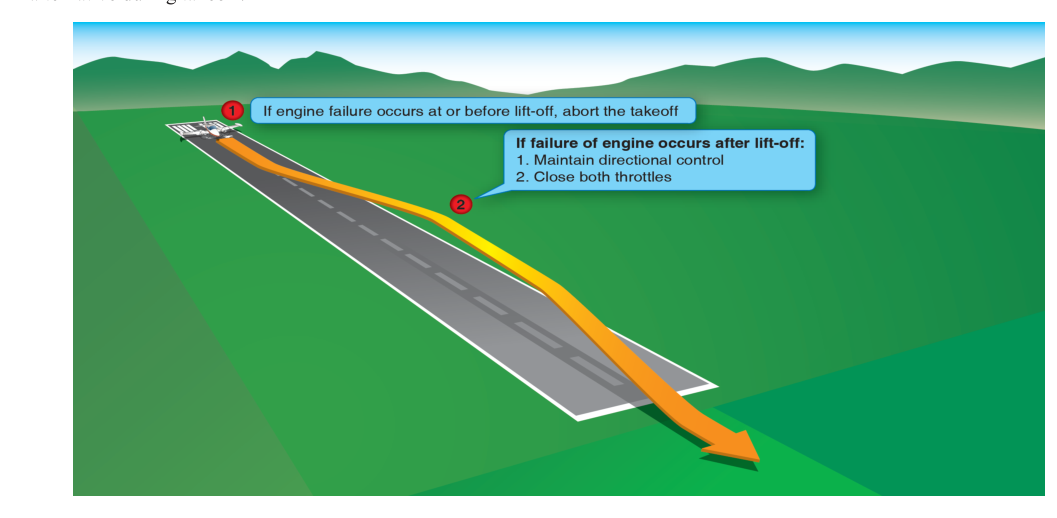
For pilots flying multi-engine aircraft under IFR, engine failure introduces additional complexity. The Airplane Flying Handbook covers the critical engine concept, Vmc (minimum control speed with critical engine inoperative), and the memory items that constitute the classic engine-out drill: identify, verify, feather. In IMC, executing these steps while maintaining instrument scan and communicating is a genuine workload challenge.
After identifying the failed engine (dead foot, dead engine — the rudder pressure required to maintain heading indicates which engine is producing thrust), the pilot must verify by slowly retarding the throttle of the suspected engine and confirming no further change in performance or control before feathering the propeller. Feathering reduces drag dramatically and makes the difference between a manageable single-engine climb and a slow descent. The multi-engine pilot must also be aware that Vmc is a calibrated airspeed tested in a specific configuration; in actual IMC with cargo, density altitude, and bank corrections, maintaining directional control requires discipline and may demand accepting a slower-than-ideal climb gradient.
Single-engine service ceiling is a critical planning number for IFR multi-engine operations. If the single-engine ceiling is below the MEA for a mountain route, losing one engine makes that route unsuitable for continued flight. Pre-flight route planning must account for this.
Why This Matters: The Statistics and the Stakes
Engine failures resulting in accidents frequently occur not because the pilot could not handle the mechanical failure, but because of poor decision-making afterward: continuing into deteriorating weather, selecting an unsuitable landing area, or failing to communicate the emergency in time to receive useful ATC assistance. The FAA's Risk Management Handbook and accident analysis consistently emphasize that continued flight into a worsening situation — not the initial engine failure — is often the fatal decision.
IFR currency and proficiency also play a role. A pilot who is rusty on partial-panel flying (flying without a functioning attitude indicator) faces a much more dangerous engine-failure scenario if the electrical failure that caused the engine problem also takes out the primary flight instruments. This is why practicing partial-panel flight is a standard element of IFR training and proficiency checks.
Key Numbers and Rules
- Best glide speed (VG): Found in the aircraft POH; the single most important speed after engine failure.
- Squawk 7700: Universal emergency transponder code; use it immediately.
- 121.5 MHz: Emergency frequency; monitored by ATC facilities and most airliners.
- 14 CFR 91.3: Grants PIC authority to deviate from any regulation in an emergency.
- MSA/ESA: MSA provides 1,000 feet obstacle clearance within 25 nm of the reference navaid (2,000 feet mountainous); ESA provides similar clearance over a much larger area, often 100 nm along the route.
- Vmc (multi-engine): Minimum control speed with critical engine inoperative; must not be approached in IMC or low-altitude maneuvering.
- Glide range rule of thumb: Many light aircraft achieve approximately 1.5 nm per 1,000 feet AGL; check your specific POH.
Memory Aid
The classic priority mantra for any emergency is A-N-C: Aviate, Navigate, Communicate. Each level must be stabilized before moving to the next:
- Aviate: Fly the aircraft. Establish best glide. Maintain attitude and heading by instruments.
- Navigate: Identify where you are, where the nearest suitable airport is, and whether you have enough altitude to reach it.
- Communicate: Declare MAYDAY, squawk 7700, relay position and intentions to ATC.
Common Test Traps
- Forgetting to declare an emergency: Many candidates know the procedures but underestimate how strongly the FAA expects pilots to use ATC assistance. The test may ask what action provides the most comprehensive emergency support — the answer is declaring an emergency, which triggers priority handling and services.
- Confusing MSA with MEA: The Minimum Safe Altitude on an approach chart (within 25 nm of the reference navaid) is a circle drawn on the approach plate. The MEA is an en-route altitude. In an emergency, the MSA on the approach plate is the quick reference; the pilot may need to descend below the MEA to glide to the airport.
- Assuming best glide equals a safe landing: Reaching the airport environment does not guarantee visibility or ceiling is adequate to land. Knowing the weather at the destination — and having an IAP available — is essential planning that must happen before fuel and altitude run out.
- Multi-engine dead-foot trap: On the written and oral, examiners look for correct identification: the classic mnemonic is "dead foot, dead engine": the foot that is relaxed, not pushing on the rudder, corresponds to the dead engine, while the foot pushing harder is on the live side. Getting this backwards leads to feathering the wrong propeller.
- Neglecting partial-panel skills: An engine failure caused by electrical or fuel-system issues may simultaneously degrade avionics. The FAA instrument practical test standards require demonstrated partial-panel proficiency precisely because this scenario is realistic.