Imagine cruising in solid IMC at FL200 when the cabin suddenly loses pressurization — or smoke begins filling the cockpit. In either scenario, time is your scarcest resource. An emergency descent is a controlled, deliberate maneuver designed to bring the aircraft to a lower, breathable, or safer altitude as rapidly as aerodynamics and structural limits allow. For instrument-rated pilots, the added complexity of executing this maneuver while flying inside a cloud, coordinating with ATC, and managing a second emergency simultaneously makes thorough mental preparation essential long before you ever file an IFR flight plan.
This article walks through the aerodynamics, cockpit procedures, ATC communication, and decision-making framework that govern emergency descents in IMC. It is grounded in the FAA's Instrument Flying Handbook (FAA-H-8083-15), Pilot's Handbook of Aeronautical Knowledge (FAA-H-8083-25), the Aeronautical Information Manual (AIM), and 14 CFR Part 91.
Why an Emergency Descent May Be Necessary
The two most common triggers for an emergency descent are loss of pressurization and smoke or fire in the cockpit or cabin. Pressurization failure at high altitudes is immediately life-threatening: at FL250, the time of useful consciousness (TUC) without supplemental oxygen is roughly three to five minutes, and that window shrinks dramatically with altitude. At FL350, TUC can be as short as 30 to 60 seconds. A rapid descent to 10,000 feet MSL or below — where hypoxia risk from cabin altitude is low for most people on ambient air — is the physiologically sound response.
Cockpit smoke or fire presents a different urgency: descending reduces the time the aircraft remains at risk, gets it closer to the ground for landing, and may reduce the intensity of certain electrical fires if systems are shut down during the descent. Engine failures, severe icing accumulation beyond the aircraft's capability, and structural concerns are other scenarios that may demand a rapid loss of altitude.
Aerodynamics and Aircraft Limits During the Descent
The goal is maximum rate of descent without exceeding the aircraft's structural or airspeed limits. Every aircraft has a VNE (never-exceed speed) and a VMO/MMO (maximum operating speed/Mach) that must be respected absolutely, because exceeding them in turbulence or with any control input can cause structural failure. The manufacturer's Emergency Descent procedure in the Pilot's Operating Handbook (POH) or Airplane Flight Manual (AFM) defines the exact configuration and speeds for a given aircraft — always defer to that checklist.
In a generic light twin or high-performance single, the typical technique involves three coordinated actions: reducing power (often to idle), extending speed brakes or spoilers if available, and configuring the aircraft for maximum drag within limits. In some turboprop and jet procedures, power may not go to idle immediately; the POH will specify. Lowering the landing gear is sometimes used to increase drag, but this is only appropriate if the airspeed is at or below the VLE (landing gear extended limit speed). Propeller-equipped aircraft may be set to high RPM to add drag from the propeller disc.
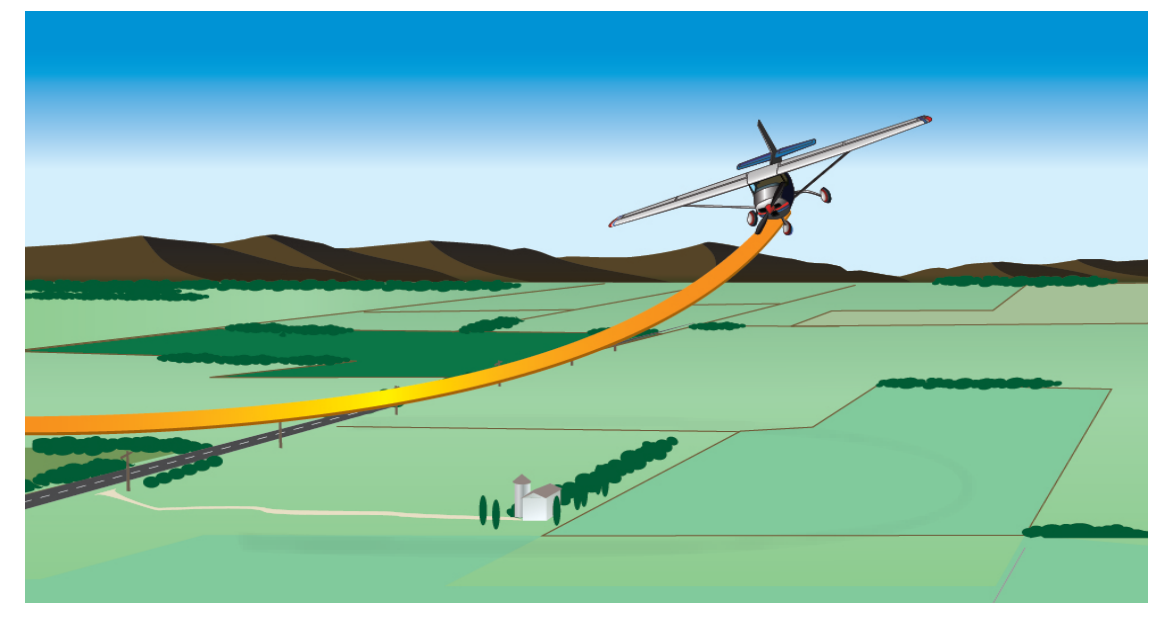
Bank angle plays an important role. Many procedures call for establishing a bank of 30 to 45 degrees while simultaneously pitching to the target descent speed. The coordinated bank increases the load factor slightly, which keeps airspeed from racing past VMO while still allowing a steep, high-rate descent. In IMC, this bank must be flown entirely by reference to instruments — primarily the attitude indicator and altimeter — so instrument scan discipline is non-negotiable.
Flying the Maneuver in IMC
The instrument scan during an emergency descent is compressed and rapid. You are simultaneously managing airspeed (do not exceed limits), vertical speed (maximize within limits), heading (maintain ATC-assigned or cleared), and situational awareness about terrain and traffic below you. Here is a step-by-step cognitive flow:
- Declare the emergency immediately — squawk 7700 and call ATC on the assigned frequency. If no response, broadcast on 121.5 MHz.
- Execute the POH emergency descent checklist from memory — or from a quick-reference card if the aircraft provides one. Simultaneously reduce power, configure drag, and establish the target pitch attitude and airspeed.
- Establish and cross-check attitude — use the attitude indicator as the primary reference; crosscheck with airspeed and altimeter. A 30–45-degree bank, nose pitched to target speed, high vertical speed indicator reading.
- Monitor airspeed against limits — in turbulence, the structural limit drops to VA (maneuvering speed) or lower. If you are in moderate or severe turbulence, the emergency descent speed may need to be reduced to protect the airframe even at the cost of descent rate.
- Plan for terrain — know the minimum safe altitude (MSA) or grid MORA for your sector before you began cruising. You cannot descend below the MEA, MOCA, or other applicable minimum altitude without visual conditions or radar vectors from ATC unless doing so is necessary to save the aircraft (14 CFR 91.3 gives PIC emergency authority).
- Level off and reassess — at the target altitude (typically 10,000 feet MSL for hypoxia emergencies, or the MEA if higher), level off, re-establish communications, and brief the flight attendant or passengers.
ATC Coordination and 14 CFR Authority
ATC is your partner in an emergency descent. When you declare a MAYDAY, the controller's first priority becomes your aircraft. They will provide traffic advisories, coordinate airspace with adjacent facilities, and offer radar vectors to the nearest suitable airport. Give them as much information as possible: aircraft type, souls on board, fuel remaining, nature of the emergency, and your intentions.
Under 14 CFR 91.3(b), the pilot in command may deviate from any rule in Part 91 to the extent necessary to meet an emergency. This explicitly permits descending through an assigned altitude, busting an airspace boundary, or operating below minimum IFR altitudes when required for safety. Under 14 CFR 91.3(c), if you exercise this emergency authority, you must send a written report to the FAA upon request — in practice, a thorough debrief with ATC usually satisfies this.
Squawking 7700 activates the emergency flag on all ATC radar displays in range. Do not hesitate to use it. Some pilots avoid squawking 7700 because they fear bureaucratic consequences, but the AIM is explicit: declare early, declare clearly. A slightly premature declaration costs nothing; a delayed one can cost everything.
Hypoxia Awareness During Descent Planning
A critically important factor: if pressurization has failed at altitude, the crew may already be hypoxic before they realize anything is wrong. Hypoxia is insidious — one of its early symptoms is a false sense of well-being (euphoria) and impaired judgment. The FAA and aviation physiology literature emphasize that hypoxia may impair the pilot's ability to recognize hypoxia itself. This is why the memory flow for pressurization failure should be practiced to automaticity: masks on first, descent initiated, then checklists and ATC. If supplemental oxygen is available, don the mask before doing anything else. Only after the mask is on and oxygen confirmed should you begin the cognitive workload of emergency procedures.
Key Numbers and Rules
- Time of Useful Consciousness (TUC): approximately 3–5 minutes at 25,000 ft, 30–60 seconds at 35,000 ft — reinforces the urgency of immediate action.
- Target descent altitude for hypoxia: 10,000 feet MSL or below (or as high as terrain requires).
- Emergency squawk: 7700 (transponder); 121.5 MHz (emergency frequency for voice).
- VNE / VMO: Never exceed during descent — exceeding structural limits in IMC with no visual references is catastrophic.
- VA: In turbulent IMC, may be the appropriate limit for emergency descent speed instead of VMO.
- 14 CFR 91.3(b): PIC emergency authority to deviate from any Part 91 rule to the extent necessary; 91.3(c) requires a written report to the FAA upon request.
- Bank angle: Typically 30–45 degrees in POH-specified procedures to manage airspeed while maximizing descent rate.
- MEA/terrain clearance: Know the minimum safe altitude for your sector before you need it — terrain does not negotiate.
Common Test Traps
- Assuming you can always descend to 10,000 ft: The target altitude is 10,000 feet MSL or the MEA, whichever is higher. In mountainous terrain, the MEA may be well above 10,000 feet, and descending below it in IMC without ATC radar separation puts you into rock.
- Forgetting to squawk 7700 first: Many students narrate the checklist but skip the squawk. ATC alert should happen simultaneously with or even before the descent is initiated.
- Overriding VMO in the name of urgency: No emergency justifies exceeding the structural limits of the aircraft. The POH emergency descent speed is chosen to maximize rate of descent while staying inside the flight envelope.
- Neglecting oxygen before checklists: In pressurization failures at high altitude, TUC may be shorter than the time it takes to run a checklist. Mask on is always the first action.
- Confusing emergency authority with blanket immunity: 14 CFR 91.3(b) permits deviation; it does not eliminate accountability. Under 91.3(c), you must be prepared to justify the deviation and submit a written report if the FAA requests one.