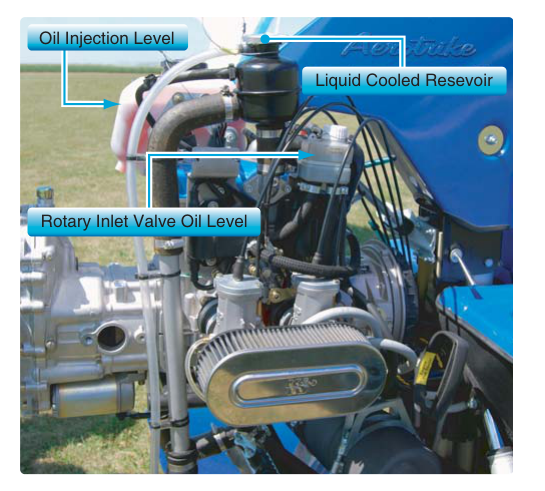
Liquid-cooled aircraft engines use a closed-circuit coolant system to transfer heat away from cylinder walls, heads, and other hot components. Unlike air-cooled engines — which rely entirely on airflow over finned cylinders — liquid-cooled powerplants circulate a carefully formulated fluid through internal passages, then route that fluid through a radiator where heat is rejected to the outside air. The system offers precise temperature control and quieter operation, but it also demands strict attention to coolant chemistry, concentration, and compatibility. For AMT powerplant technicians, understanding the science behind coolants is just as important as knowing how to inspect hoses and pressure-test caps.
This article covers the primary coolant types approved for aircraft use, how mixing ratios affect freeze protection and boiling point, why coolant chemistry matters for corrosion control, and the maintenance practices an AMT must know to keep liquid-cooled engines operating safely and reliably.
Types of Coolant Used in Aircraft
Most modern liquid-cooled aircraft engines — including those in light sport, experimental, and certain certified aircraft — specify one of two broad coolant chemistries: ethylene glycol-based or propylene glycol-based formulations. Both are mixable with water and share the same fundamental heat-transfer role, but they differ in toxicity, viscosity, and specific material compatibility.
Ethylene Glycol (EG)
Ethylene glycol has been the industry standard for decades. It offers excellent heat-transfer characteristics, a wide freeze-protection range, and a high boiling point when properly diluted. Most automotive-origin coolants and many aviation-approved coolants are EG-based. However, ethylene glycol is toxic if ingested and requires careful disposal. Aviation-specific EG coolants typically include a corrosion inhibitor package formulated for aluminum-heavy engine construction — critical because aircraft engines often use aluminum cylinder heads, cooling jackets, and pump housings that can be attacked by aggressive pH levels or incompatible inhibitors.
Propylene Glycol (PG)
Propylene glycol is less toxic and is sometimes preferred in environments where incidental contact with personnel or wildlife is a concern. Its viscosity is higher than EG at low temperatures, which can slightly reduce pump efficiency in very cold conditions. When an engine manufacturer approves propylene glycol, the mixing ratios and performance curves will be specified in the engine maintenance manual (EMM). Technicians must never assume that PG and EG coolants are interchangeable; mixing them is generally discouraged unless the manufacturer explicitly permits it, and even then only with compatible inhibitor packages.
Inhibitor Packages: OAT, HOAT, and IAT
Beyond the glycol base, the inhibitor package defines much of a coolant's compatibility and service life. Three major chemistries exist:
- Inorganic Additive Technology (IAT): The traditional green coolant using silicates and phosphates as corrosion inhibitors. IAT coolants deplete relatively quickly (typically every 1–2 years) and are less common in newer aviation engine designs.
- Organic Acid Technology (OAT): Uses organic corrosion inhibitors (such as carboxylates) that last longer in service — often 5 years in automotive use. OAT coolants are dye-colored orange, red, or yellow and are common in modern engines with aluminum-heavy construction.
- Hybrid Organic Acid Technology (HOAT): Combines both organic and inorganic inhibitors for a balance of rapid initial protection (from silicates) and long-term protection (from organic acids). Many aviation engine manufacturers specify HOAT or an equivalent approved coolant.
The key rule: always follow the engine manufacturer's approved coolant specification, found in the engine maintenance manual or type certificate data sheet. Using an incompatible inhibitor package can cause silicate gel formation, clogged coolant passages, and accelerated corrosion of aluminum components — all of which can lead to engine failure.
Mixing Ratios: Freeze Protection and Boiling Point
Coolant is almost never used full-strength. It is mixed with distilled or deionized water in a ratio that balances freeze protection against boiling point and heat-transfer efficiency. The relationship between concentration and protection is not linear, and this is one of the most commonly tested concepts for powerplant AMTs.
A 50/50 mix (50% glycol, 50% water by volume) is the most widely recommended ratio for general aviation use. At this concentration, ethylene glycol coolant provides freeze protection to approximately –34°F (–37°C) and raises the pressurized-system boiling point well above 212°F (100°C) — often to 265°F (129°C) or higher when the system cap holds 15 psi of pressure. This ratio also maximizes heat-transfer efficiency; pure glycol actually transfers heat less effectively than a glycol-water mixture because water has a higher specific heat capacity.
A 70/30 mix (70% glycol, 30% water) extends freeze protection to approximately –60°F to –65°F (–51°C to –54°C) — useful in extremely cold climates — but at the cost of slightly reduced heat transfer and a modest increase in viscosity. Most manufacturers specify that glycol concentration should not exceed 70%, because beyond that point the freeze protection actually begins to decrease and heat-transfer efficiency drops significantly. Full-strength glycol freezes at a higher temperature than a properly diluted mixture, a counterintuitive fact that frequently appears on FAA knowledge tests.
A 60/40 mix is a reasonable intermediate choice for cold-weather operations, offering freeze protection to roughly –54°F (–48°C). Always use the manufacturer's concentration chart rather than generic automotive references, as aviation engines may have specific requirements based on their metallurgy and operating temperatures.
Why Coolant Condition and Chemistry Matter
Over time, coolant degrades. Inhibitors are consumed by reaction with metal surfaces and by oxidation. As inhibitor reserves deplete, pH shifts — typically becoming more acidic — and corrosion of aluminum, steel, and copper components accelerates. Electrolytic corrosion can occur when dissimilar metals (aluminum pump housings, steel fasteners, copper heater cores) are in contact with degraded coolant acting as an electrolyte.
Technicians should check coolant condition using test strips or a refractometer. A refractometer measures the specific gravity of the coolant mixture and translates it directly to a freeze-protection temperature — a fast, reliable field check. Test strips check pH and inhibitor reserve levels. The FAA Aviation Maintenance Technician Handbook — Powerplant (FAA-H-8083-32) emphasizes following the manufacturer's maintenance schedule for coolant sampling and replacement, because degraded coolant is a leading cause of water pump seal failure, thermostat sticking, and internal corrosion in liquid-cooled aircraft engines.
Water quality also matters. Always use distilled or deionized water when mixing coolant. Tap water contains minerals (calcium, magnesium, chlorides) that react with glycol inhibitors, precipitate scale inside cooling passages, and introduce chloride ions that can pit aluminum. This is not merely a best practice — many engine manufacturers mandate it in the EMM as a maintenance requirement.
Key Numbers and Rules
- 50/50 glycol-to-water is the standard recommended ratio for most operating environments, providing approximately –34°F freeze protection.
- Maximum glycol concentration: 70%. Beyond this, freeze protection decreases and heat transfer suffers. Never use undiluted glycol.
- 70/30 glycol-to-water provides approximately –60°F to –65°F freeze protection for extreme cold-weather operations.
- Always use distilled or deionized water — never tap water — when mixing or topping off the system.
- Do not mix coolant types (EG vs. PG, or incompatible inhibitor packages) unless explicitly approved by the engine manufacturer.
- Check coolant concentration with a refractometer at each inspection interval; verify pH and inhibitor reserve with test strips.
- Replace coolant per the engine manufacturer's schedule — not automotive schedules, which may differ significantly.
- Pressurized systems raise the boiling point: a 15-psi pressure cap can raise the effective boiling point by approximately 45–50°F above the atmospheric boiling point of the mixture.
Common Test Traps
- Pure glycol is NOT the best freeze protection. Many test candidates assume that undiluted coolant provides the most freeze protection — it does not. A 60–70% concentration actually protects to lower temperatures than full-strength glycol.
- Coolant type compatibility. The exam may present a scenario where topping off with a different coolant type seems acceptable. It is not — mixing incompatible inhibitor packages can cause gel formation and blockage.
- Tap water vs. distilled water. Questions may ask what type of water is appropriate for mixing. The correct answer is always distilled or deionized water.
- Boiling point vs. freeze point. Increasing glycol concentration raises the boiling point up to a point and lowers the freeze point up to about 70% concentration — students sometimes confuse which property is being affected by a ratio change.
- Coolant degradation interval. The test may ask about coolant service life. The answer depends entirely on the engine manufacturer's manual — not on automotive coolant labels or generic schedules.