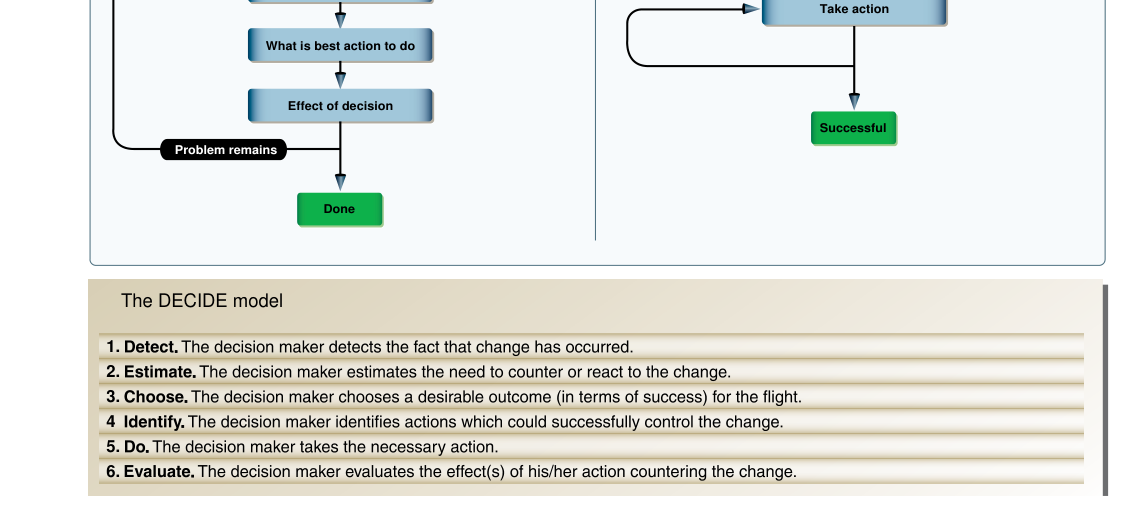
Every flight presents moments where a pilot must make decisions under pressure, sometimes with incomplete information and a ticking clock. Without a structured mental framework, it is easy to fixate on one aspect of a problem, skip critical steps, or leap to action before fully understanding what is actually wrong. The DECIDE model is the FAA's recommended systematic decision-making framework for pilots, designed to turn an otherwise reactive, gut-level response into a deliberate, loop-based process. Mastering DECIDE does not just help you pass the knowledge test — it can stop a minor inconvenience from spiraling into an emergency.
The DECIDE model is a continuous loop, not a one-time checklist. You cycle through it as many times as necessary until the problem is resolved or until you are safely on the ground. The FAA introduces it in the Pilot's Handbook of Aeronautical Knowledge (FAA-H-8083-25) and the Risk Management Handbook (FAA-H-8083-2) as part of a broader aeronautical decision-making (ADM) curriculum. Understanding it in depth — not just memorizing the acronym — is what makes it genuinely useful in the cockpit.
The Six Steps of DECIDE
Each letter represents a discrete mental action. Think of them as questions you ask yourself in order, then repeat.
D — Detect
The first step is simply noticing that something has changed or is not as expected. This sounds obvious, but studies of aviation accidents consistently show that pilots sometimes fly for minutes — or longer — without recognizing that a problem exists. Detection requires active monitoring: scanning your instruments, listening to engine sounds, feeling control feedback, and staying mentally ahead of the aircraft. A fuel gauge that reads lower than your flight-planned fuel burn, an oil pressure needle that has crept slightly left, a GPS groundspeed that does not match your expected tailwind — all of these are signals that demand detection. You cannot solve a problem you have not noticed.
E — Estimate
Once you have detected a change, you must estimate the significance of the problem and how urgently it demands action. Ask yourself: How serious is this? How quickly is it developing? What are the consequences if I do nothing? A slow oil pressure drop is different from a sudden loss of oil pressure accompanied by a rough engine — both need attention, but they carry very different time horizons. Estimating also includes sizing up the resources available to you: your current altitude, proximity to airports, weather, fuel state, and the capabilities of the aircraft. This step prevents two opposite errors — panicking over something minor, and under-reacting to something serious.
C — Choose
With the problem understood and its urgency estimated, you now choose a course of action from the options available. Crucially, this step requires generating alternatives, not just accepting the first idea that comes to mind. If your alternator fails, your options might include: (1) immediately diverting to the nearest airport, (2) reducing electrical load and continuing to your destination if it is close, or (3) declaring an emergency and requesting priority handling. Each option has costs and benefits. The DECIDE model asks you to consciously compare them rather than reflexively choosing the most obvious or most comfortable path. This is where having a strong foundation of aircraft systems knowledge pays dividends — you cannot generate good options if you do not understand what is happening mechanically.
I — Identify
Having chosen a course of action, you now identify the best action to implement that choice. This step bridges the gap between a broad decision ("I will divert") and the specific actions required to carry it out ("I will dial in the nearest airport on the GPS, declare minimum fuel to ATC, configure for best-range airspeed, and brief myself on the approach"). Breaking the chosen action into concrete, sequenced steps keeps you from becoming overwhelmed by the big picture and ensures nothing is overlooked. It is also the moment to pull out checklists, reference the AFM/POH, or consult ATC — any resource that helps you execute with precision.
D — Do
Now you execute the action. This sounds like the most straightforward step, and in some ways it is — but it also requires discipline. Pilots under stress can rush the execution phase, skip items, or revert to habits rather than following the plan they just identified. Fly the aircraft first; aviate, navigate, communicate in that priority order. Work through the appropriate checklists deliberately. If you have a co-pilot or a passenger who is a pilot, assign tasks. The "Do" step is where preparation and currency matter most: a pilot who has practiced emergency procedures in the sim or with an instructor will execute them far more smoothly under real pressure than one who has only read about them.
E — Evaluate
The final step — and the one that makes DECIDE a loop rather than a line — is to evaluate the effect of your action. Did the problem improve, stay the same, or worsen? Has a new problem emerged? If the action worked, continue monitoring. If it did not produce the expected result, you immediately re-enter the loop at the Detect step: you now have new information that changes your estimate of the situation, and you must choose a different course of action. This built-in feedback loop is what separates DECIDE from a simple linear checklist. Aviation emergencies are dynamic; the model is specifically designed for that dynamism.
Why DECIDE Matters: The Human Factors Connection
The FAA developed structured ADM tools like DECIDE in direct response to accident data showing that the majority of general aviation accidents involve human factors rather than mechanical failure. Pilots who react impulsively, fixate on a single symptom, or allow stress to narrow their thinking make poor decisions even when they have the skill to handle the situation physically. DECIDE counteracts the psychological traps that degrade judgment under pressure.
Among the most dangerous traps DECIDE protects against is get-there-itis, the hazardous attitude of pressing on regardless of warning signs. A pilot who follows DECIDE cannot skip the Estimate step — they must honestly assess how serious the situation is, which tends to override the emotional pull toward the original destination. Similarly, DECIDE combats fixation (the tendency to focus on one instrument or problem while the rest of the situation deteriorates) because the Evaluate step forces a holistic reassessment after every action. The model also encourages deliberate generation of alternatives during the Choose step, which directly counters impulsivity — acting on the first solution without considering better options.
Key Numbers and Rules to Know
- Six steps, one acronym: Detect, Estimate, Choose, Identify, Do, Evaluate — tested in order on the FAA knowledge exam.
- DECIDE is a continuous loop: after the Evaluate step, if the problem persists, you return to Detect with updated information. This cycling is explicitly part of the model.
- Part of broader ADM: DECIDE is one of several FAA-endorsed ADM tools. The PAVE checklist (Pilot, Aircraft, enVironment, External pressures) is used during preflight risk assessment; IMSAFE covers pilot self-certification; the 5 Ps (Plan, Plane, Pilot, Passengers, Programming) are used at strategic decision points in flight. DECIDE is the in-flight, real-time problem-solving tool.
- Hazardous attitudes: The FAA identifies five hazardous attitudes — anti-authority, impulsivity, invulnerability, macho, and resignation — that DECIDE is specifically designed to check by slowing down and structuring the decision process.
- Not a substitute for checklists: DECIDE tells you that you need to use a checklist and when; the AFM/POH emergency checklist tells you exactly what to do. They work together.
Memory Aid
The acronym itself is the mnemonic: D-E-C-I-D-E.
- Detect — notice the change
- Estimate — judge the need to react
- Choose — select an outcome to achieve
- Identify — pick the best action to achieve it
- Do — take that action
- Evaluate — determine whether the action worked
A useful mental trigger: "I need to DECIDE what to do." Hearing that word in your head during a stressful situation is itself a cue to slow down and work the steps rather than reacting instinctively.
Common Test Traps
- Mixing up Estimate and Identify: Test questions sometimes present answer choices that blur these two steps. Remember — Estimate is about judging the severity and urgency of the problem; Identify is about selecting the specific actions needed to carry out the chosen course. They are separated by the Choose step.
- Thinking DECIDE is linear: Many students memorize the steps as a one-pass sequence. Exam questions may ask about what happens when the chosen action does not solve the problem. The correct answer reflects re-entering the loop — the model is explicitly iterative.
- Confusing DECIDE with PAVE or IMSAFE: These are all ADM tools, but they apply at different phases. PAVE and IMSAFE are pre-flight risk tools; DECIDE is the in-flight problem-solving model. Know which tool applies when.
- Assuming "Do" means act immediately without a checklist: The model does not endorse skipping procedures for speed. The Identify step is specifically designed to make you plan the execution — including pulling the correct checklist — before you act.
- Overlooking the Evaluate step: Some questions describe a pilot who completes an emergency action and then returns to normal flying without reassessing. This violates the Evaluate step and is presented as an incorrect approach. Evaluation must always follow action, especially in dynamic situations.