In airline operations, a crew that loses situational awareness or rushes to a conclusion under pressure can transform a manageable problem into a fatal accident. Structured decision-making models exist precisely to prevent that outcome. Two of the most widely taught frameworks in Crew Resource Management (CRM) training are FORDEC — a model with origins in Lufthansa/German aviation training, favored by many international operators and referenced in ICAO and EASA CRM training guidance — and DECIDE — a six-step loop originally developed by Benner (1975) for accident/decision analysis and later adopted by the FAA, appearing prominently in the FAA's Risk Management Handbook (FAA-H-8083-2) and the Pilot's Handbook of Aeronautical Knowledge (FAA-H-8083-25). Both models share the same philosophy: slow the crew down enough to think clearly, share information across the flight deck, make an explicit decision, and then verify that the decision is actually working. Understanding both models — their steps, their differences, and how they interact with CRM principles — is essential for any pilot pursuing an Airline Transport Pilot (ATP) certificate or preparing for airline-specific simulator evaluations.
The FORDEC Model
FORDEC was developed as a crew-centered decision framework because every step is explicitly designed to be performed together by the captain and first officer. The acronym stands for Facts, Options, Risks and Benefits, Decision, Execution, and Check. Each phase has a distinct cognitive purpose, and skipping any one of them is a recognized source of crew error.
Facts
The crew gathers all available information about the situation. This includes instrument indications, checklists, ATIS, ATC advisories, company ACARS messages, and the input of cabin crew. The goal is to build a shared mental model — an identical picture of reality in both pilots' minds. CRM research consistently shows that accidents accelerate when the captain and first officer are working from different assumptions about what is happening. Stating facts aloud, cross-checking instruments, and explicitly inviting the first officer's observations are all part of this phase. A crew should resist the urge to jump to solutions until the factual picture is as complete as time permits.
Options
With the facts established, the crew brainstorms all realistic courses of action — not just the obvious one. For an engine failure after V1, options might include continuing the departure, requesting an immediate return, diverting to a nearby alternate, or declaring an emergency to gain ATC priority. Listing options explicitly prevents plan continuation bias, the deeply studied human tendency to keep doing what was planned even after conditions change. The first officer's voice is especially important here; psychological research shows that junior crew members often see options the captain has anchored away from.
Risks and Benefits
Each option is evaluated against its costs and payoffs. Crew must weigh fuel state, weather, aircraft configuration, passenger considerations, company policy, and regulatory requirements. This is where threat-and-error management thinking intersects with FORDEC: threats are identified for each option (what could go wrong?) and the likely outcomes are compared. Time pressure is itself a risk — if the situation demands action in sixty seconds, the crew cannot spend five minutes deliberating.
Decision
The captain makes and states the decision explicitly. This is not a negotiation, but good CRM doctrine holds that the captain should acknowledge the crew's input and explain the rationale briefly. An explicit statement — "We are diverting to Frankfurt, declaring PAN-PAN, cabin crew will be notified" — eliminates ambiguity and ensures both pilots understand what is about to happen. Unspoken decisions are a classic precursor to coordination failures.
Execution
The decision is carried out using the appropriate abnormal or emergency checklist, task sharing consistent with standard operating procedures, and clear crew communication. The pilot flying and pilot monitoring roles are reaffirmed. ATC, dispatch, and cabin crew are notified according to the operator's procedures. Discipline during execution — following the checklist rather than relying on memory — is a foundational CRM principle.
Check
After execution, the crew monitors the outcome to verify the decision is producing the intended result. If it is not — if the divert airport's weather has deteriorated, if a second system has failed — the crew loops back to Facts and begins FORDEC again. This closing step is what transforms FORDEC from a linear checklist into a dynamic feedback loop suited to the evolving nature of in-flight emergencies.
The DECIDE Model
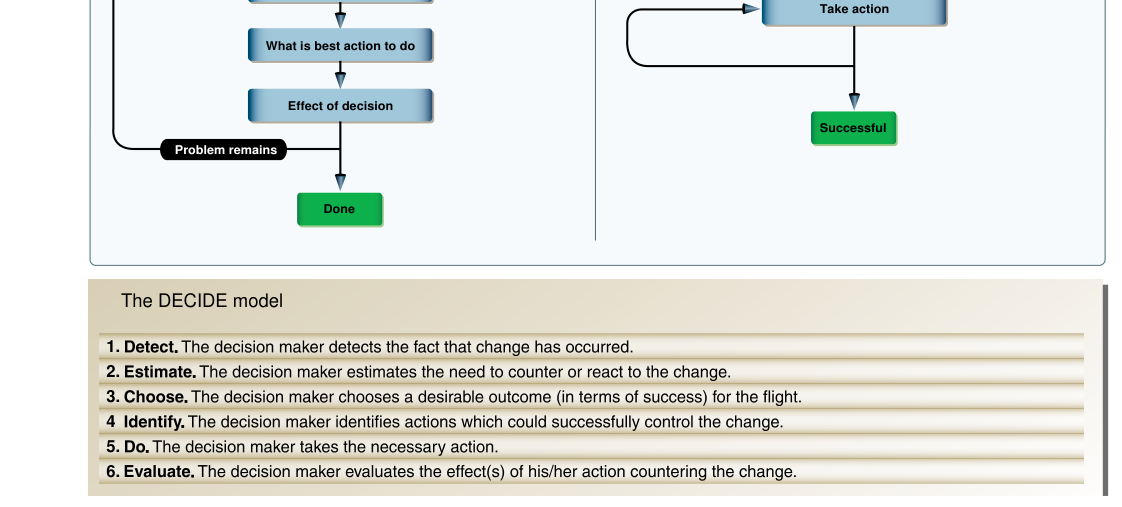
The DECIDE model, described in the FAA's Risk Management Handbook and the Pilot's Handbook of Aeronautical Knowledge, is a six-step process originally framed for individual pilot decision-making but equally applicable in a crew environment. The acronym stands for Detect, Estimate, Choose, Identify, Do, and Evaluate.
- Detect: Recognize that a change has occurred or that a problem exists. Detection requires active monitoring and a low threshold for concern — complacency is the enemy of early detection.
- Estimate: Assess the significance of the change. How urgent is it? How much time is available? What systems or operations are affected?
- Choose: Select a course of action from the available options. In a crew environment, this mirrors the Options and Risks phases of FORDEC.
- Identify: Determine the actions needed to execute the chosen option, including who does what and in what sequence. Task allocation is a CRM responsibility.
- Do: Execute the selected action using established procedures.
- Evaluate: Monitor the outcome and loop back to Detect if the situation has changed or if the action has not resolved the problem.
A key feature of DECIDE emphasized in FAA literature is its iterative nature. The model is not intended to terminate after one pass. The Evaluate step feeds directly back into Detect, making DECIDE a continuous loop rather than a one-time sequence. This aligns well with the dynamic, evolving nature of airline operations where initial assessments frequently require updating.
How FORDEC and DECIDE Complement Each Other
FORDEC and DECIDE are not competitors — they are complementary tools with different emphases. FORDEC is inherently crew-focused: its structure assumes a multi-pilot environment and naturally prompts cross-cockpit communication at every step. DECIDE is more individually framed in its original formulation but scales readily to crew operations. Many airline training programs teach DECIDE as the cognitive backbone for an individual pilot's thinking and FORDEC as the crew communication and coordination structure layered on top. In practice, a crew might use DECIDE internally — detecting and estimating a hydraulic anomaly — and then transition to FORDEC structure to share options, weigh risks together, and assign tasks for execution.
Why These Models Matter for Safety
FAA materials, including the Risk Management Handbook, emphasize that most aviation accidents involve human and decision-making factors rather than mechanical failure or stick-and-rudder skill. Hazardous attitudes — anti-authority, impulsivity, invulnerability, macho, and resignation, all identified in FAA-H-8083-2 — tend to short-circuit structured decision-making. A pilot who thinks "I can handle this" (macho) skips the Options and Risks phases. A pilot who thinks "what's the use?" (resignation) never gets to the Decision phase at all. Structured models counteract these tendencies by creating procedural obligations: you cannot get to Execution without first completing Risks and Benefits.
CRM training under AC 120-51E (the FAA advisory circular on CRM training for air carrier operations) emphasizes that structured decision-making is a measurable, trainable skill. Evaluators in Line Oriented Flight Training (LOFT) and Advanced Qualification Program (AQP) scenarios specifically observe whether crews use structured decision processes, share mental models, and loop back to re-evaluate after executing a response.
Key Numbers and Rules
- FORDEC has six steps: Facts, Options, Risks and Benefits, Decision, Execution, Check.
- DECIDE has six steps: Detect, Estimate, Choose, Identify, Do, Evaluate.
- Both models are iterative — the final step feeds back to the first when conditions change.
- FAA-H-8083-2 identifies five hazardous attitudes (anti-authority, impulsivity, invulnerability, macho, resignation) that disrupt decision-making.
- The shared mental model — identical situational awareness across all crew members — is a prerequisite for effective FORDEC execution.
- CRM principles underlying both models are governed by 14 CFR Part 121 training requirements and FAA CRM guidance.
Memory Aid
For FORDEC, use the phrase "Facts Open Roads, Decisions Execute Correctly" — each first word matches the FORDEC step: Facts, Options, Risks and Benefits, Decision, Execution, Check. For DECIDE, remember "Decisions Can Identify Dangerous Events" — but note the model starts with Detect, so the full loop is: Detect, Estimate, Choose, Identify, Do, Evaluate. Writing the acronym vertically and associating a one-word action with each letter during study is a proven memory technique.
Common Test Traps
- Confusing the final step's purpose: Both DECIDE's Evaluate and FORDEC's Check are not endpoints — they are feedback triggers. A question may ask what happens if the action does not resolve the problem; the correct answer is that the crew cycles back to the beginning, not that the process ends.
- Misidentifying who makes the decision in FORDEC: The captain makes the final decision. FORDEC is collaborative in gathering information and evaluating options, but it is not a vote. The captain's authority and responsibility under 14 CFR Part 91 and Part 121 are unchanged.
- Treating DECIDE as purely individual: FAA exam questions in the ATP context apply DECIDE to crew operations. Both Identify (task allocation) and Do (execution with task sharing) have explicit crew-coordination dimensions.
- Skipping the Options step under time pressure: Scenario questions often present a rushed crew that goes directly from problem identification to action. This represents a failure of structured decision-making and is a classic CRM exam trap; the correct behavior is to at least briefly state and consider alternatives even under time pressure.
- Hazardous attitudes as DECIDE disruptors: Exam questions may describe a crew behavior — pressing on into deteriorating weather, dismissing a crew member's concern — and ask which hazardous attitude is at work. Know all five attitudes and their antidotes as defined in FAA-H-8083-2.