When an engine fire breaks out in flight, the aircraft's built-in fire suppression system must act within seconds to prevent catastrophic structural damage or loss of control. At the heart of these systems are two interdependent elements: the extinguishing agent itself and the high-rate-discharge (HRD) container that delivers it. For AMT airframe technicians, understanding the chemistry, performance characteristics, storage requirements, and regulatory status of each agent type — along with the mechanical design of HRD bottles — is not merely academic. This knowledge directly governs how you inspect, service, and certify aircraft fire suppression systems under 14 CFR Part 43 and the aircraft manufacturer's approved maintenance data.
This article walks through the major extinguishing agent families used in aircraft, the environmental and regulatory pressures that have reshaped the industry since the 1990s, and the engineering principles behind HRD bottles — covering what the FAA expects an airframe technician to know for certification and continued airworthiness.
Why Aircraft Fire Suppression Is Unique
Ground-based fire suppression can use water, foam, or dry chemical agents that would be completely unsuitable in an aircraft engine nacelle. At altitude, the suppression system must work in a sealed or semi-sealed nacelle environment, often in the presence of strong airflow through ventilation gaps. The agent must extinguish a fire quickly and completely with a minimal quantity of material — because every pound of agent and every pound of container hardware is weight carried on every flight. Additionally, the agent must be non-corrosive to aluminum, titanium, and composite structures, and must not damage engine components or flight control cables routed through the nacelle. These demanding constraints shaped the dominance of halogenated hydrocarbons — commonly called Halon agents — for most of the twentieth century.
Halon: The Legacy Standard
Halon extinguishing agents are halogenated hydrocarbons that suppress fire through a chemical chain-breaking mechanism rather than simply smothering or cooling a flame. The halogen atoms (bromine, chlorine, or fluorine) interfere with the free-radical combustion chain reaction, extinguishing the fire at a molecular level. This makes Halon agents extremely effective at very low concentrations compared with inert gas or dry chemical alternatives.
Two Halon agents dominated aviation applications:
- Halon 1301 (Bromotrifluoromethane, CF₃Br): The most widely used aircraft fire suppression agent. Halon 1301 is stored as a liquefied gas under pressure and discharges as a vapor. It is colorless, non-conductive, leaves no residue, and is effective in the low concentrations typically achievable in an engine nacelle. It has very low acute toxicity at the concentrations needed for fire suppression, making it acceptable for use in normally unoccupied areas such as cargo compartments as well as engine nacelles, though its toxicity profile limits its use in continuously occupied spaces such as the flight deck or cabin.
- Halon 1211 (Bromochlorodifluoromethane, CF₂ClBr): More commonly found in hand-held portable extinguishers on the flight deck and in the cabin. Halon 1211 discharges as a liquid stream that quickly vaporizes, providing both a knockdown effect and a vapor blanket. It is slightly more toxic than Halon 1301 and is generally not used in fixed engine suppression systems.
The critical problem with both agents is their ozone depletion potential (ODP). The bromine and chlorine content of Halon compounds is highly destructive to stratospheric ozone. The Montreal Protocol, adopted in 1987, identified Halon 1301 and 1211 as controlled substances. Production of virgin Halon was banned in developed countries by January 1, 1994. Aviation received a critical-use exemption, meaning existing Halon systems remain legal and can be serviced, but only from recycled or reclaimed stockpiles — no new Halon is manufactured. The FAA recognizes this constraint and has actively supported research into alternatives.
Halon Alternative Agents
The challenge of replacing Halon in aircraft engine suppression systems is substantial. An ideal alternative must match or approach Halon 1301's effectiveness at low agent concentrations, impose minimal weight penalties, present acceptable toxicity profiles, have low or zero ozone depletion potential (ODP), and low global warming potential (GWP). No single agent fully meets all criteria simultaneously, but several have emerged as viable or promising alternatives:
HFCs and HFEs (Hydrofluorocarbons and Hydrofluoroethers)
HFC-125 (Pentafluoroethane, C₂HF₅) is one of the most studied Halon 1301 alternatives for engine nacelle suppression. It has zero ODP because it contains no bromine or chlorine. It suppresses fire primarily through a combination of heat absorption (physical mechanism) and some degree of chemical interference, though it is less chemically efficient than Halon 1301. This means a larger agent quantity — and therefore heavier bottles — is typically required to achieve equivalent suppression in the same nacelle volume. HFC-125 is approved for use in some transport-category aircraft fire suppression systems, and ongoing FAA and industry research has validated its performance in representative engine nacelle environments.
HFC-227ea (Heptafluoropropane, C₃HF₇), commercially known as FM-200, is another zero-ODP alternative used in some aircraft and military applications. Like HFC-125, it relies more heavily on physical heat-absorption than Halon's chemical chain-breaking, requiring larger concentrations for equivalent suppression.
Hydrofluoroethers (HFEs) have also been investigated. They offer very low ODP and moderate GWP, and some show improved compatibility with aircraft materials. However, their deployment in certified aircraft systems has been limited, and they remain more prominent in research and military evaluation contexts.
Inert Gas Agents
Nitrogen and argon-based systems suppress fire by displacing oxygen below the concentration needed to sustain combustion. They have zero ODP and effectively zero GWP. However, the volumes of gas required to reduce oxygen to fire-suppressing levels in an engine nacelle are very large, the storage pressures are extremely high, and the weight penalty is severe. Inert gas agents are therefore more practical for sealed cargo compartments than for ventilated engine nacelles, and they are rarely used in engine fire suppression on current transport-category aircraft.
Emerging Agents: C6-Fluoroketone
A compound commercially known as Novec 1230 (dodecafluoro-2-methylpentan-3-one) has received significant attention as a next-generation Halon alternative. It has an ODP of zero, an atmospheric lifetime measured in days rather than decades (giving it a very low GWP), and extinguishes fire primarily through heat absorption. FAA-sponsored nacelle suppression testing has been conducted on this agent family, and while results have been promising in some configurations, achieving reliable suppression at practical fill quantities in the dynamic airflow conditions of an open nacelle remains a validation challenge. It has not yet displaced HFC-125 as the leading certified alternative in transport-category fixed systems.
High-Rate-Discharge (HRD) Bottles
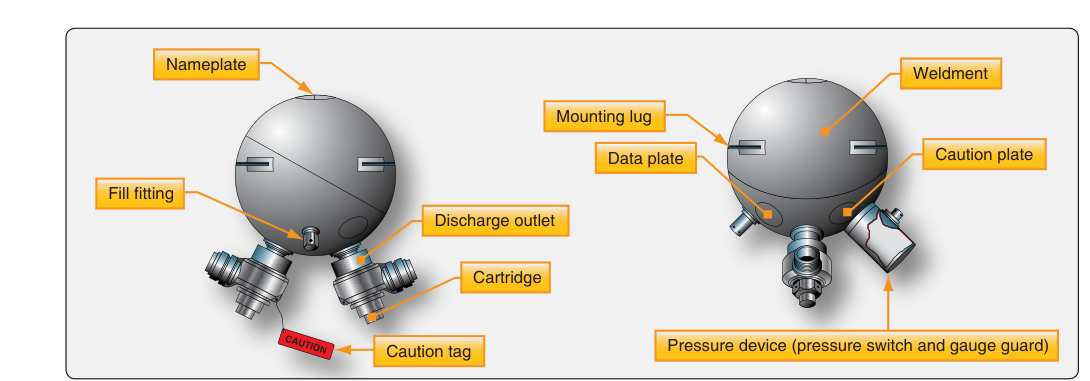
The extinguishing agent is only as effective as the system that delivers it. HRD containers — commonly called HRD bottles or fire extinguisher containers — are designed to discharge their entire agent load in a fraction of a second, producing a rapid, concentrated flood of agent in the nacelle before airflow can dilute it below effective concentration. This rapid discharge characteristic is what makes them fundamentally different from the slow-release systems used in buildings.
Key design and maintenance features of HRD bottles include:
- Pressure vessel construction: HRD bottles are spherical or cylindrical high-pressure vessels, typically manufactured from stainless steel or steel alloy, hydrostatically tested at pressures well above their service pressure. They are charged with agent under pressure — in the case of Halon 1301, the agent is a liquefied gas; nitrogen supercharging may be added to ensure consistent discharge across altitude and temperature ranges.
- Discharge cartridge (squib): Agent release is triggered by an electrically initiated explosive cartridge — the squib — which ruptures the container's outlet when a cockpit fire handle or push-button is activated. AMT technicians must handle squibs with extreme caution; they are classified as explosive devices and are subject to hazardous materials handling procedures. Resistance of the squib circuit is checked with a low-current ohmmeter approved for the purpose — never with a standard ohmmeter that could inadvertently fire the cartridge.
- Thermal discharge (red disk / yellow disk indicators): HRD bottles are equipped with overpressure relief provisions. A red disk or red blowout plug on the bottle outlet indicates the agent discharged normally via the squib. A yellow disk (or yellow cap) blowing out indicates thermal overpressure relief — the bottle self-discharged due to excessive heat or temperature, meaning the agent is spent but not necessarily because a fire occurred. Both conditions require bottle replacement and investigation before return to service.
- Weighing and pressure checks: The primary serviceability check for Halon HRD bottles is weight. Because Halon 1301 is a liquefied gas, pressure alone does not confirm adequate agent quantity — a bottle can maintain pressure with only nitrogen supercharge even if all liquid agent has leaked away. Manufacturer-approved scales and minimum weight limits (from the AMM or the bottle's data plate) must be used. Pressure is checked as a secondary indicator. For alternative agents stored as liquids under pressure, similar weighing procedures apply.
- Two-shot systems: Many transport-category aircraft provide two HRD bottles per engine — a first shot discharged immediately upon fire detection, and a second shot (or reserve shot) the crew can discharge if the fire rekindles. This two-shot design is a common industry practice used to meet the performance-based fire-extinguishing requirements of 14 CFR Part 25 (§§25.1195–25.1203), which do not explicitly mandate a specific numeric shot count.
Key Numbers and Rules
- Halon 1301 production banned in the U.S. as of January 1, 1994 (Montreal Protocol implementation); reclaimed Halon may still be used legally in certified aircraft systems.
- HRD bottle weight is the primary serviceability check — pressure alone is insufficient for liquefied-gas agents.
- Squib resistance checks must use a low-current ohmmeter (typically milliamp range) specifically approved for the task to prevent inadvertent firing.
- A yellow discharge indicator disk = thermal overpressure relief discharge; a red indicator disk = normal squib-initiated discharge — both require bottle replacement.
- Transport-category turbine nacelle suppression systems commonly provide a minimum of two shots per engine to meet the performance-based extinguishing requirements of 14 CFR Part 25 (§§25.1195–25.1203).
- All maintenance must be performed in accordance with the aircraft manufacturer's approved Aircraft Maintenance Manual (AMM) and applicable FAA-approved data under 14 CFR Part 43.
Common Test Traps
- Pressure vs. weight: Examinees often select pressure as the primary check for HRD bottle serviceability. The correct answer is weight — pressure can remain even after the liquid agent has escaped, leaving only pressurizing gas.
- Red vs. yellow disk confusion: Mixing up which color indicates normal discharge versus thermal overpressure is a frequent error. Remember: yellow = heat-driven relief (unwanted); red = normal squib firing (intentional, but still requires replacement).
- Halon production vs. Halon use: The question may ask whether Halon systems are still legal on aircraft. The answer is yes — existing systems and recycled agent are permitted. Only new production of Halon is banned.
- Halon's suppression mechanism: Halon does not primarily work by smothering or cooling. It works by chemical chain-breaking of the combustion reaction — a detail the test probes directly.
- Squib handling: Treating a squib like an ordinary electrical component and using a standard ohmmeter to check it is a dangerous error. Always use the manufacturer-specified low-current tester.