Of all the fluids an aviation maintenance technician handles on a daily basis, engine oil is among the most consequential. It lubricates, cools, cleans, and protects moving parts inside a piston or turbine engine against wear, corrosion, and heat. Getting oil servicing right — the correct type, the correct grade, and the correct quantity — is a foundational skill for any AMT working toward an FAA General certification. More importantly, an incorrect oil selection can lead to accelerated engine wear, bearing failure, sludge buildup, or oil starvation events that shorten engine life or cause in-flight emergencies.
This article covers the major oil types used in certificated aircraft engines, how viscosity grading works, what the specifications mean, and the practical considerations that govern how and when oil is added or changed. Every detail here is grounded in FAA guidance and standard industry specifications referenced in the Aviation Maintenance Handbooks and approved manufacturer data.
Why Engines Need Specialized Aviation Oil
Automobile engine oil is engineered for car engines that operate within tighter temperature bands, at lower specific loads, and with frequent oil changes. Aircraft piston engines — particularly air-cooled designs — run at much higher cylinder head temperatures, experience wide temperature swings from cold starts to cruise power, and may sit unused for weeks between flights. Aviation oils must tolerate these extremes without breaking down, foaming, or leaving harmful deposits. Turbine engines have entirely different metallurgy, much higher internal temperatures, and different lubrication requirements, so they require their own class of synthetic oils altogether.
Types of Aviation Engine Oil
Straight Mineral Oil
Straight mineral oil is a highly refined petroleum product with no additives beyond what is necessary to meet basic aviation specifications. It is used primarily during the break-in period of a new or newly overhauled reciprocating engine. During break-in, the piston rings must seat properly against the cylinder walls. Ashless dispersant (AD) oils, with their anti-wear additives, can actually prevent the mild controlled wear that allows rings to seat, so manufacturers typically specify straight mineral oil for the first 25 to 50 hours of operation (always defer to the engine manufacturer's instructions for the exact interval). Once ring seating is confirmed — typically evidenced by stable oil consumption — the technician transitions the engine to an ashless dispersant oil.
Straight mineral oil is historically specified under the military designation MIL-L-6082, along with corresponding SAE straight mineral aviation oil grades, which have long governed aviation-grade mineral oils. It should never be mixed with synthetic or AD oils in large proportions without consulting the engine manufacturer, as incompatibility can cause additive dropout or sludge formation.
Ashless Dispersant (AD) Oil
Ashless dispersant oil is the most commonly used oil in certificated piston aircraft engines in normal service. The term ashless refers to the fact that the additive package does not leave metallic ash deposits in the combustion chamber when small amounts of oil are burned — a critical concern because metallic ash can cause pre-ignition and spark plug fouling. The dispersant portion means the oil holds combustion byproducts, soot, and contaminants in suspension so they are carried to the filter rather than forming sludge deposits on engine components.
AD oils meet SAE specification standards and typically conform to the SAE J-1899 standard for aviation piston engine oils. They are also sometimes qualified to military specification MIL-PRF-22851. The additive package includes anti-wear agents, oxidation inhibitors, and rust and corrosion inhibitors — all engineered to be compatible with the metals, seals, and gaskets used in certified aircraft engines.
Semi-Synthetic (Ashless Dispersant with Synthetic Components)
Some oil products blend mineral base stock with synthetic base stock to achieve a middle ground — better low-temperature flow than straight mineral oil and better high-temperature stability than fully mineral AD oils, at a lower cost than full synthetic. These blended products still carry the AD additive package and are approved for use where the engine manufacturer permits synthetic or semi-synthetic oils. Always verify approval in the engine's Type Certificate Data Sheet (TCDS) or the manufacturer's service bulletins and instructions for continued airworthiness (ICA).
Synthetic Oil for Turbine Engines
Turbine engines — whether in turboprops, turbofan airliners, or turboshaft helicopters — require fully synthetic lubricants because the internal temperatures and pressures far exceed what petroleum-based oils can tolerate. The two dominant specification types are Type I and Type II synthetic turbine oils, both based on polyol ester chemistry.
Type I synthetic oils meet MIL-PRF-7808 and have a lower viscosity. They are considered older-generation oils and are used in some legacy turbine engines. Type II synthetic oils meet MIL-PRF-23699 and provide higher viscosity and a more robust additive package suited to modern high-performance turbine engines. Most current turbine engines specify Type II oils. There is also a Type III designation (MIL-PRF-23699 HTS, High Thermal Stability) for the most demanding applications. Turbine synthetic oils must never be mixed with piston engine oils; the chemistry is fundamentally incompatible. Even mixing two different approved turbine oils from different specification classes requires manufacturer approval because additive interactions can degrade performance.
Viscosity Grades and the SAE System
Oil viscosity describes how readily the oil flows — a thinner oil has lower viscosity and flows more easily; a thicker oil has higher viscosity and provides a more robust film under heavy loads. The Society of Automotive Engineers (SAE) viscosity grading system is used for aviation piston engine oils. Common aviation grades include SAE 30, SAE 40, SAE 50, and SAE 60. Multi-viscosity oils, such as SAE 15W-50, use a winter (W) rating that describes cold-temperature flow alongside a high-temperature viscosity rating — 15W means the oil flows adequately at cold temperatures to provide protection on startup, while 50 describes its viscosity behavior at operating temperature.
Engine manufacturers publish an approved oil viscosity chart in the engine operating handbook or service manual, typically correlated to expected ambient temperature. For example, a manufacturer might specify SAE 50 for warm climates above 60°F, SAE 40 for mild temperatures, and SAE 30 for colder conditions. In cold-weather operations, using too heavy an oil can starve bearings on cold startup before the oil warms and circulates; using too light an oil at high temperatures can thin out the film enough to allow metal-to-metal contact. The multi-grade 15W-50 oils address this range by maintaining acceptable viscosity across a broad temperature span and are widely approved for many certified piston engines as a result.
Specifications and Approval: What Controls Oil Selection
An AMT must never select an oil based on personal preference or what is on the shelf. Oil selection is governed by the engine manufacturer's approved data, which is part of the aircraft's airworthiness documentation. The hierarchy of sources is:
- Engine Type Certificate Data Sheet (TCDS) — establishes what types and specifications are approved for the engine model.
- Engine Operator's Manual or Maintenance Manual — gives viscosity-temperature charts, oil capacity, and change intervals.
- Manufacturer Service Bulletins (SBs) and Service Instructions (SIs) — may update oil approvals, restrict certain brands, or respond to findings from field service experience.
- Aircraft Flight Manual (AFM) or Pilot's Operating Handbook (POH) — cross-references oil type for the pilot's preflight checks and may state minimum and maximum oil level limits.
Using an oil that is not approved for the engine is a maintenance deviation from approved data and can constitute a violation of 14 CFR Part 43, which requires all maintenance to be performed in accordance with manufacturer instructions or other FAA-accepted data. It can also void the engine manufacturer's warranty and potentially affect the aircraft's airworthiness.
Oil Servicing Procedures
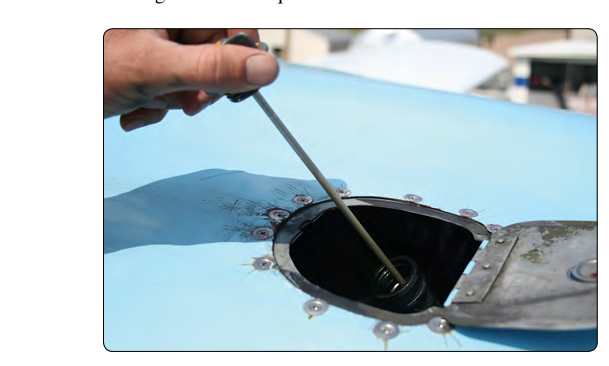
When adding oil, the AMT must verify the oil type matches what is already in the engine — mixing incompatible types can lead to additive interactions, foaming, or sludge. Check the engine logbook or the squawk sheet to confirm the oil type currently in service. Oil is added through the oil filler cap, which on most light aircraft is accessed through an oil door on the cowling. Use a clean, approved funnel or dispensing can to prevent contamination. Check the dipstick or sight gauge before and after adding oil, and never overfill — oil above the maximum level can be ingested into the crankcase breather and result in excessive oil loss in flight.
Oil changes are performed at intervals specified by the manufacturer — commonly every 25 to 50 hours for piston engines, or annually if fewer hours are accumulated. The oil filter or screen must also be cut open and inspected for metallic debris as part of the change process, since the filter is a primary source of early engine health information. Document all oil servicing in the aircraft maintenance records per 14 CFR Part 43.
Key Numbers and Rules
- Break-in period typically uses straight mineral oil for the first 25–50 hours (per manufacturer guidance); always verify the exact interval with the engine manufacturer's documentation.
- Common aviation piston oil grades: SAE 30, 40, 50, 60, and multi-grade 15W-50.
- Type I turbine oil: MIL-PRF-7808; Type II turbine oil: MIL-PRF-23699.
- Piston AD oils commonly meet SAE J-1899 or MIL-PRF-22851.
- Straight mineral oil for piston engines is historically specified under MIL-L-6082 and corresponding SAE straight mineral aviation oil grades.
- Oil changes for typical air-cooled piston engines: every 25–50 hours or per TBO instructions — always follow manufacturer-specific intervals.
- All oil servicing must be documented per 14 CFR Part 43.9 (maintenance records entry requirements).
Common Test Traps
- Mixing oil types during break-in: Some students think any aviation oil is fine for break-in. In fact, straight mineral oil — not AD oil — is required during break-in so rings can seat properly. Using AD oil during break-in can prevent proper ring seating.
- Assuming automotive oil is acceptable: Automobile motor oils do not meet aviation specifications and are not approved for certificated aircraft engines. The ashless additive requirement alone disqualifies most automotive oils.
- Confusing turbine and piston oil types: Type I and Type II refer to synthetic turbine oils and have no meaning for piston engine oil selection. Never use turbine oil in a piston engine, and never use piston oil in a turbine engine.
- Selecting viscosity by preference, not temperature: The correct SAE grade is determined by the expected operating temperature range, not by habit. Using SAE 50 in sub-freezing temperatures risks oil starvation at startup.
- Overfilling the oil: Adding oil above the maximum dipstick level is a maintenance error. Excess oil can be forced out through the crankcase breather, resulting in significant oil loss in flight — a potentially serious situation.