Aircraft oxygen systems are among the most safety-critical components an Aviation Maintenance Technician (AMT) will service. They supply breathable oxygen to crew and passengers at altitudes where the ambient atmosphere cannot sustain consciousness. Under 14 CFR 91.211, required minimum flight crew must use supplemental oxygen above 12,500 feet MSL up to and including 14,000 feet MSL for that part of the flight at those altitudes lasting more than 30 minutes, and at all times when above 14,000 feet MSL; oxygen must be provided to occupants (though not necessarily used by them) whenever the aircraft is operated above 15,000 feet MSL. Because high-pressure oxygen is an aggressive oxidizer that can turn ordinary contaminants into ignition sources, every step of servicing and handling must follow strict FAA-approved procedures. A mistake is not just a regulatory violation — it can be catastrophic.
This article covers the types of aircraft oxygen systems, the equipment and materials used, how to safely service those systems, and the precautions every AMT must observe. The content is grounded in the Aviation Maintenance Technician Handbook — General (FAA-H-8083-30) and the Airframe handbook (FAA-H-8083-31), which serve as the primary FAA references for oxygen system maintenance.
Types of Aircraft Oxygen Systems
Understanding what you are servicing is the first step to servicing it safely. Aircraft oxygen systems fall into three broad categories.
- High-pressure gaseous systems: The most common type in general aviation and older transport-category aircraft. Oxygen is stored as a compressed gas in steel or aluminum alloy cylinders at pressures typically ranging from 1,800 to 2,200 psi when fully charged. A regulator reduces this high pressure to a safe, breathable flow delivered to masks or cannulas.
- Liquid oxygen (LOX) systems: Used primarily in military and some older transport aircraft. Liquid oxygen is stored at extremely low temperatures (approximately −183°C / −297°F) and vaporized before delivery. LOX systems hold a large quantity of oxygen in a relatively small, lightweight container, but they require specialized handling equipment and present unique hazards including cryogenic burns.
- Chemical oxygen generators: Common in transport-category passenger compartments (the drop-down passenger masks). A chemical reaction — typically the decomposition of sodium chlorate — releases oxygen when activated. These are not rechargeable in the field and must be replaced as assemblies. They generate significant heat during operation and must never be treated as inert after activation.
How Gaseous Oxygen Systems Work
In a high-pressure gaseous system, oxygen stored in the cylinder passes through a pressure reducer or regulator that steps the pressure down to a usable level, commonly around 60–90 psi intermediate pressure, before flowing to individual user regulators or continuous-flow outlets. A shutoff valve controls flow from the cylinder. Pressure gauges allow the technician and crew to monitor system status. Tubing is typically stainless steel, and all fittings are designed to be oxygen-compatible — meaning no materials prone to ignition from the oxygen-enriched environment.
The continuous-flow type delivers a constant stream of oxygen to the user, often through a rebreather bag that captures exhaled oxygen mixed with fresh supply. The diluter-demand type, more common in crew systems and pressurized aircraft, delivers oxygen only when the user inhales and can mix cabin air with oxygen in varying ratios depending on altitude. Pressure-demand regulators, used above approximately 40,000 feet, supply oxygen under positive pressure to prevent hypoxia even if the mask seal is imperfect.
Servicing Procedures
Checking System Pressure and Determining Service Need
Before servicing, always consult the aircraft's approved maintenance manual (AMM) or manufacturer's service instructions. Cylinder pressure is read on the system gauge; compare it to the approved full-charge pressure listed for that specific system — commonly 1,800–2,000 psi, but values vary by aircraft. Never assume a standard value applies without verification. Record the existing pressure and calculate the quantity of oxygen needed.
Cylinders must be periodically hydrostatically tested to verify structural integrity. The test date and pressure rating are stamped on the cylinder. An AMT must verify that a cylinder is within its hydrostatic test interval before charging it — a cylinder that has exceeded its test interval must be removed from service and sent for testing or condemned.
Connecting the Servicing Equipment
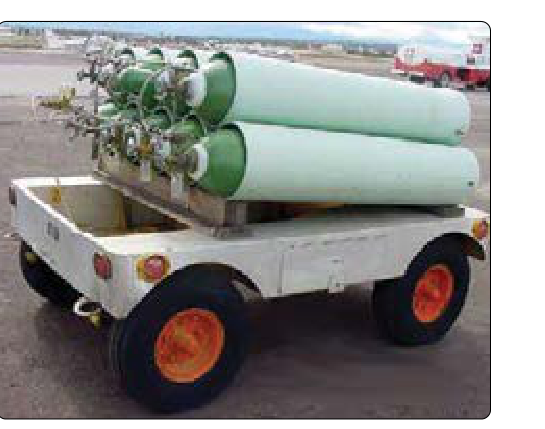
Aviation oxygen servicing carts store oxygen at high pressure and are fitted with special fittings, regulators, and high-pressure hoses. Before connecting any servicing equipment, confirm the oxygen source is aviator's breathing oxygen — this is specified in MIL-PRF-27210 and is extremely dry (low moisture content) to prevent ice formation in the system and to meet purity standards. Industrial oxygen or medical oxygen may have different moisture levels or purity characteristics and is not approved for aircraft oxygen systems without specific authorization.
Connect the servicing hose to the aircraft oxygen filler valve according to the AMM. Purge the hose briefly to remove any contaminants before opening the aircraft system valve. Open valves slowly and deliberately — never crack them rapidly, as the rapid compression of oxygen (adiabatic compression) can generate sufficient heat to ignite contamination in the line, a phenomenon sometimes called a compression ignition or diesel effect.
Charging the System
Open the service valve slowly, allowing pressure to equalize gradually. Monitor the system gauge constantly. Fill to the pressure specified in the AMM for the ambient temperature, since oxygen pressure varies with temperature (refer to the temperature-pressure correction chart provided in the aircraft's maintenance manual or the servicing cart documentation). Overfilling a cylinder beyond its rated pressure is dangerous and may weaken the cylinder. Once the target pressure is reached, close the aircraft filler valve first, then the service cart valve, and carefully bleed pressure from the hose before disconnecting it.
Safety Precautions — Non-Negotiable Rules
The hazards associated with oxygen servicing stem from oxygen's role as an oxidizer. Oxygen itself does not burn, but it dramatically accelerates the combustion of almost any other material. Even substances that are not normally flammable — certain lubricants, skin oils, and rubber compounds — can ignite violently in an oxygen-rich environment under pressure.
- Absolutely no oil, grease, or petroleum products: Keep all oxygen equipment and your hands free of any hydrocarbon contamination. Never use standard lubricants on oxygen fittings or valves. If thread lubrication is required, use only oxygen-compatible compounds approved by the manufacturer.
- No smoking or open flames: Maintain a no-smoking zone of at least 50 feet around any oxygen servicing operation. Post appropriate warning signs. Remove all ignition sources from the area.
- Use dedicated oxygen equipment only: Oxygen hoses, regulators, and fittings must never be used for other gases and must be protected from contamination between uses. Store servicing equipment with protective caps on all fittings.
- Wear appropriate PPE: Use clean, grease-free gloves (not petroleum-based) when handling oxygen equipment. Eye protection is required when working around high-pressure systems.
- Ground the aircraft and equipment: Static electricity is a potential ignition source. Bond the servicing cart and the aircraft together and to a common ground before beginning any servicing operation.
- Work in a well-ventilated area: Oxygen-enriched atmospheres increase fire risk. Ensure adequate ventilation to prevent oxygen buildup in enclosed spaces.
- Never use oxygen to pressurize other systems: Oxygen must never be used as a substitute for compressed air or nitrogen in tires, struts, or other systems not designed for it.
Cylinder Handling and Storage
High-pressure oxygen cylinders must be secured at all times — in the aircraft, on a service cart, or in storage. A falling cylinder can shear the valve assembly, turning the cylinder into an unguided projectile. Store cylinders in cool, dry, ventilated areas away from heat sources and flammable materials. Cylinders must be kept at least 20 feet from flammable gas cylinders (such as acetylene) or separated by a fire-resistant barrier of at least 30 minutes fire rating, as specified in safety standards. Transport cylinders with their protective valve caps installed.
Inspect cylinders externally for corrosion, dents, arc strikes, or any damage that could compromise integrity. Any such damage warrants removal from service pending inspection or testing. Check the hydrostatic test date stamp — for typical high-pressure aircraft oxygen cylinders, hydrostatic testing is required every five years, though you must verify the specific interval per the applicable regulations and manufacturer's data.
Why It Matters
Hypoxia incapacitates without warning — a pilot who begins to lose consciousness from oxygen deprivation may not recognize the symptoms until it is too late. A properly serviced and functional oxygen system is the direct countermeasure. Equally, an improperly serviced system — one contaminated with oil, over-pressurized, or connected with the wrong equipment — can cause a fire or explosion in the cockpit or cabin with catastrophic results. The AMT who services the system is the last line of defense before that equipment goes airborne.
Common Test Traps
- Industrial vs. aviator's oxygen: The FAA knowledge test may offer industrial or medical oxygen as plausible alternatives. Only aviator's breathing oxygen meeting the applicable military specification is approved for aircraft oxygen systems unless the AMM specifically states otherwise.
- Valve opening speed: Examinees often underestimate the hazard of opening oxygen valves rapidly. The correct answer is always to open slowly to prevent compression ignition from adiabatic heating.
- Lubricants on fittings: Any question about lubricating oxygen system fittings should trigger caution — the default answer is that petroleum-based lubricants are prohibited; only oxygen-compatible compounds approved by the manufacturer may be used.
- Temperature correction when charging: Pressure readings alone are insufficient without accounting for ambient temperature. The AMM's temperature-pressure correction chart must be used to determine the correct fill pressure.
- Hydrostatic test intervals: Questions may test whether an AMT can charge a cylinder that is overdue for hydrostatic testing. The answer is no — it must be removed from service and tested or condemned before being returned to use.