Every reciprocating aircraft engine is essentially an air pump that burns a precise blend of fuel and air to produce power. The fuel-air mixture ratio — the proportion of fuel to air by weight entering the cylinders — governs how completely the fuel burns, how much power is released, and how hot the engine runs. Getting this ratio right is one of the most fundamental skills an aviation maintenance technician must understand, because an improperly leaned or enriched mixture can silently destroy an engine over time or cause an immediate loss of power at the worst possible moment.
This article covers how mixture ratios work, why stoichiometry matters to aviation, how pilots and systems control the mixture, and what can go wrong when the mixture is off. Whether you are preparing for the FAA Powerplant knowledge test or learning to inspect and troubleshoot fuel metering systems, a thorough grasp of this topic is essential.
The Chemistry Behind Mixture Ratios
Complete combustion of aviation gasoline (avgas) requires a specific ratio of fuel to air by mass. The stoichiometric ratio — the chemically perfect mixture — for avgas is commonly cited as approximately 15:1 (15 parts air to 1 part fuel by weight), though some sources cite values closer to 14.7:1 as with automotive gasoline; the exact figure varies somewhat by source, but 15:1 is the widely accepted approximation used in aviation training. At this ratio, every molecule of fuel finds approximately enough oxygen to burn completely, releasing maximum heat energy. In practice, aircraft engines rarely operate at exactly stoichiometric for reasons explained below.
Mixture ratio is often discussed in terms of being rich or lean relative to stoichiometric rather than through a specific numeric fuel-air ratio figure. A rich mixture contains more fuel than stoichiometric; a lean mixture contains less fuel than stoichiometric.
Rich vs. Lean: What Actually Happens
Rich Mixture Effects
When the mixture is richer than stoichiometric, excess fuel is present that cannot fully oxidize. Some of that unburned fuel absorbs heat as it vaporizes inside the cylinder, which actually cools the cylinder head and exhaust valve temperatures. This is why manufacturers specify a rich mixture for high-power operations such as takeoff and climb — the extra fuel acts as an internal coolant. However, running excessively rich at low power settings causes carbon fouling of spark plugs and deposits on piston crowns, incomplete combustion, increased fuel consumption, and increased carbon monoxide production. A very rich mixture can also cause engine roughness and, in extreme cases, cause the engine to quit entirely.
Lean Mixture Effects
When the mixture is leaner than stoichiometric, there is more oxygen than the available fuel can consume. Combustion temperatures rise — often peaking at a mixture slightly lean of stoichiometric — before falling again as the mixture becomes very lean. The region just lean of peak (LOP) has been studied extensively, but the key FAA knowledge-test point is that leaning appropriately reduces fuel flow, increases fuel economy, reduces carbon fouling, and can produce smoother engine operation at cruise power settings. However, leaning too aggressively at high power settings raises cylinder head temperatures (CHT) and exhaust gas temperatures (EGT) to dangerous levels, risks detonation, and can burn exhaust valves.
Peak EGT and Best Economy vs. Best Power
Exhaust gas temperature (EGT) peaks when the mixture is at or very near stoichiometric, because that is where combustion is most complete. Two operationally important mixture settings are defined relative to peak EGT:
- Best economy mixture: Set at or slightly lean of peak EGT. Fuel consumption is minimized because nearly all fuel is burned, but CHTs must be monitored carefully.
- Best power mixture: Set approximately 50°F (about 28°C) richer than peak EGT. This slightly rich mixture maximizes power output and keeps CHTs at safe levels; it is the correct setting for most climb and high-power cruise operations unless the manufacturer specifies otherwise.
Manufacturer guidance in the Pilot's Operating Handbook (POH) and engine manufacturer data always takes precedence over general guidelines. Always consult the applicable documentation before establishing leaning procedures.
How Air Density Requires Mixture Adjustment
Air density decreases with altitude. As an aircraft climbs, each intake stroke draws in the same volume of air, but that air contains progressively fewer air molecules — and therefore less oxygen — per unit volume. A carburetor or fuel injector calibrated to deliver the correct mixture at sea level will deliver an increasingly rich mixture as the aircraft climbs, because the fuel flow remains nearly constant while the mass of air inducted decreases. Without adjustment, the engine becomes over-rich, loses power, wastes fuel, and fouls plugs.
The mixture control exists specifically to compensate for this density change. By restricting the fuel flow to match the reduced air mass at altitude, the pilot or automated system restores the desired fuel-air ratio. This is the foundational reason mixture leaning is required at cruise altitudes.
Mixture Control Systems
Float-Type Carburetors
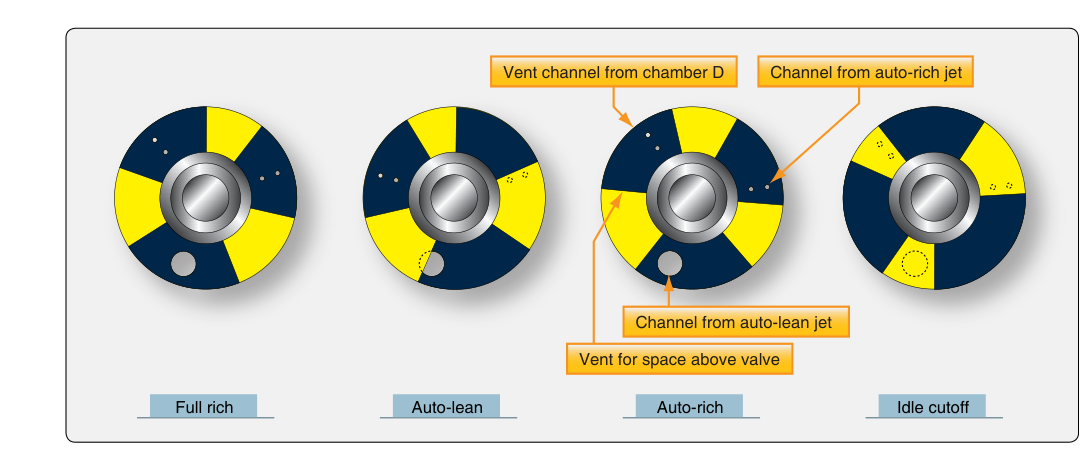
In a float-type carburetor, the mixture control is typically a needle valve (or a mixture valve) that either restricts the fuel passage to the main metering jet or introduces additional air into the fuel/air stream (the back-suction or economizer type). Moving the mixture control toward IDLE CUT-OFF progressively reduces or completely stops fuel flow, allowing the engine to be shut down cleanly by fuel starvation rather than by turning off the magnetos — which is important because turning off the magnetos alone can leave unburned fuel-air mixture in the intake that could fire unexpectedly.
Fuel Injection Systems
Continuous-flow fuel injection systems (such as the Bendix/RSA system common on Lycoming and Continental engines) meter fuel according to the pressure differential created by air flowing through the throttle body. The mixture control in these systems typically adjusts a valve that controls the reference pressure or directly throttles fuel flow to the flow divider and injector nozzles. Injected engines generally respond precisely to mixture adjustment and are less prone to induction icing than carbureted engines, but fuel-injected installations can be more susceptible to vapor lock depending on system design and installation, and require careful priming procedures.
Altitude-Compensating Carburetors and Automatic Controllers
Some aircraft use altitude-compensating carburetors or fuel control units that automatically adjust the mixture as density changes. Turbocharged engines with full-authority fuel controllers may automate much of this process, but AMTs must still understand the underlying principles for troubleshooting, overhaul inspection, and adjustment.
Detonation: The Critical Risk of Improper Mixture
Detonation occurs when the compressed fuel-air charge in the cylinder ignites spontaneously before or after the spark plug fires, creating multiple flame fronts that collide and produce a sharp pressure spike. Unlike normal combustion's smooth pressure rise, detonation causes extreme and rapid peak pressures that can crack ring lands, punch holes in piston crowns, break connecting rods, and destroy valves — sometimes within seconds of onset. A lean mixture at high power settings is a primary trigger for detonation because combustion temperatures and pressures rise dramatically. Using the correct fuel grade and octane rating specified for the engine (many certified piston engines are approved for 100LL, while many lower-compression engines are certified for and commonly use 80/87, 91/96, or unleaded fuels such as UL94/UL91) and maintaining proper mixture — particularly enrichening for high-power operations — are the primary defenses against detonation.
Pre-ignition is a related but distinct phenomenon where a hot spot in the combustion chamber (such as a carbon deposit or overheated exhaust valve) ignites the mixture before the spark occurs. Pre-ignition can arise from chronic over-leaning, which overheats valves and deposits carbon, creating future ignition sources.
Key Numbers and Rules
- Stoichiometric ratio: commonly cited as approximately 15:1 air-to-fuel by weight for avgas (some sources cite values closer to 14.7:1).
- Best power mixture: approximately 50°F rich of peak EGT (rich of peak, ROP).
- Best economy mixture: at or slightly lean of peak EGT.
- Takeoff and full-power operations: full rich mixture (or as specified by POH) to maximize cooling and prevent detonation.
- Idle cut-off: used to shut down the engine by stopping fuel flow; moving the mixture to idle cut-off is the standard shutdown method specified in most piston aircraft POH procedures.
- Altitude effect: air density decreases with altitude, requiring progressive leaning during climb; consult POH performance data for specific figures.
- Turbocharged engines: may require full-rich mixture up to the critical altitude where the turbocharger can no longer maintain sea-level manifold pressure; always follow POH.
Common Test Traps
- Confusing best power with best economy: Best power is richer than peak EGT; best economy is at or lean of peak EGT. The FAA exam often reverses these to see if you know which is richer.
- Assuming leaning is always safe: Leaning at high power settings (above approximately 75% power on most engines) significantly increases detonation risk. Always follow POH limits; many manufacturers prohibit leaning below a certain altitude at full power.
- Idle cut-off vs. magneto off: The correct way to shut down most piston engines is mixture to idle cut-off, not turning the magnetos off first. This ensures no unburned mixture remains in the intake.
- Rich mixture and plug fouling: Excessive richness at low power causes lead and carbon deposits on spark plugs (a common cause of rough engine operation found during the mag check). The fix is proper leaning during ground operations and cruise.
- EGT peaks lean of stoichiometric (common misconception): EGT actually peaks at or very near stoichiometric (approximately 15:1). Some students confuse this with best power, which is richer than peak EGT, not leaner.