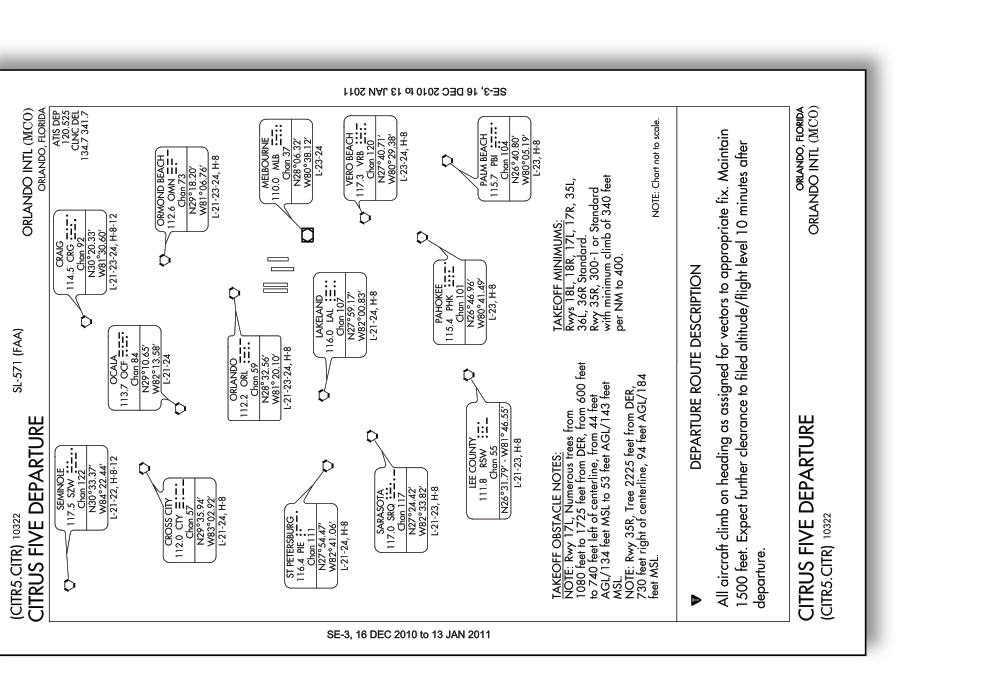
Every IFR flight begins with the most unforgiving phase of flight: departure. The aircraft is heavy with fuel, the runway environment is close behind, and the terrain or obstacles ahead may be invisible in clouds or darkness. The FAA's system of Obstacle Departure Procedures (ODPs) and Standard Instrument Departures (SIDs) exists precisely to protect you during this critical window — from the moment the wheels leave the runway until you are safely established in the en-route environment. Understanding the difference between these procedure types, when each applies, and how to fly them correctly is not only a knowledge-test staple; it is a fundamental instrument-flying safety skill.
This article focuses primarily on ODPs, since they carry the most nuanced pilot-in-command responsibilities, but it also covers how SIDs fit into the bigger picture. All material is grounded in the Instrument Procedures Handbook (FAA-H-8083-16) and the Instrument Flying Handbook (FAA-H-8083-15), along with the Aeronautical Information Manual (AIM).
The Purpose of Departure Procedures
A Departure Procedure (DP) is an FAA-developed routing designed to protect IFR aircraft from controlled flight into terrain (CFIT) and obstacles during the climb phase. The FAA publishes two distinct types of DPs: Obstacle Departure Procedures (ODPs) and Standard Instrument Departures (SIDs). Both serve the obstacle-clearance mission, but they differ in their level of formality, their ATC role, and whether a pilot is required — or merely encouraged — to use them.
The governing concept is the standard climb gradient. The FAA assumes that a departing aircraft can achieve a climb gradient of 200 feet per nautical mile (ft/NM) above the departure end of the runway elevation. This is the minimum performance the national airspace system expects. If obstacles in the departure area demand a steeper climb, or a specific routing to avoid terrain, an ODP or SID will specify that requirement explicitly.
Obstacle Departure Procedures (ODPs)
An ODP is the most basic type of instrument departure. It exists for one purpose only: obstacle clearance. ODPs are developed by the FAA whenever analysis shows that a straightforward climb out of a given runway could threaten safe separation from obstacles. They are not designed for traffic flow management — that is the domain of SIDs.
Where to Find ODPs
ODPs are published in one of two ways. If the procedure is complex enough to require a graphic depiction — specific headings, turns, crossing altitudes, or unusual routing — it appears as a graphic ODP on a standard instrument approach/departure chart (the same booklets as approach plates, published by FAA Aeronautical Information Services or Jeppesen). If the procedure is simple enough to be stated in a sentence or two, it is published as a textual ODP in the front-matter notes of the terminal procedures publication (the booklet of approach plates for that region), under the header "IFR Takeoff Minimums and (Obstacle) Departure Procedures." Pilots must check both the chart page and the textual section for the departure airport — they are not duplicates; they can each contain unique information.
Are ODPs Mandatory?
This is one of the most frequently tested concepts in the instrument rating knowledge exam. The answer is nuanced. Per the AIM and the Instrument Procedures Handbook, pilots operating under 14 CFR Part 91 are not required to fly an ODP unless ATC specifically assigns one in the clearance. However — and this is critical — flying the ODP is strongly recommended because it is the only FAA-approved method of guaranteeing obstacle clearance when no radar vectors or other ATC service is provided. A Part 91 pilot who departs without an ODP and without radar vectors accepts personal responsibility for obstacle clearance. Pilots operating under Parts 121 or 135 (commercial operations) face stricter requirements and must comply with applicable company operations specifications, which typically mandate ODP compliance.
The practical takeaway: if your clearance says "Fly runway heading" or gives you a specific departure routing different from the published ODP, ATC has assumed responsibility for obstacle clearance on that routing. If your clearance simply says "cleared as filed" and there is a published ODP for that runway, you should fly it unless ATC explicitly states otherwise.
Climb Gradients and Why They Matter
When an ODP specifies a climb gradient steeper than the standard 200 ft/NM, the pilot must verify that the aircraft can actually meet that performance requirement given the actual conditions — weight, temperature, pressure altitude, and engine status. A climb gradient of, say, 340 ft/NM may appear straightforward on a warm sea-level day but become unachievable at a high-elevation mountain airport on a hot afternoon. Failure to meet a published climb gradient defeats the entire purpose of the procedure and places the aircraft in obstacle-penetrating airspace.
Converting climb gradient to a rate of climb is straightforward in practice. Multiply the required gradient (ft/NM) by your groundspeed in knots, then divide by 60. For example, a 300 ft/NM gradient at a groundspeed of 90 knots requires: (300 × 90) ÷ 60 = 450 feet per minute. This conversion must be done before every IFR departure where a non-standard gradient is published.
Standard Instrument Departures (SIDs)
A SID is also an ATC procedure designed with obstacle clearance built in, but its primary function is to simplify ATC clearances and manage traffic flow at busy airports. SIDs are graphic procedures — always depicted on charts — and they include coded waypoints, transitions, and sometimes speed or altitude restrictions that benefit ATC's sequencing needs as much as the pilot's obstacle clearance needs.
Unlike an ODP, a SID must be assigned by ATC to be part of your clearance; you cannot elect to fly one on your own. When ATC assigns a SID, it becomes a mandatory part of your IFR clearance. If you do not have the required equipment to fly a SID (for example, it requires DME or RNAV capability your aircraft lacks), or if you simply cannot accept the procedure, you must tell ATC: "Unable (SID name) SID." ATC will then provide an alternative clearance.
It is also worth noting that a pilot may file a "No SIDs/STARs" notation in the remarks section of the flight plan if they prefer plain-language routing, although ATC may still issue a SID if traffic flow demands it.
Takeoff Minimums
Closely related to ODPs are takeoff minimums. Under 14 CFR Part 91, there are no regulatory takeoff minimums for general aviation pilots — a Part 91 pilot may legally depart in zero visibility. However, the FAA publishes non-standard takeoff minimums in the same textual section as ODPs. These are noted with the symbol "T" (a bold T inside a triangle) on instrument approach charts. Non-standard minimums typically require higher ceiling and visibility than the standard one statute mile (or one-half mile for certain turbine aircraft) used under Part 121/135. Part 91 pilots are again not required to comply, but departing in conditions below published minimums without the ability to fly the ODP safely is operationally reckless and legally unprotected if an accident occurs.
Why This Matters: The Safety Case
The majority of instrument-rated pilots who have experienced CFIT on departure did so because they did not know — or did not bother to verify — whether a departure procedure existed for their runway. Mountain airports with short runways and rising terrain are the most dangerous, but even coastal airports can have communication towers or rising ground that the standard 200 ft/NM gradient does not clear. Spending two minutes reviewing the textual ODP section before every IFR departure is one of the highest-value pre-flight habits an instrument pilot can develop.
Key Numbers and Rules
- Standard climb gradient: 200 ft/NM above the departure end of runway elevation (DERE), providing 48 feet per NM of obstacle clearance above the obstacle identification surface.
- Standard IFR takeoff minimums (Parts 121/135): 1 statute mile visibility for aircraft with 1-2 engines; ½ statute mile for aircraft with 3 or more engines. Part 91 has no regulatory minimums.
- "T" symbol on charts: Indicates non-standard takeoff minimums and/or ODP exists — always look up the textual section when this symbol is present.
- ODPs vs. SIDs: ODPs are obstacle clearance only; SIDs are ATC traffic management tools that also provide obstacle clearance. SIDs require ATC assignment; ODPs may be flown at pilot discretion under Part 91.
- Climb gradient conversion: Required climb rate (fpm) = gradient (ft/NM) × groundspeed (knots) ÷ 60.
- Diverse Vector Area (DVA): Where ATC can issue radar vectors from the runway without a DP, radar coverage and obstacle evaluation permit it. Outside DVAs, published procedures or pilot-maintained obstacle clearance are required.
Memory Aid
Use the phrase "T means Take Time" to remind yourself that the bold-T triangle on any instrument chart means you must take time to look up the non-standard takeoff minimums and departure procedure before you go flying. It won't win any mnemonic awards, but it encodes a critical pre-flight habit: if you see that T, stop and read the textual DP section before you start the engine.
Common Test Traps
- "ODPs are mandatory for Part 91." — False. They are recommended but not required unless assigned by ATC. SIDs, when assigned, are mandatory.
- Confusing graphic vs. textual ODPs. — Students assume all ODPs are on charts. Many simple ODPs are text-only in the front of the terminal procedures booklet. Always check both places.
- Ignoring non-standard climb gradients. — The exam will give you a scenario with a published gradient above 200 ft/NM and ask whether the aircraft performance is adequate. Do the math: gradient × GS ÷ 60 = required fpm.
- Assuming "cleared as filed" covers obstacle clearance. — A "cleared as filed" clearance means you follow your filed route. If there is a published ODP for the departure runway and no radar vectors are assigned, the responsibility to fly that ODP (or self-provide obstacle clearance) falls on the pilot.
- Mixing up the "T" and "A" symbols. — The bold T-in-triangle means non-standard takeoff minimums and/or DP. The inverted A symbol (alternate minimums symbol) means non-standard alternate minimums. These are different things published in different sections of the front matter.