One of the most powerful tools in a flight instructor's toolkit is not a checklist or a maneuver — it is a well-crafted question. The FAA's Aviation Instructor's Handbook (FAA-H-8083-9) dedicates significant attention to oral questioning because the way an instructor asks questions directly shapes how deeply a student learns. A student who can recite a memorized answer is not the same as a student who truly understands the concept. Purposeful questioning bridges that gap, transforms passive listeners into active thinkers, and gives the instructor ongoing, real-time feedback about where to focus instructional effort.
The Aviation Instructor's Handbook identifies several distinct types of questions, each serving a different instructional purpose. Fact questions check basic recall — for example, asking a student to name the standard temperature at sea level. Thought-provoking questions go deeper, requiring the student to apply, analyze, or evaluate knowledge — such as asking how a density altitude change would affect takeoff distance on a hot day at a high-elevation airport. Instructors should lean heavily toward thought-provoking questions because they reveal whether a student can use knowledge, not just repeat it. Leadoff questions open a discussion and should be broad enough to invite explanation rather than a simple yes or no. Follow-up questions build on a student's answer to push understanding further or to correct a misconception gently.
Why It Matters
The FAA holds that effective questioning is inseparable from effective assessment. During a lesson, an instructor who asks only yes/no or leading questions may finish an hour of ground instruction believing the student understands, when the student has merely been nodding along. Conversely, a student who is regularly asked to explain why and what would happen if develops the kind of aeronautical decision-making skills that keep pilots safe. Beyond assessment, good questioning actively maintains student attention, respects adult learning principles, and builds the student's confidence when they discover they can reason through an unfamiliar scenario using what they already know.
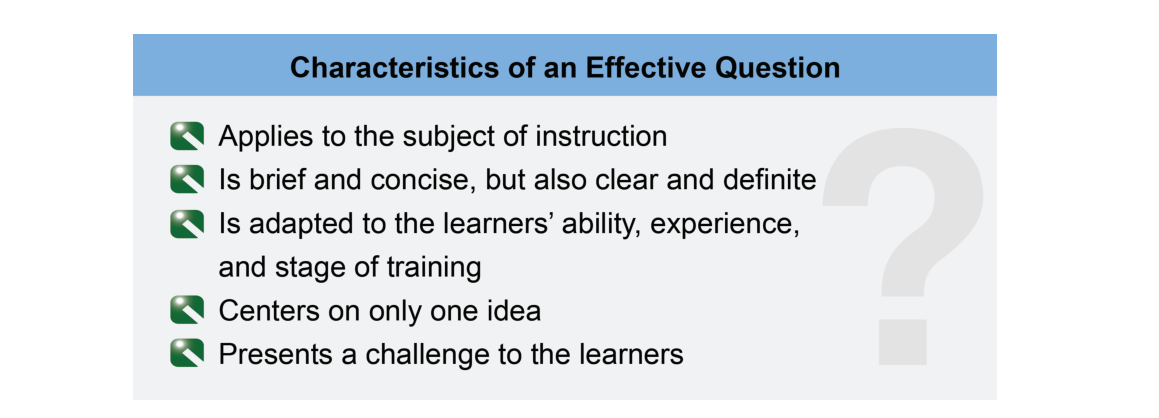
Characteristics of an Effective Question
- Clear and concise: The question should focus on one concept at a time. Compound or vague questions confuse students and produce muddled answers.
- Appropriate level: Questions should match the student's current stage of training. Early-stage students need foundational fact questions; advanced students need scenario-based application questions.
- Non-leading: A leading question ("That's a standard left-hand traffic pattern, right?") gives the answer away and teaches nothing. The student should construct the answer independently.
- Open-ended when possible: Questions that begin with how, why, what would happen, describe, or explain promote fuller responses and expose the depth — or limits — of understanding.
- Followed by adequate wait time: The FAA emphasizes that instructors must allow students time to think before stepping in. Jumping in too quickly trains students to wait for the instructor to answer for them.
Memory Aid
The Aviation Instructor's Handbook does not use a catchy acronym for question types, but it is helpful to remember the FAA's core categories in two groups. The first group checks recall and basic use: fact questions (simple recall of information) and comprehension questions (understanding, not just repeating, a fact). The second group reveals true aeronautical understanding: application questions (using knowledge in a new situation) and thought-provoking/open-ended questions (analysis, evaluation, and judgment). The handbook also warns instructors to avoid poor question types — puzzle, oversize, toss-up, bewilderment, trick, and irrelevant questions — because they confuse students or fail to assess real understanding. When planning a ground lesson, deliberately write at least one question from each of the good categories so your questioning covers the full spectrum of student cognition, and avoid the poor question types altogether.
Handling Incorrect Answers
How an instructor responds to a wrong answer is just as important as the question itself. The Aviation Instructor's Handbook advises instructors never to ridicule or ignore incorrect responses. Instead, acknowledge the attempt, redirect with a follow-up question or a hint, and help the student reason to the correct answer. This approach preserves the student's motivation and turns a mistake into a genuine learning opportunity. It also models the constructive self-critique that safe pilots use after every flight.
Common Test Traps
- Leading questions are always acceptable — FALSE. The FAA explicitly cautions against leading questions because they short-circuit the student's thinking process and provide no real assessment value.
- Rhetorical questions count as effective assessment — FALSE. Rhetorical questions neither invite a response nor reveal the student's understanding; they are essentially statements in disguise.
- An instructor should answer immediately if a student pauses — FALSE. Adequate wait time is essential. Filling every silence robs the student of the chance to think independently.
- Yes/no questions are the most effective type — FALSE. Open-ended, thought-provoking questions that require explanation are far more useful for both instruction and assessment than simple binary-response questions.