Aeronautical decision-making (ADM) is defined in the Risk Management Handbook (FAA-H-8083-2) as a systematic approach to the mental process used by pilots to consistently determine the best course of action in response to a given set of circumstances. For flight and ground instructors, evaluating that mental process is one of the most challenging—and most important—responsibilities in aviation education. Unlike altitude control or crosswind correction, ADM cannot be measured on a dial or read off a GPS; it must be inferred from what a student says, chooses, and does across a wide range of realistic situations. The Aviation Instructor's Handbook (FAA-H-8083-9) makes clear that ADM skill is not innate—it is learned, it can be taught systematically, and it must be assessed with the same rigor applied to any maneuver on the Airman Certification Standards.
What ADM Evaluation Actually Measures
Instructors sometimes reduce ADM assessment to whether a student made the "right call" at a given moment. That approach misses the point. ADM evaluation is fundamentally about the quality and structure of a student's thinking process, not just the outcome. The FAA-H-8083-9 identifies several thinking hazards—sometimes called hazardous attitudes—that distort aeronautical judgment: anti-authority, impulsivity, invulnerability, macho, and resignation. A student who rushes a preflight because they feel invincible, or who dismisses an instructor's concern out of an anti-authority attitude, is demonstrating measurable ADM deficiency even if the flight concludes without incident.
What instructors should be watching for includes: whether the student spontaneously identifies risk before being prompted; how they prioritize competing information under workload; whether they change a decision when new data arrives; and whether they can articulate their reasoning after the fact. Each of these behaviors is observable and, with practice, reliably ratable.
Structured Frameworks That Support Evaluation
The PAVE Checklist
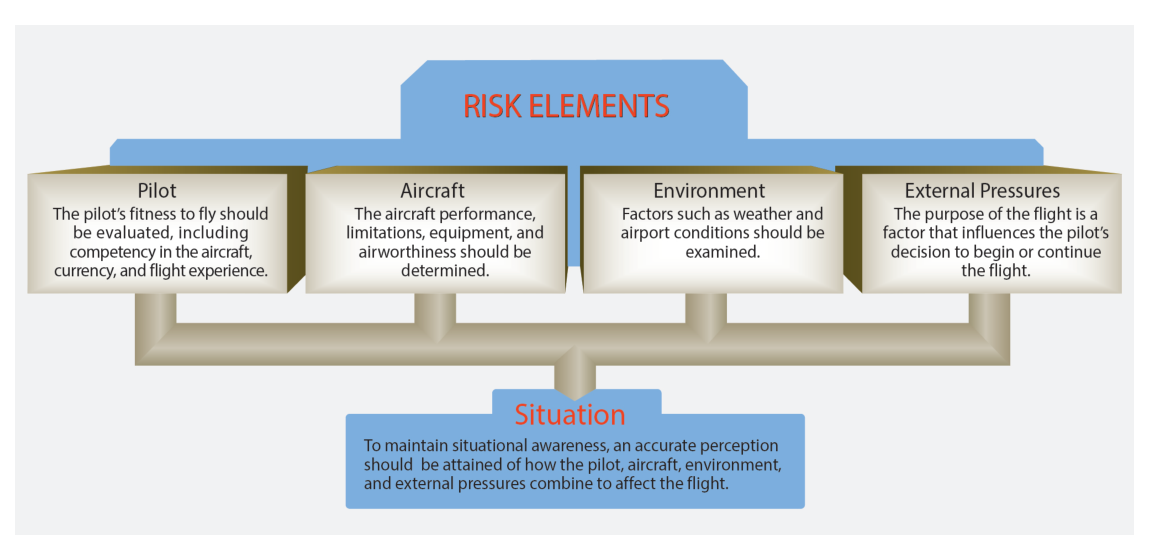
Before a single control surface is touched, a student's ADM quality is already visible in preflight planning. The PAVE checklist—Pilot fitness, Aircraft airworthiness, enVironment, and External pressures—gives instructors a structured lens for observing preflight risk assessment. Does the student spontaneously work through each element, or do they skip directly to fueling? Do they flag a personal concern, such as mild fatigue or recent medication, without being asked? Do they recognize that a passenger's schedule pressure constitutes an external pressure worth naming and managing? Observing PAVE use—or its absence—during preflight planning is one of the earliest and most informative ADM data points available.
The DECIDE Model
Once airborne, the DECIDE model (Detect, Estimate, Choose, Identify, Do, Evaluate) described in FAA-H-8083-2 provides a repeatable framework instructors can use to structure both training scenarios and post-flight critique. When an instructor introduces a simulated deterioration in visibility or a passenger expressing urgency to divert, they can later ask the student to walk through each DECIDE step explicitly: What did you detect? How did you estimate severity and time available? What options did you generate? This retrospective walkthrough reveals whether the student is applying a structured process or reacting instinctively, and it pinpoints exactly where the reasoning broke down.
Scenario-Based Training as the Primary Evaluation Tool
Scenario-based training (SBT) is identified in FAA-H-8083-9 as among the most effective methods for both teaching and evaluating ADM. SBT places students in realistic, goal-oriented situations that require judgment, not just execution. Critically, SBT is not limited to emergencies. Effective ADM scenarios include everyday judgment calls: a go/no-go decision when the ATIS reveals ceilings near personal minimums; a fuel stop decision influenced by headwinds and passenger impatience; a route deviation request from ATC that affects alternates. Each of these situations surfaces the student's risk tolerance, information-gathering habits, and decision-making structure in a way that straight-and-level or maneuver practice cannot.
Instructors should design SBT so that the scenario evolves over time. A single, static decision point is less revealing than a situation that deteriorates gradually—because the latter tests whether the student recognizes a trend before it becomes a crisis. FAA-H-8083-2 specifically discusses the concept of the error chain, the sequential accumulation of small judgment failures that precede most accidents. SBT that unfolds over several minutes allows instructors to observe whether a student catches and breaks the chain early or continues down it despite gathering evidence that something is wrong.
How to Deliver Effective ADM Critique
Evaluating ADM without critiquing it skillfully accomplishes nothing. The FAA-H-8083-9 outlines the characteristics of effective critique, and several apply with particular force to ADM feedback.
- Be specific and tie it to a moment. "Your ADM needs work" is not feedback. "When the ATIS came back with 1,400-foot ceilings, I noticed you did not revisit whether our filed alternate met the requirements under 14 CFR Part 91—walk me through your thinking at that point" is feedback a student can learn from.
- Evaluate process, not just outcome. FAA-H-8083-9 explicitly warns against outcome bias—the tendency to rate a decision as good because it worked out, or bad because it did not. A flawed decision that produced no adverse consequence is still a flawed decision and must be addressed; a sound decision that led to an unexpectedly difficult situation still deserves recognition as good thinking.
- Keep the debrief non-punitive. If students fear judgment for admitting uncertainty or confessing a wrong turn in their thinking, they stop verbalizing their reasoning. An instructor who rewards honest self-assessment—"I see you caught that you had dismissed the fuel concern too quickly; that's exactly the self-correction we want"—builds a student who continues to think out loud, which is the only way the instructor can monitor and guide ADM development.
- Connect the critique to realistic consequences. Explaining why a decision was hazardous—not just that it was wrong—builds genuine risk awareness. A student who understands that pressing into IMC with 200-foot ceilings and no instrument rating has resulted in fatal accidents in conditions very similar to those encountered in the scenario is far more likely to internalize the lesson than one who simply hears "that was a wrong answer."
ADM in the Airman Certification Standards Context
The Airman Certification Standards (ACS), which replaced the older Practical Test Standards for most certificates, embed risk management and ADM requirements directly into every task area. This means a designated pilot examiner is assessing ADM during steep turns just as much as during emergency procedures. Flight instructors should prepare students for this reality by integrating ADM critique throughout training—not saving it for a special "decision-making lesson" or the pre-checkride phase. FAA-H-8083-9 is explicit that ADM assessment is not a one-time event; it is an ongoing process woven through every instructional flight from the first lesson forward.
Key Numbers, Rules, and Reference Points
- Five hazardous attitudes identified in FAA-H-8083-2: anti-authority, impulsivity, invulnerability, macho, and resignation. Each has a specific antidote phrase the student should be able to state.
- PAVE covers four risk categories: Pilot, Aircraft, enVironment, External pressures. Used pre-flight for go/no-go decisions.
- DECIDE model: six steps—Detect, Estimate, Choose, Identify, Do, Evaluate—applicable to any in-flight problem.
- The 3P model (Perceive, Process, Perform) introduced in FAA-H-8083-2 is a streamlined alternative to DECIDE, sometimes favored for its real-time, cockpit-workload-appropriate brevity.
- 14 CFR Part 91 general operating rules provide the regulatory backdrop against which many ADM scenarios are set—fuel minimums, VFR weather minimums, and preflight action requirements (§91.103) are frequent reference points.
Common Test Traps
- ADM versus risk management: Some questions distinguish these terms. ADM is the overarching decision-making framework; risk management is the subprocess of identifying hazards, assessing their likelihood and severity, and applying mitigations. Risk management feeds into ADM but does not equal it.
- Outcome bias: Questions may present a scenario where a poor decision worked out fine and ask whether the instructor should commend the student. The correct FAA answer is no—the instructor must address the flawed reasoning regardless of outcome.
- Scenario-based training scope: SBT is sometimes mischaracterized as applying only to emergency simulations. In fact, FAA-H-8083-9 and FAA-H-8083-2 both emphasize that SBT encompasses all judgment situations, including routine ones.
- Timing of ADM assessment: Questions sometimes imply ADM is assessed only at culminating events like a checkride. The ACS and FAA-H-8083-9 both specify that ADM must be evaluated throughout all phases of training.
- Hazardous attitudes are not personality defects: All pilots are susceptible to these attitudes situationally. The evaluative question is whether the student recognizes and counters them, not whether they are somehow immune.