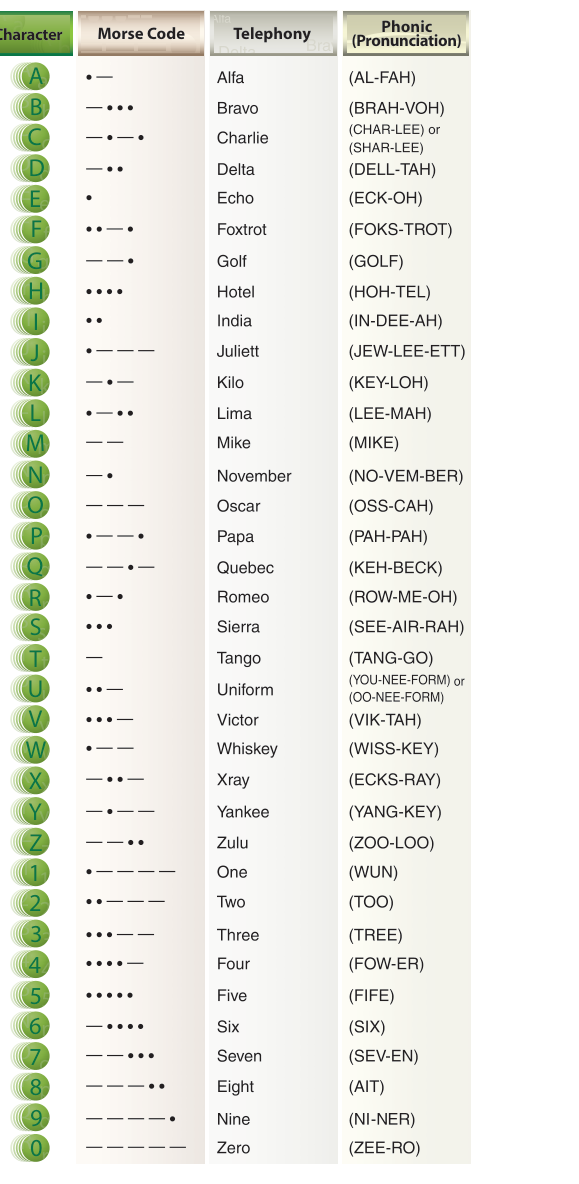
Imagine receiving a clearance over a scratchy radio and hearing the letter "B" — does that sound like "D," "E," "G," or "P"? In the noisy, high-workload environment of aviation radio, a single misheard letter or digit can send a pilot to the wrong runway, the wrong altitude, or the wrong destination. To eliminate that risk, the International Civil Aviation Organization (ICAO) standardized a phonetic alphabet and a specific set of number-pronunciation rules that every pilot, controller, and dispatcher on Earth is trained to use. The FAA has adopted these standards, and they apply to every radio transmission you will make as a private pilot.
Understanding and internalizing this system is not just about passing the FAA knowledge test — it is a foundational communication skill. Controllers expect it, and using it correctly builds your credibility on the frequency from your very first student solo call.
The ICAO Phonetic Alphabet
The phonetic alphabet replaces each of the 26 letters of the Latin alphabet with a distinct spoken word. Each word was chosen because it sounds markedly different from every other word in the set, even across language backgrounds and poor radio quality. The complete alphabet is:
- A — Alpha
- B — Bravo
- C — Charlie
- D — Delta
- E — Echo
- F — Foxtrot
- G — Golf
- H — Hotel
- I — India
- J — Juliett (note the double-t)
- K — Kilo
- L — Lima
- M — Mike
- N — November
- O — Oscar
- P — Papa
- Q — Quebec
- R — Romeo
- S — Sierra
- T — Tango
- U — Uniform
- V — Victor
- W — Whiskey
- X — X-ray
- Y — Yankee
- Z — Zulu
These words are used any time a specific letter must be communicated without ambiguity. The most common applications for a private pilot include: stating your aircraft tail number (N-number), identifying a VOR or waypoint, reading back an assigned squawk code one digit at a time, and spelling out an unusual place name or airways identifier.
How Aircraft Tail Numbers Are Spoken
In the United States, all registered civil aircraft carry an N-number beginning with the letter N. The FAA's Aeronautical Information Manual (AIM) specifies how these are read on the radio. When you initially call a facility, you say the full registration using phonetics and standard number pronunciation. For example, N4721B is spoken as "November Four Seven Two One Bravo." Once two-way communication is established and the controller has abbreviated your call sign, you may use a shortened form — typically the last three characters. So N4721B might become "Two One Bravo" or "Two One Bravo" after the controller has used that abbreviation first. Never shorten your call sign until the controller does it for you.
Aircraft with special registrations sometimes include letters throughout, such as N44TF, spoken as "November Four Four Tango Foxtrot." Experiment aircraft or warbirds may also carry type designators in conversation, but the N-number phonetic format remains the same.
Number Pronunciation Rules
Numbers in aviation are not always spoken the way you would say them in everyday conversation. The AIM and FAA Pilot's Handbook of Aeronautical Knowledge (PHAK) both describe specific pronunciation rules designed to reduce confusion between digits that sound similar, especially the numbers nine and five, which can blur together at high audio compression rates.
Individual digits are generally spoken one at a time. The digit pronunciations to memorize are:
- 0 — Ze-ro
- 1 — Wun
- 2 — Too
- 3 — Tree
- 4 — Fow-er
- 5 — Fife
- 6 — Six
- 7 — Sev-en
- 8 — Ait
- 9 — Nin-er
The pronunciations that surprise new students most are niner for 9, fife for 5, tree for 3, and fow-er for 4. These modified pronunciations exist precisely because the standard English words "five," "nine," "three," and "four" can be mistaken for each other or for words in other languages on a congested frequency. Niner in particular is used because the German word for "no" is nein, and the ICAO standard had to work across many languages.
Applying Numbers in Context
How numbers are grouped depends on the type of information being conveyed:
- Altitudes and flight levels: Altitudes below 10,000 feet are spoken as individual digits followed by the word "hundred" if applicable — for example, 6,500 feet is "Six Thousand Five Hundred." Flight Level 350 is spoken as "Flight Level Tree Fife Zero."
- Headings: Always spoken as three digits. Heading 090 is "Zero Niner Zero." Heading 270 is "Two Seven Zero."
- Frequencies: Spoken as individual digits with the decimal spoken as "point." The frequency 121.5 MHz is "One Two One Point Fife." The frequency 118.3 is "One One Ait Point Tree."
- Transponder squawk codes: Always four digits spoken individually. Squawk 4521 is "Squawk Fow-er Fife Two Wun."
- Wind: Given as direction and speed. "Wind 270 at 15" is spoken as "Wind Two Seven Zero at Wun Fife."
- Time: Coordinated Universal Time (UTC, also called Zulu) is the aviation standard. 1430Z is spoken as "One Four Tree Zero Zulu."
Why It Matters
Radio communication errors have been directly linked to runway incursions, airspace violations, and fatal accidents. When a runway number, an altitude clearance, or a squawk code is misread because a pilot used plain English instead of standardized aviation phraseology, the consequences can be severe. The phonetic alphabet and number-pronunciation standards form the first line of defense against these errors because they make every character acoustically unique.
Controllers rely on pilots using the standard system. When a student pilot says "one-two-one point five" instead of "Wun Two Wun Point Fife," or reads an N-number as plain letters instead of phonetics, the controller must work harder to confirm the message, increasing workload for everyone on the frequency. Professionalism and safety go hand-in-hand here.
Key Numbers and Rules
- Always use the full N-number in phonetic form on the initial call to any ATC facility.
- Never shorten your call sign until the controller abbreviates it first — this is an AIM requirement.
- The digit 9 is always niner, never "nine."
- Altitudes are spoken in thousands and hundreds: 8,500 = "Eight Thousand Five Hundred" — not "eighty-five hundred."
- Headings always include three digits: heading 30 is spoken as "Zero Tree Zero."
- Frequencies include the decimal point spoken as "point": 122.8 = "One Two Two Point Ait."
- Squawk codes are always four individual digits, one at a time.
Memory Aid
There is no single acronym for the entire phonetic alphabet, but a classic technique is to associate each word with a vivid mental image. Walk yourself through the alphabet and visualize: an Alpha wolf, a Bravo audience applauding, a Charlie Chaplin hat, and so on through Zulu warriors. The more absurd and specific your mental picture, the stickier the word becomes. For the tricky numbers, remember this phrase: "Tree fife niner — the aviation diver" — the three most commonly mispronounced digits (3, 5, 9) spoken in sequence. Drill these three until they feel natural before your first solo flight.
Common Test Traps
- Shortening the call sign too early: The FAA knowledge test and practical test both assess whether you know that only the controller may initiate a shortened call sign. A student who abbreviates first is technically non-compliant with AIM guidance.
- Saying "nine" instead of "niner": Test questions may ask how a specific digit is pronounced. The answer for 9 is always niner.
- Saying "eighty-five hundred" for 8,500 feet: FAA standards require "Eight Thousand Five Hundred." Conversational shortcuts are incorrect in ATC communications.
- Forgetting leading zeros in headings: Heading 090 must be spoken as "Zero Niner Zero," not "ninety" or "nine zero." Three digits, always.
- Misidentifying Juliett: Some students spell it "Juliet" (one t). The ICAO/FAA standard spelling is Juliett with two t's — a minor detail that appears in written test questions about the phonetic alphabet.