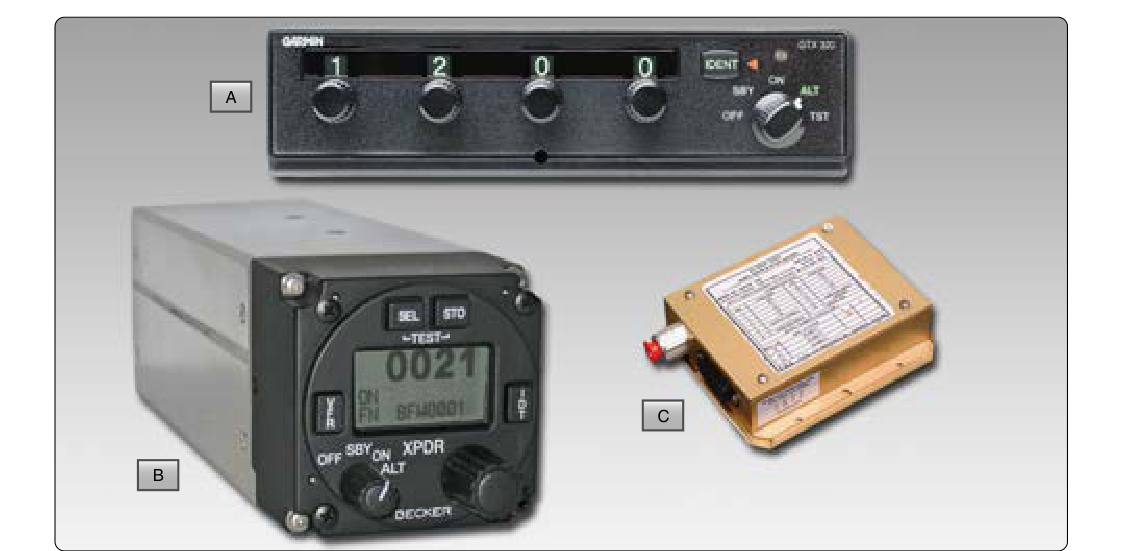
Every aircraft flying in controlled or busy airspace carries a transponder — a radio transmitter-receiver that responds to radar interrogations from ATC ground stations. When ATC's radar sweeps your aircraft, your transponder replies with a coded signal that appears as a data block on the controller's screen. That block can show your identity, your altitude, your groundspeed, and even your aircraft type. For student pilots, understanding how transponder codes work, which codes are reserved for emergencies, and exactly where Mode C altitude reporting is required is both a practical cockpit skill and a heavily tested knowledge-exam topic.
This article walks through the full picture: how the system operates, the meaning of every special squawk code, the regulatory airspace requirements, and the traps that show up repeatedly on the FAA Private Pilot knowledge test.
How the Transponder System Works
ATC radar systems use two complementary radar types. Primary surveillance radar (PSR) detects an aircraft by bouncing radio energy off its skin — it sees a "blip" but knows nothing about who you are. Secondary surveillance radar (SSR), also called the Air Traffic Control Radar Beacon System (ATCRBS), works differently: a ground interrogator transmits on 1,030 MHz, and your transponder automatically replies on 1,090 MHz. That reply is what carries the code and altitude data.
Transponders operate in several modes, but the two you must know are Mode A and Mode C. Mode A transmits a four-digit octal code — called a squawk — that identifies your aircraft. Each digit can be 0 through 7, giving 4,096 possible combinations. Mode C adds pressure altitude information encoded in 100-foot increments. Modern transponders combine both automatically, and many aircraft are now equipped with Mode S, which also transmits a unique 24-bit aircraft address and supports the Traffic Alert and Collision Avoidance System (TCAS) used by airliners. ADS-B Out, required in most controlled airspace since January 1, 2020, builds on Mode S but uses GPS position and is covered separately.
Setting and Operating Your Transponder
Before takeoff, set your transponder to the code assigned by ATC, or to 1200 if you are flying VFR without a clearance. Switch the mode selector to ALT (not just ON), so that Mode C altitude data is transmitted whenever Mode C is required. Many older transponders have an IDENT button — pressing it briefly causes your return to blossom on the controller's scope for about 18 seconds, positively identifying your aircraft. Use IDENT only when ATC asks you to; pressing it randomly is the radio-comms equivalent of waving your arms in a crowd.
Special Squawk Codes You Must Memorize
Three four-digit codes are internationally reserved for emergencies and special situations. No ATC facility will ever assign these codes as routine squawks. Knowing them cold is critical for both the test and for real emergencies.
- 7700 — Emergency. Squawking 7700 immediately alerts every ATC facility within radar range. Use it any time you declare an emergency — engine failure, medical emergency, fuel exhaustion. The code activates an alarm on ATC scopes. Importantly, if you are already talking to ATC and squawking an assigned code when the emergency begins, you do not have to change to 7700 immediately; continue using the assigned code if ATC is already working the problem. But if radar contact is lost or uncertain, 7700 is the universal distress signal.
- 7600 — Loss of Communications (NORDO). Squawk 7600 if your radio fails in flight. Controllers know to look for this code and will provide a light-gun signal sequence at towered airports. The AIM provides detailed procedures for operating in Class B, C, and D airspace with a radio failure; squawking 7600 is the first step in making your situation known.
- 7500 — Hijacking / Unlawful Interference. This code signals that your aircraft is being hijacked or subject to unlawful interference. ATC will immediately alert law enforcement. Never squawk 7500 accidentally — it triggers a major security response. If a controller asks you to verify your code and you have accidentally entered 7500, advise ATC immediately.
A useful memory trick many instructors use: think of these in ascending order of urgency — 7500 (someone's taking the plane), 7600 (can't talk), 7700 (major emergency). The progression goes from a security crisis to a comms crisis to a general emergency.
VFR Code 1200 and Discrete Codes
When flying VFR in uncontrolled airspace without radar service, squawk 1200. This is the standard North American VFR code and tells controllers the target is an unidentified VFR flight. When ATC provides radar service — flight following, Class C or B operations, or an IFR clearance — they will assign you a discrete transponder code unique to your flight. Once assigned, do not change your code without ATC instruction unless an emergency occurs.
Mode C Altitude Reporting: Where It Is Required
Mode C (or equivalent altitude encoding) is a regulatory requirement in specific airspace defined in 14 CFR Part 91.215. Understanding exactly where it applies is the most frequently tested transponder topic.
- Class A airspace — Mode C required (all operations require IFR clearance anyway, and transponder with Mode C is mandatory).
- Class B airspace and within 30 nautical miles of the Class B primary airport (the "Mode C veil") — Mode C is required from the surface up to 10,000 feet MSL. This is one of the most tested rules. Even if you are flying below the floor of the Class B shelves and never entering Class B, you must have Mode C if you are within that 30-nm veil — unless you have an ATC waiver.
- Class C airspace — Mode C required while in Class C and within the outer area (generally up to 20 nm from the primary airport).
- Above 10,000 feet MSL (excluding the airspace at and below 2,500 feet AGL) — Mode C required. If you are cruising at 10,500 feet MSL but only 1,200 feet above the terrain, you are below 2,500 feet AGL and technically exempt — but this edge case rarely affects typical student flights.
- Class D, E, and G airspace below 10,000 feet MSL and outside the Mode C veil — Mode C is not federally required, though a transponder in Mode A (ON) is required in Class D and when operating in or near Class C. Practically speaking, having Mode C active at all times is a safety best practice and almost universally encouraged.
Transponder Requirements by Airspace
Beyond Mode C, a transponder itself (Mode A at minimum) is required by 14 CFR 91.215 and 91.225 whenever you operate in Class A, B, or C airspace, or in the airspace above the ceiling and within the lateral boundaries of Class B or C airspace up to 10,000 feet MSL. You also need a transponder when operating in Class D airspace, within 30 nm of a Class B primary airport below 10,000 feet MSL, and above 10,000 feet MSL. Put simply: if there is significant traffic or controlled airspace nearby, assume you need a transponder with Mode C on.
Why This Matters: Safety and Separation
Mode C altitude data is what allows ATC to provide altitude-based traffic separation. Without it, a controller sees your radar return but cannot confirm your altitude. TCAS on airliners also relies on Mode C (and Mode S) replies from nearby traffic to generate resolution advisories. An aircraft flying without Mode C in the Mode C veil is essentially invisible in the vertical dimension — a serious collision risk in high-density terminal environments. That is exactly why the FAA drew a hard 30-nm boundary around major Class B airports: the terminal area traffic density demands full situational awareness from the ground up.
From a legal perspective, operating without a required transponder or Mode C in the wrong airspace is a regulatory violation that can draw a certificate action. ATC can grant short-term waivers, but you must request one before you enter the airspace, not after.
Key Numbers and Rules
- VFR squawk: 1200
- Emergency: 7700
- Radio failure: 7600
- Hijack: 7500
- Mode C veil around Class B primary airport: 30 nautical miles, surface to 10,000 feet MSL
- High-altitude Mode C requirement: above 10,000 feet MSL (except at or below 2,500 feet AGL)
- Transponder reply frequency: 1090 MHz; interrogation frequency: 1030 MHz
- Total possible squawk codes: 4,096 (digits 0–7 only, no 8 or 9)
- IDENT duration on scope: approximately 18 seconds
Common Test Traps
- "Mode C veil" extent. Students often confuse the 30-nm veil (Mode C required) with the 30-nm ring being the outer boundary of Class B itself. Class B airspace typically extends only 20 nm from the primary airport in its outermost ring; the Mode C requirement extends an additional 10 nm beyond that outer ring, to 30 nm total.
- Octal digits only. Transponder codes use digits 0 through 7. There is no digit 8 or 9. A question about a squawk of "8421" is a trick — that is not a valid transponder code.
- Mode C exemption at high altitude near terrain. The rule above 10,000 feet MSL has an exception: if you are at or below 2,500 feet AGL, Mode C is not required even above 10,000 MSL. This surprises students flying in mountainous terrain at high-altitude strips.
- When to squawk 7700 vs. continue assigned code. The FAA tests whether you know that 7700 is appropriate if you are NOT already in radio contact with ATC. If ATC is already helping you with the emergency, keeping your assigned discrete code may actually help them track you more efficiently.
- IDENT on your own initiative. Pressing IDENT without ATC instruction is not an emergency signal — it can confuse controllers. IDENT only when asked ("Cessna 123AB, squawk 4521 and ident").