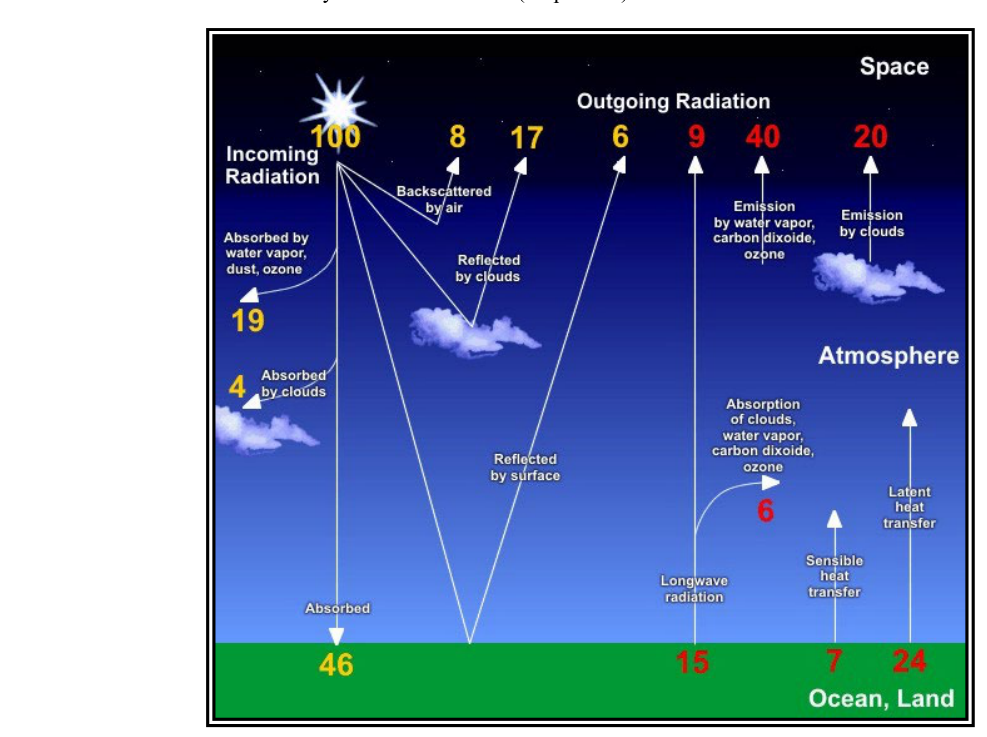
Every time you file a flight plan and check the weather, you are looking at the downstream consequences of a single, planet-scale process: the balance between energy arriving from the Sun and energy leaving from Earth back to space. Understanding this balance is not merely academic — it explains why thermals form under cumulus clouds, why overcast nights stay warmer than clear ones, why the tropics breed powerful weather systems, and why seasons shift the entire character of the atmosphere pilots fly through.
The FAA Aviation Weather Handbook (FAA-H-8083-28B), Chapter 7, lays out this energy balance in quantitative terms and then traces its consequences all the way down to the cockpit. This article follows that same path.
How Incoming Solar Radiation Is Distributed
Picture 100 units of solar energy arriving at the top of the atmosphere. Not all of it reaches the ground, and not all of it heats the surface in the same way. The FAA handbook assigns approximate percentages to each pathway:
- Reflected by air (scattering): 8 percent — gas molecules scatter shortwave sunlight back to space without absorbing it.
- Reflected by clouds: 17 percent — cloud tops act like mirrors, bouncing incoming radiation away.
- Reflected by the surface: 6 percent — lighter surfaces such as snow, desert, and ocean glint return energy unused.
- Absorbed by water vapor, dust, and ozone: 19 percent — these atmospheric constituents intercept solar energy before it can reach the ground.
- Absorbed by clouds: 4 percent — clouds are not perfectly reflective; some energy heats cloud droplets directly.
- Absorbed by the Earth's surface: 46 percent — just under half of all incoming solar energy actually heats the land and ocean.
Add those numbers: 8 + 17 + 6 + 19 + 4 + 46 = 100. Every unit that comes in eventually goes out. That is the definition of balance.
Terrestrial Radiation and the Greenhouse Effect
The Sun is extremely hot — its surface temperature exceeds 5,500 °C — so it radiates energy at short wavelengths, primarily visible light. The Earth's surface, far cooler, radiates energy back to space at much longer infrared (heat) wavelengths. You can sense this difference on a sunny day when you hold your hand over a hot asphalt surface and feel the invisible heat radiating upward — those shimmers rising from a highway on a hot afternoon are a direct visual cue of long-wave terrestrial radiation leaving the surface.
Certain atmospheric gases — water vapor being the most important, along with carbon dioxide and others — absorb outgoing long-wave infrared energy rather than letting it escape directly to space. This absorption stores extra energy near the surface and warms the lower atmosphere well above the temperature Earth would otherwise have. This is the greenhouse effect. The FAA handbook quantifies its significance with a direct comparison: the Moon, which has no atmosphere, maintains an average surface temperature of –18 °C (0 °F), while Earth's average surface temperature is 15 °C (59 °F) — a difference of 33 °C attributable almost entirely to this atmospheric blanketing.
The greenhouse effect is intensified on overcast nights. Clouds trap outgoing infrared radiation much like a blanket, so temperatures drop less than they would under a clear sky. Under partly cloudy skies, some heat escapes and temperatures cool moderately. Clear skies allow the most radiational cooling, which is why the coldest nights often follow clear, calm, dry conditions — exactly the scenario that produces radiation fog and frost for the pilot to deal with at dawn.
How Earth Transfers Surface Heat Into the Atmosphere
If the surface absorbed 46 percent of incoming solar energy and held all of it, it would continually warm until it became uninhabitable. Instead, two mechanisms move that heat upward into the atmosphere: sensible heating and latent heat transfer. Together they account for 31 of the 100 units (7 percent via sensible heat, 24 percent via latent heat) in the FAA's energy-balance accounting.
Sensible Heating: Conduction and Convection
When solar radiation heats the ground on a sunny day, the warm surface conducts heat to the thin layer of air immediately above it. That air warms, expands, and becomes less dense than the surrounding cooler air. Because warm air is less dense, it is buoyant — it rises. The rising bubble of warm air is called a thermal. As it lifts away from the surface, cooler and denser air sinks to replace it, gets heated in turn, and rises again. This cycle is convection, and it is the dominant mechanism for moving sensible heat vertically through the atmosphere.
Air is a poor conductor of heat, so pure conduction alone can only warm a very thin layer immediately adjacent to the ground. Convection is far more efficient at transporting heat over the thousands of feet pilots care about. Thermals are the practical result: the smooth, invisible columns of rising air that glider pilots seek and that can build into towering cumulus and thunderstorms when the atmosphere is unstable.
Latent Heat: The Water Cycle as an Energy Conveyor
The larger pathway — 24 of the 100 units — works through water. Solar energy absorbed at the surface evaporates water from oceans, lakes, rivers, soil, and vegetation. The heat used to convert liquid water to vapor does not raise the temperature of the water; instead, it is stored invisibly as latent heat of vaporization within the water vapor molecule itself.
When that water vapor later rises, cools, and condenses into cloud droplets or deposits as ice crystals, the stored latent heat is released back into the atmosphere at altitude. This is why a developing thunderstorm grows with such ferocity — each kilogram of condensing water releases roughly 2,260,000 joules (about 2,260 kJ) of heat energy into the updraft, amplifying the storm's circulation. The latent heat pathway is thus the primary mechanism by which the excess energy absorbed at the surface is redistributed into the atmosphere, preventing the surface from overheating and the upper atmosphere from cooling without limit.
Heat Imbalances With Latitude and the Poleward Heat Engine
Because Earth is roughly spherical, the Sun's parallel rays strike equatorial regions nearly perpendicularly (low solar zenith angle) and spread over a much larger area at high latitudes (high solar zenith angle). The result: lower latitudes absorb far more solar energy per unit of surface area than polar regions. Terrestrial radiation emission also decreases toward the poles (colder surfaces radiate less), but not by as much as the drop in solar absorption. So, at higher latitudes the annual rate of cooling exceeds warming, while the tropics show net warming.
Averaged over the entire globe, incoming solar radiation must equal outgoing terrestrial radiation — otherwise Earth could not maintain a stable long-term average temperature. According to the FAA handbook, this crossover point is at approximately 35° latitude in both hemispheres. Poleward of that line there is an annual net energy deficit; equatorward of it there is an annual net surplus. Yet the poles do not grow endlessly colder and the tropics endlessly hotter. The excess tropical heat is transported poleward by atmospheric circulations, weather systems, and ocean currents — the very phenomena that create wind, storms, and the jet stream that pilots ride or fight every day.
Seasons and Diurnal Temperature Variation
Earth's rotational axis is tilted 23.5° from the perpendicular to its orbital plane, and that tilt points in a fixed direction in space throughout the year. As Earth orbits the Sun, first one hemisphere and then the other is angled more directly toward the Sun, producing seasons. In the Northern Hemisphere, the summer solstice (approximately June 22) is the longest day and delivers the most intense insolation; the winter solstice (approximately December 22) is the shortest. The vernal equinox (approximately March 21) and autumnal equinox (approximately September 23) each produce 12 hours of daylight worldwide.
One important nuance: the warmest days of the Northern Hemisphere year do not occur on the summer solstice but rather weeks afterward. This lag exists because the surface needs time to accumulate heat. The same thermal lag pushes the coldest average temperatures to late January rather than the December solstice.
On a daily scale, the same principle governs diurnal temperature variation. Earth loses heat continuously day and night via terrestrial radiation, but gains solar energy only during daylight. Temperatures reach their lowest point shortly before or around sunrise, when solar input finally overtakes the ongoing terrestrial heat loss. Maximum surface temperatures typically occur in mid-afternoon rather than at solar noon, again because of the time required for the surface to transfer its absorbed heat into the air.
Why It Matters to Pilots
The energy balance is not background theory — it is the engine behind practical weather hazards. Thermals from uneven sensible heating produce convective turbulence and, on unstable days, build into cumulonimbus. Latent heat release within developing clouds drives explosive storm growth. Radiational cooling on clear nights brings fog, frost, and ice. Latitude-driven heat imbalances sustain the jet stream that dictates winds aloft. Seasonal shifts change density altitude, icing levels, and storm tracks. Understanding why these phenomena exist — tracing them back to those 100 units of incoming sunshine — makes a pilot a better decision-maker, not just a better test-taker.
Key Numbers and Rules
- 100 units — conceptual total of incoming solar radiation used in the FAA energy-balance model.
- 46 percent — fraction absorbed by Earth's surface (the largest single sink).
- 19 percent — absorbed by water vapor, dust, and ozone in the atmosphere.
- 17 percent — reflected by clouds.
- 7 percent sensible heat / 24 percent latent heat — the two surface-to-atmosphere transfer pathways.
- –18 °C (0 °F) — Moon's average surface temperature (no atmosphere, no greenhouse effect).
- 15 °C (59 °F) — Earth's average surface temperature (greenhouse effect adds ~33 °C).
- 35° latitude — approximate crossover where annual incoming solar equals outgoing terrestrial radiation.
- 23.5° — Earth's axial tilt, the cause of seasons.
Common Test Traps
- Mixing up solar and terrestrial wavelengths. Solar radiation is shortwave (visible light); terrestrial radiation is longwave (infrared). Greenhouse gases absorb the outgoing longwave radiation, not the incoming shortwave.
- Assuming clear nights are warmer. The opposite is true. Clear skies allow maximum radiational cooling. Overcast skies trap outgoing infrared and keep nights warmer.
- Thinking the warmest day coincides with the summer solstice. A thermal lag pushes peak seasonal and diurnal temperatures to after the peak insolation date/time.
- Underestimating latent heat. The 24 percent latent heat pathway is more than three times the 7 percent sensible heat pathway — latent heat is the dominant surface-to-atmosphere transfer mechanism and the primary fuel for thunderstorm development.
- Ignoring latitude gradients. Heat imbalances between the equator and poles are the root cause of atmospheric circulation, wind, and most significant weather systems. Treating energy balance as purely vertical misses this critical horizontal dimension.