Every time a pilot reads a METAR, checks a density altitude chart, or evaluates icing conditions, temperature is at the center of the decision. Yet many pilots use temperature numbers without understanding what they actually represent physically or why aviation settled on one scale while science uses another. The FAA Aviation Weather Handbook (FAA-H-8083-28B), Chapter 5 gives a rigorous, physics-based foundation for temperature and its relationship to heat—knowledge that pays dividends every time you decode a weather product or wonder why your aircraft is not performing as the POH predicts.
This article walks through the molecular physics of temperature, the three scales pilots encounter, the exact conversion formulas, and the practical situations where getting the conversion wrong can compromise safety.
What Temperature Actually Measures
To use temperature intelligently, a pilot should understand what the number on a thermometer represents at the molecular level. All matter—air, fuel, metal, water—is made of atoms and molecules in constant, random motion. That motion is kinetic energy. The FAA handbook draws a clear distinction between two related but different concepts:
- Heat is the total kinetic energy of all the atoms and molecules in a substance. A large, cool air mass can contain enormous total heat energy simply because it contains so many molecules.
- Temperature is a numerical value representing the average kinetic energy of those molecules. It is an indicator of the internal energy of air, not the total energy content.
This distinction matters operationally. A small cup of boiling water (100 °C) has a higher temperature than a bathtub of warm water (38 °C), but the bathtub contains far more total heat energy because it holds vastly more molecules. Heat always transfers from a higher-temperature body to a lower-temperature body until thermal equilibrium is reached—a principle that governs everything from carburetor icing to the formation of thunderstorm updrafts.
When air is warmed, its molecules speed up, raising average kinetic energy and therefore temperature. When air cools, molecular speeds decrease, average kinetic energy drops, and temperature falls. A thermometer is simply an instrument whose own molecular response (expansion of mercury, change in electrical resistance, etc.) tracks those average molecular energies.
The Three Temperature Scales
Kelvin — the Absolute Scale
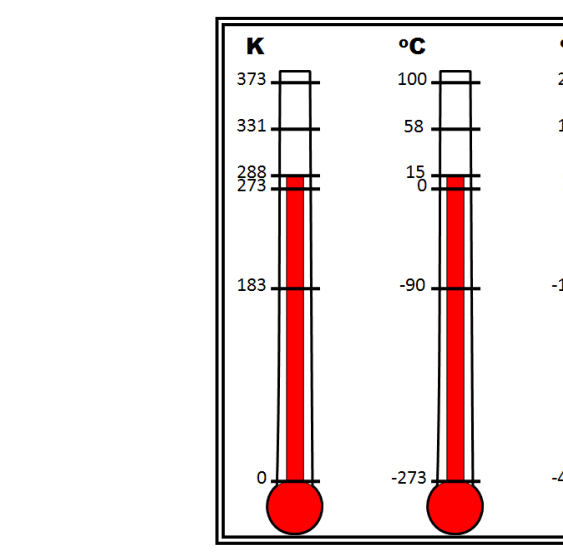
The Kelvin (K) scale is a thermodynamic, or absolute, scale. Its zero point—0 K, absolute zero—represents the theoretical condition where all molecular thermal motion ceases. Because nothing can be colder than the complete absence of molecular motion, the Kelvin scale has no negative numbers. Scientists and atmospheric physicists favor Kelvin because equations for gas behavior (such as the ideal gas law, PV = nRT) require an absolute temperature scale to give correct results. The size of one Kelvin degree is identical to the size of one Celsius degree, which makes conversions between the two straightforward. Standard sea-level temperature in the International Standard Atmosphere is 288.15 K (15 °C).
Celsius — the Aviation Meteorology Standard
The Celsius (°C) scale is the most commonly used temperature scale worldwide and is the standard for meteorology globally. Its reference points are physically intuitive: 0 °C is the freezing point of water and 100 °C is the boiling point of water, both measured at one standard atmosphere of pressure (approximately sea level). The United States aligned with ICAO standards in the early 1990s, adopting Celsius for all aviation weather reports. As a result, METARs, TAFs, PIREPs, SIGMETs, AIRMETs, and all official U.S. aviation weather products report temperature in degrees Celsius. If a weather app displays Fahrenheit from a METAR, that is the app's conversion software—the raw METAR value is always Celsius.
Fahrenheit — the U.S. Everyday Scale
The Fahrenheit (°F) scale remains in common use for non-aviation purposes in the United States. Its reference points are less intuitive from a scientific standpoint: the freezing point of water is 32 °F and the boiling point is 212 °F, spanning 180 Fahrenheit degrees across the same physical interval that Celsius spans in 100 degrees. Pilots based in the U.S. often think naturally in Fahrenheit, which makes conscious, deliberate conversion essential when reading weather products.
Exact Conversion Formulas
The FAA handbook provides exact conversion formulas, and students are expected to know how to apply them. The relationships below are taken directly from Tables 5-1 and 5-2 of FAA-H-8083-28B:
- Celsius to Fahrenheit: °F = (°C × 9/5) + 32
- Fahrenheit to Celsius: °C = (°F − 32) × 5/9
- Celsius to Kelvin: K = °C + 273.15
- Kelvin to Celsius: °C = K − 273.15
- Fahrenheit to Kelvin: K = (°F + 459.67) × 5/9
- Kelvin to Fahrenheit: °F = (K × 9/5) − 459.67
An equally important but often overlooked concept from the handbook concerns temperature intervals (differences) rather than specific temperatures. When you want to know how much one scale's degree compares to another's in terms of size:
- ±1 °C = ±1 K (the degree sizes are identical)
- ±1 °C = ±1.8 °F
- ±1 °F = ±0.56 °C = ±0.56 K
This interval relationship explains why Celsius and Fahrenheit converge at −40° (the one temperature where both scales read the same value: −40 °C = −40 °F), a useful benchmark many pilots memorize.
Worked Conversion Examples
Applying the formulas with real aviation scenarios cements the concepts:
- METAR reports OAT as +15 °C. Convert to Fahrenheit: (15 × 9/5) + 32 = 27 + 32 = 59 °F. This is ISA standard temperature at sea level—a useful sanity check.
- OAT on a summer afternoon reads 38 °C. Convert: (38 × 9/5) + 32 = 68.4 + 32 = 100.4 °F. Significant density altitude implications.
- Freezing level temperature is, by definition, 0 °C. In Fahrenheit: (0 × 9/5) + 32 = 32 °F. In Kelvin: 0 + 273.15 = 273.15 K.
- You know the OAT is 50 °F and need it in Celsius for a density altitude calculation. (50 − 32) × 5/9 = 18 × 5/9 = 10 °C.
Why Temperature Scales Matter Operationally
Temperature permeates virtually every aviation weather concept and aircraft performance calculation. Several high-stakes applications depend on accurate scale awareness:
- Density altitude: Performance charts use °C for OAT input. Entering a Fahrenheit value where Celsius is required will produce a wildly incorrect density altitude, potentially leading to runway overruns or failure to climb.
- Icing conditions: Structural icing is possible whenever visible moisture is present and OAT is at or below 0 °C (32 °F). Pilots must recognize the Celsius freezing point instantly.
- ISA deviations: The International Standard Atmosphere defines sea-level temperature as 15 °C, with a standard lapse rate of 2 °C per 1,000 feet. Deviations from ISA (ISA+ or ISA−) are always expressed in Celsius.
- Cold temperature altitude corrections: When OAT falls well below ISA, true altitude is lower than indicated, requiring corrections (per AIM Chapter 7 cold temperature tables) expressed in Celsius.
- Carburetor icing: Most POH carburetor heat guidance describes icing-probability temperature ranges in Celsius, consistent with METAR reporting.
Key Numbers and Rules
- Absolute zero: 0 K = −273.15 °C = −459.67 °F
- Water freezes: 0 °C = 32 °F = 273.15 K
- Water boils (1 atm): 100 °C = 212 °F = 373.15 K
- ISA sea-level standard temperature: 15 °C = 59 °F = 288.15 K
- Both Celsius and Fahrenheit read the same at: −40°
- All U.S. aviation weather products (METAR, TAF, etc.) use: °C only
- Temperature interval relationship: 1 °C = 1 K = 1.8 °F
Memory Aid
For quick Fahrenheit-to-Celsius mental math, pilots often use the "double-and-add-thirty" reverse trick: to convert Celsius to an approximate Fahrenheit, double the Celsius value and add 30. Example: 20 °C → (20 × 2) + 30 = 70 °F (exact answer is 68 °F—close enough for a quick cockpit check). To go the other direction, subtract 30 and halve: 70 °F → (70 − 30) ÷ 2 = 20 °C. This approximation introduces about a 2–4 °F error and should never replace the exact formula for performance calculations, but it is invaluable for rapid preflight mental math.
Common Test Traps
- Confusing heat and temperature. Heat is total kinetic energy; temperature is average kinetic energy. A large cold air mass can hold more total heat than a small hot one. Exam questions exploit this distinction.
- Applying the conversion formula backward. The most common error: students add 32 before multiplying instead of after (Celsius-to-Fahrenheit), or subtract 32 after dividing instead of before (Fahrenheit-to-Celsius). Always follow the correct order of operations.
- Using interval math for specific temperatures. The rule "1 °C = 1.8 °F" applies to differences between temperatures, not to converting a specific temperature reading. Applying it to a specific temperature (e.g., claiming 20 °C = 36 °F) is incorrect.
- Assuming METAR temperatures are in Fahrenheit. Every METAR temperature field is strictly Celsius, per ICAO standards adopted by the U.S. in the early 1990s. Any Fahrenheit display is app-generated, not the raw report.
- Forgetting the Kelvin offset. Kelvin and Celsius degrees are the same size, but 0 °C is not 0 K—it is 273.15 K. Using 0 as the offset instead of 273.15 in gas-law problems will produce incorrect answers on written tests and in real atmospheric calculations.