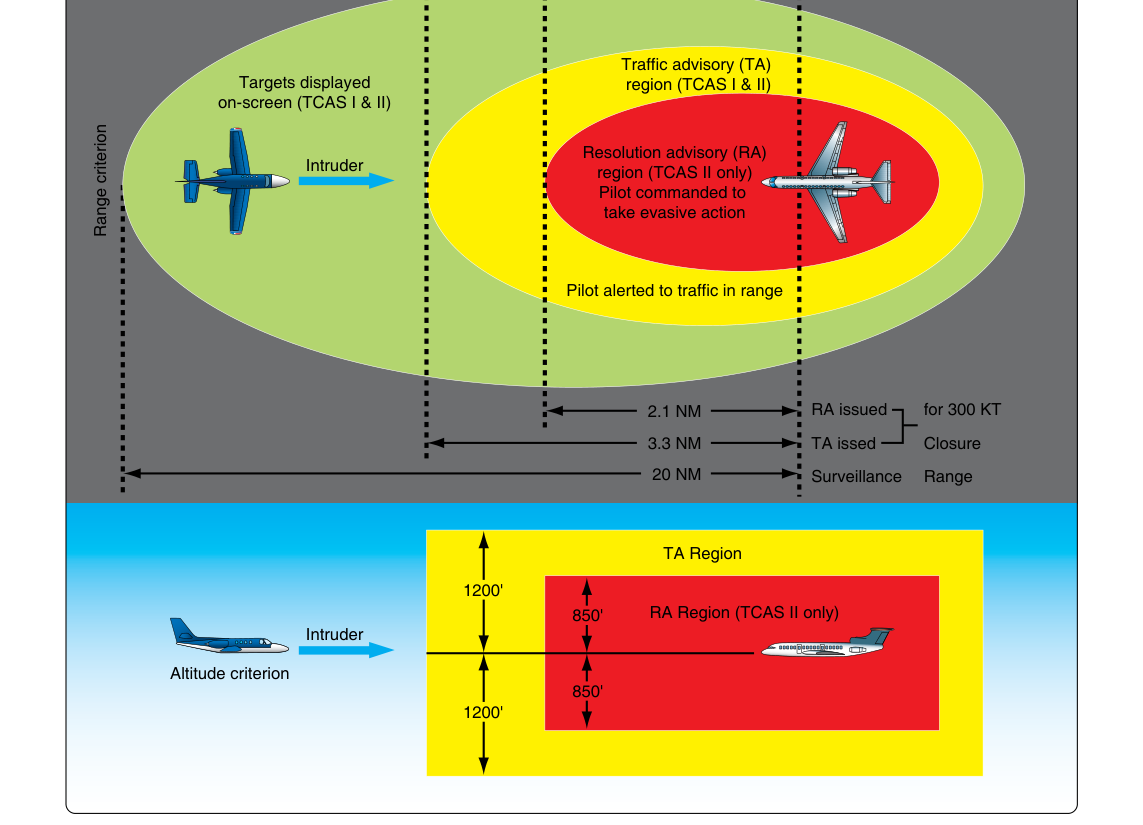
The Traffic Collision Avoidance System II (TCAS II) stands as one of the most consequential safety layers in modern air transport operations. Mandated by 14 CFR Part 121 for most turbine-powered transport-category aircraft operating in U.S. airspace, TCAS II functions entirely independent of the ATC system. It interrogates the Mode C or Mode S transponders of nearby aircraft, builds a real-time picture of surrounding traffic, and—when a collision threat is detected—issues direct vertical guidance to the flight crew without waiting for a controller instruction. For ATP candidates, the system's Resolution Advisory (RA) logic is a high-priority knowledge area that appears on the ATP Airplane Knowledge Test and, more importantly, governs life-safety decisions in the cockpit.
How TCAS II Detects and Classifies Threats
TCAS II uses a 1030 MHz interrogation signal to query Mode C and Mode S transponders in surrounding airspace. Replies on 1090 MHz provide range, bearing (Mode S only), and altitude data. The system then computes each intruder's tau—a time-based parameter representing the estimated seconds until closest point of approach (CPA) in both range and altitude. Tau is not a fixed distance; it is a computed time that adapts dynamically to closure geometry, making it more reliable across a wide range of encounter scenarios than a simple proximity boundary.
Based on tau values and the aircraft's own altitude, TCAS II classifies threats into two escalating categories. A Traffic Advisory (TA) is generated when an intruder's range tau reaches roughly 35–48 seconds (the exact threshold is altitude-sensitive, defined in the TCAS II Minimum Operational Performance Standards). A TA activates the amber TRAFFIC aural alert and displays the intruder as a filled amber circle on the traffic display. It is a preparation cue—the crew should look outside, clear the airspace visually, and be ready to maneuver—but no specific vertical maneuver is commanded. If the intruder continues to close and the vertical tau drops to approximately 15–35 seconds (again, altitude-dependent), the system escalates to a Resolution Advisory (RA), commanding an explicit vertical response.
Types of Resolution Advisories
Corrective RAs
A corrective RA requires the crew to deviate from the current vertical flight path. Classic examples include Climb, Climb, Climb and Descend, Descend, Descend, issued when the aircraft is in level flight or moving in the wrong direction. Corrective RAs also include Increase Climb or Increase Descent, which appear when the system determines the initial rate of response is insufficient to achieve the required vertical separation—typically 300 feet at CPA. These strengthened advisories demand the crew increase their vertical speed to approximately 2,500 feet per minute or more.
Preventive RAs
A preventive RA does not demand a deviation but restricts the crew from entering a particular vertical rate range that would create a conflict. Examples include Do Not Climb, Do Not Descend, and Maintain Vertical Speed, Maintain. A preventive RA may occur even when the aircraft is already in a benign state—for instance, in level cruise—if the geometry of the approaching traffic makes any vertical excursion dangerous. Preventive RAs are easy to underestimate precisely because they feel passive; the correct response is nonetheless mandatory compliance.
Cockpit Annunciation
All RAs are annunciated both aurally and visually. The vertical speed indicator (VSI) or Primary Flight Display (PFD) depicts a green arc showing the commanded vertical speed range and a red arc marking the vertical speeds to avoid. The crew's task is straightforward: maneuver promptly to place the VSI needle inside the green arc and keep it out of the red arc until the RA clears. Aural callouts are designed to be unambiguous—Climb, Climb, Climb or Descend, Descend, Descend—so the verbal message reinforces the visual display. FAA guidance found in the Aeronautical Information Manual (AIM) Chapter 4 emphasizes that pilot response should begin immediately upon RA issuance.
Coordination Between TCAS II-Equipped Aircraft
When two TCAS II aircraft are converging, their onboard computers communicate directly via the 1030/1090 MHz datalink using a protocol specified in the TCAS II MOPS. This air-to-air coordination, which occurs automatically in milliseconds, guarantees that the two aircraft receive complementary advisories—if Aircraft A is commanded to climb, Aircraft B is simultaneously commanded to descend. Neither flight crew needs to know what the other aircraft is doing; the coordination is handled at the system level.
If conditions change mid-encounter—for example, one crew responds too slowly—the system can issue a sense reversal, commanding the opposite vertical direction. A sense reversal is announced with a specific callout such as Climb, Climb NOW or Descend, Descend NOW. Crews must react to sense reversals with the same immediacy as the original RA, even though the commanded direction has just flipped. Delayed recognition of a sense reversal is a documented hazard.
TCAS II Priority Over ATC Instructions
A foundational regulatory and operational point: during an active RA, the flight crew must follow the RA, even if the RA conflicts with an ATC clearance. This is explicitly addressed in the AIM and is consistent with the intent of 14 CFR 91.123, which generally requires compliance with ATC instructions but recognizes the authority of the pilot in command to deviate as necessary to meet an emergency or safety-critical situation. ATC controllers do not have real-time awareness of TCAS RA logic and may issue a conflicting instruction during an encounter—the correct action is to comply with the RA, deviate from the ATC clearance, and notify ATC as soon as practicable. After the RA clears, the crew must promptly report the deviation to ATC and, if required, file a report under 14 CFR 91.123(b).
Performance Standards and Response Timing
- Initial RA response: The crew should begin vertical maneuvering within approximately five seconds of the RA onset to achieve the modeled separation at CPA.
- Target vertical speed: Standard corrective RAs typically target 1,500 feet per minute; strengthened advisories (Increase Climb/Descent) target approximately 2,500 feet per minute or higher.
- Required separation: TCAS II is designed to provide a minimum of 300 feet of vertical separation at CPA under normal response conditions.
- TA range tau: Approximately 35–48 seconds, altitude-dependent.
- RA range tau: Approximately 15–35 seconds, altitude-dependent.
- System coverage: TCAS II surveillance typically extends to roughly 30–40 nautical miles laterally depending on conditions, with the RA/TA decision logic acting within a much smaller volume, and vertical surveillance of approximately ±10,000 feet under nominal conditions.
Operational Limitations
TCAS II has important limitations that every ATP candidate must know. First, the system addresses the vertical dimension only—it never commands lateral turns or heading changes. This distinguishes TCAS II from the conceptual TCAS III, which has been studied but not fielded. Second, TCAS II can only interrogate aircraft equipped with operating Mode C or Mode S transponders. An intruder with a failed or disabled transponder, or one operating only Mode A (no altitude), may generate a TA without an RA because altitude data is unavailable to compute vertical tau. Third, TCAS II performance degrades near terrain that reflects interrogation signals and in very high-traffic-density environments where transponder garbling can occur.
Common Test Traps
- TAs are not maneuver commands: A Traffic Advisory is a situational awareness cue only. No specific vertical or lateral maneuver is required by a TA—only visual scanning and preparation.
- ATC vs. RA priority: ATC instruction does not override an active RA. The exam frequently presents a scenario in which ATC commands the opposite vertical direction during an RA; the correct answer is always to comply with the RA.
- Vertical guidance only: TCAS II provides no lateral guidance. Confusing TCAS II with a system that commands turns is a recurring error, as is conflating TCAS I (TAs only, no RAs) with TCAS II.
- Sense reversals: Students sometimes believe the first RA command is permanent. The system can reverse sense mid-encounter; compliance must be immediate and in the newly commanded direction.
- Post-RA ATC notification: After an RA clears, the crew must notify ATC of the deviation. This step is frequently omitted in scenario-based test answers.
- Transponder dependency: TCAS II only generates RAs against transponder-equipped aircraft reporting altitude. Non-altitude-reporting traffic may produce a TA but not an RA.
Memory Aid
Use "Green means go, red means no" to reinforce the VSI/PFD display logic during any active RA: maneuver to keep the vertical speed needle in the green arc and entirely out of the red arc until the advisory clears.