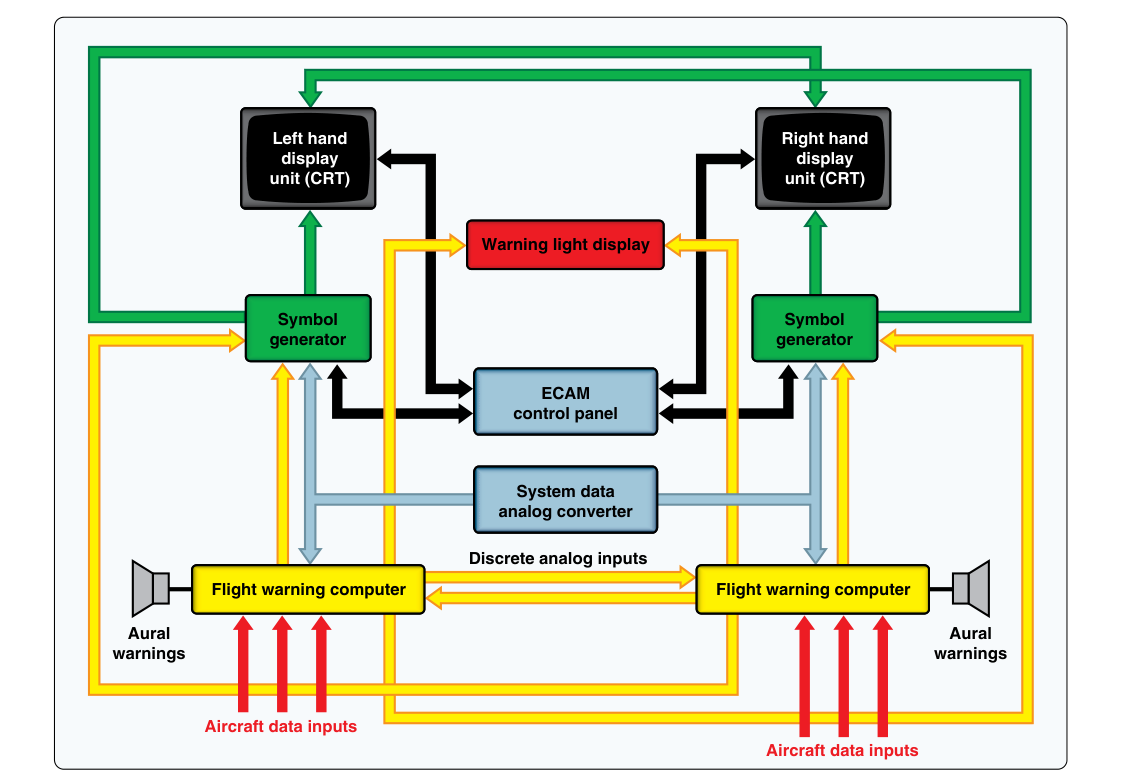
Modern transport-category aircraft are extraordinarily complex machines, with engines, hydraulics, electrical networks, pressurization, flight controls, fuel systems, and dozens of other subsystems all demanding simultaneous attention. Long before electronic monitoring systems existed, flight engineers occupied a dedicated station to interpret rows of analog gauges and warning lights. The arrival of Electronic Centralized Aircraft Monitor (ECAM) and the Engine Indication and Crew Alerting System (EICAS) effectively transferred that function to integrated digital displays, dramatically reducing crew workload while improving situational awareness. For ATP candidates, understanding the architecture, alert philosophy, inhibit logic, and practical cockpit implications of these two systems is essential—not only for the written knowledge test but for the oral and checkride environment where examiner questions dig deep.
What ECAM and EICAS Actually Are
Both systems belong to the broader category of Electronic Flight Instrument Systems (EFIS) and centralized aircraft monitoring technology, but they evolved independently through different manufacturer philosophies.
EICAS — Boeing and Others
EICAS was introduced on the Boeing 757/767, which entered service in the early 1980s, and has since become standard on Boeing wide-body and narrow-body transport aircraft. A classic EICAS installation uses two dedicated display screens. The upper EICAS display presents primary engine parameters—engine pressure ratio (EPR) or fan speed (N1) depending on engine type, N2 (and N3 on three-spool engines), engine gas temperature (EGT), fuel flow, and oil pressure and quantity—along with all crew alerting messages. The lower EICAS display shows secondary engine data and additional system synoptic information: hydraulic system quantity and pressure, electrical bus status, cargo and cabin pressurization, and landing gear position indications. On some Boeing variants, a compact display mode allows primary engine data to appear in a reduced format, freeing screen real estate for other information.
If a display fails, EICAS incorporates a display switching logic that allows the remaining screen to show either primary or secondary data, and on many aircraft a third display can serve as a backup. The system continuously monitors sensor data and compares values to defined limits stored in the aircraft's software to generate alerts.
ECAM — Airbus Philosophy
Airbus developed ECAM independently, first introducing it on the A310, and has refined it through successive aircraft families including the A320, A330, A340, A350, and A380. The ECAM architecture uses an Engine/Warning Display (E/WD) at the top and a System Display (SD) below. The E/WD presents primary engine parameters (N1/EPR, EGT, N2, fuel used, fuel flow) and all warning and caution messages. The SD continuously cycles through or selects synoptic pages—hydraulic, electrical, pressurization, fuel, flight controls, and others—giving the crew a schematic view of system status.
The most operationally significant difference between ECAM and EICAS is ECAM's automatic procedure display capability. When the system detects an abnormality, it does not merely alert the crew—it presents a color-coded, step-by-step checklist directly on the E/WD. Completed items are checked off electronically, and the system confirms when each step is done, shifting some cognitive workload from memory recall to monitored procedure execution. EICAS on many aircraft interfaces with a separate electronic checklist system to achieve similar functionality, but the integration is generally less tightly coupled than on Airbus platforms.
The Tiered Alert Hierarchy
Both systems use a three-level alert priority structure that ensures the most safety-critical conditions are never buried beneath routine information. Understanding the distinction between each level is heavily tested on the ATP knowledge exam.
- Warning (Red — Level 3): Represents an immediately hazardous condition requiring immediate crew action. Typical examples include engine fire, excessive cabin altitude, loss of all hydraulic systems, or an overspeed exceedance. (The specific cabin altitude threshold that triggers a warning is an aircraft-specific value defined in the type's AFM/FCOM and varies by aircraft.) On EICAS, warnings appear as red text messages on the upper display accompanied by an audible master warning tone (a repetitive chime or voice callout). On ECAM, a red alert triggers the flashing MASTER WARN light on both glareshields and a continuous repetitive chime (CRC). Memory items—immediate action items committed to memory through training—are typically required before consulting the displayed checklist for red-level events.
- Caution (Amber — Level 2): Indicates a condition that requires timely crew awareness and corrective action but is not immediately catastrophic. Examples include a single generator failure, low hydraulic fluid quantity, or a bleed air fault. A single chime and the MASTER CAUT light (amber) accompany these alerts. Action can generally be deferred briefly to a non-critical phase of flight before working the associated checklist.
- Advisory or Status (White or Cyan — Level 1): Informational messages indicating a degraded system mode or a maintenance-relevant condition. These do not demand immediate action and often appear without any audible alert. Status messages on ECAM, for example, list system limitations or inoperative items that affect dispatch or subsequent flight planning. Crews must evaluate status messages before or after flight as part of the minimum equipment list (MEL) review process.
Inhibit Logic — Protecting the Critical Phases
One of the most sophisticated—and most frequently tested—aspects of both systems is their alert inhibit logic. The principle reflects a well-established human factors truth: during the highest-workload phases of flight, an avalanche of non-critical alerts can distract the crew from flying the aircraft and actually reduce safety.
On a typical EICAS/ECAM-equipped aircraft, inhibit windows activate during two key phases:
- Takeoff inhibit: Generally begins around 80 knots and extends to a set altitude or time after liftoff (commonly cited as approximately 400 feet AGL on many types). These specific speed and altitude values are defined in the aircraft's type-specific FCOM/AFM and vary between manufacturers and models; 80 knots itself is unrelated to V1 or other takeoff decision speeds. During this window, caution and advisory-level alerts are suppressed. The system still presents genuine emergency warnings—engine fire, GPWS/TAWS alerts, windshear alerts, and similar immediate-action events—because suppressing those would create a greater hazard than the distraction of the alert itself.
- Landing inhibit: Activates at an aircraft-specific altitude on approach (commonly cited as approximately 800 feet AGL on many types, though some aircraft use different values) and continues through touchdown and rollout. The same logic applies: non-critical cautions are held until the aircraft is safely on the ground and decelerating, at which point suppressed alerts are displayed for crew review.
Alerts that fired and were inhibited are not lost. On ECAM, a dedicated STATUS page retains any inhibited messages so the crew can review them after landing. EICAS similarly retains and displays held messages once the inhibit window closes. This ensures that no system anomaly—even a minor one—goes unreviewed; it is simply presented at a less critical moment.
Practical Cockpit and Operational Implications
Understanding ECAM and EICAS philosophically is only part of the picture. ATP candidates should appreciate how these systems integrate with standard operating procedures (SOPs):
- Immediate action (memory) items vs. checklist items: For the most critical warnings (engine fire, rapid decompression, etc.), crews are trained to accomplish specific memory items first—actions so time-critical that waiting to read a checklist could worsen the outcome. Once memory items are complete, the crew transitions to the ECAM/EICAS-displayed or paper QRH checklist to continue the procedure.
- Non-normal checklist philosophy: Many airlines using Airbus equipment follow an ECAM-driven non-normal checklist philosophy in which the pilot not flying (PNF/PM) reads and confirms ECAM actions while the pilot flying (PF) maintains aircraft control. This division of labor is fundamental to CRM in glass-cockpit transport operations.
- Display failures and degraded modes: If one EICAS display fails, switching logic consolidates essential data on the remaining screen. ECAM systems include similar backup display logic. ATP candidates should understand that a display failure does not disable the monitoring system itself—sensors continue operating and alerts remain available.
- ECAM procedures are guidance, not a substitute for training: While automatically generated ECAM checklists are valuable, crews must complete memory items before referring to them, and must exercise judgment when sensor failures produce spurious alerts—a scenario specifically addressed in type-specific training programs.
Key Numbers and Rules
- EICAS introduced on Boeing 757/767 — early 1980s; ECAM first on Airbus A310
- Takeoff inhibit: commonly around 80 knots to approximately 400 feet AGL (aircraft-specific FCOM values)
- Landing inhibit: commonly around 800 feet AGL through rollout (aircraft-specific FCOM values)
- Red alerts — immediate action required, master warning, CRC on ECAM
- Amber alerts — timely action required, master caution, single chime
- White/cyan status — informational, no audible alert, review before or after flight
- Inhibited alerts are stored and displayed after the inhibit window closes — no alert is permanently suppressed
Common Test Traps
- ECAM ≠ EICAS: They are not interchangeable. ECAM is Airbus; EICAS is Boeing and others. Exam questions often test platform-specific knowledge.
- All emergency warnings still sound during inhibit windows. Inhibit logic only suppresses non-critical cautions and advisories. Engine fire, windshear, and GPWS warnings always annunciate.
- A caution is NOT a warning. Confusing these two levels misrepresents the urgency of the condition and can lead to both wrong written-test answers and dangerous real-world complacency.
- Inhibited alerts are not erased. They are stored for post-inhibit review. A student who thinks an inhibited alert disappears permanently misunderstands the system's safety intent.
- ECAM procedure checklists do not eliminate memory items. Immediate action items must still be performed from memory before the ECAM procedure is followed.