What Is Cabin Pressurization?
Pressurization is the process of maintaining the air inside a transport aircraft's fuselage at a pressure higher than the ambient outside pressure at cruise altitude. At 35,000 feet, ambient pressure is roughly one-quarter of sea-level pressure — far too low to sustain human consciousness for more than a few minutes without supplemental oxygen. By continuously pumping conditioned air into the fuselage and precisely regulating how quickly that air leaks out, pressurization systems allow the crew and passengers to breathe normally and comfortably without oxygen masks during the vast majority of flight operations.
The key metric is cabin altitude — the equivalent pressure altitude inside the cabin. If the cabin altitude is 6,000 feet, the occupants feel as though they are sitting at a field that is 6,000 feet above sea level, even though the aircraft may be cruising at flight level 350. Understanding how to monitor and control cabin altitude is a core skill for every transport category flight crew member.
How the Pressurization System Works
Bleed Air Source
Most transport aircraft obtain pressurization air from engine bleed air — hot, high-pressure air tapped from one or more compressor stages of each turbofan engine. This air is cooled and conditioned through the environmental control system (ECS) before entering the cabin. Some modern aircraft (most notably the Boeing 787) use electric compressors instead of engine bleed air, but the control concepts remain the same. Auxiliary power units (APUs) can also supply bleed air on the ground or as a backup in flight.
The Outflow Valve
The critical pressure-regulating component is the outflow valve (sometimes called the cabin pressure controller valve). It is typically located near the aft pressure bulkhead. By modulating — opening and closing — the outflow valve, the pressurization controller precisely manages how fast conditioned air escapes the fuselage. When the valve opens wider, more air leaves and cabin altitude rises. When it closes, air accumulates and cabin altitude falls. Safety relief valves supplement the outflow valve by preventing over-pressurization (positive pressure relief) and negative differential pressure (negative pressure relief).
Differential Pressure (ΔP)
Differential pressure (ΔP or diff press) is the difference between cabin pressure and ambient outside pressure. It is expressed in pounds per square inch (PSI) or inches of mercury. Transport category aircraft are designed to a maximum differential pressure — commonly in the range of 8 to 9 PSI for many narrowbody jets, though exact limits vary by type. Exceeding the maximum ΔP places structural stress on the fuselage skin and pressure bulkheads. Conversely, allowing cabin altitude to become too high reduces the partial pressure of oxygen available to occupants, leading to hypoxia.
Automatic vs. Manual Pressurization Control
Most transport aircraft use a dual-channel automatic pressurization controller. The crew inputs the destination field elevation and, on some aircraft, the cruise altitude. The automatic system then schedules a smooth, comfortable cabin altitude climb and descent profile. During climb, the cabin altitude rises gradually, usually reaching a cruise cabin altitude of 6,000–8,000 feet. During descent, the controller schedules the cabin to arrive at destination field elevation before or at landing so no pressure bump is felt on the ground.
Manual pressurization control is available as a backup. The pilot manually positions the outflow valve using a switch, and must directly monitor the cabin altitude gauge, cabin rate-of-change indicator, and differential pressure gauge. The checklist will specify a target cabin climb/descent rate — typically no more than 300–500 feet per minute of cabin altitude change to ensure passenger comfort.
Regulatory Requirements and Oxygen Thresholds
14 CFR 25.841 requires that the cabin pressure altitude not exceed 8,000 feet at the maximum operating altitude of the airplane under normal operating conditions — this is a design and certification requirement, not a blanket operational limit that applies at all times. 14 CFR Part 121 (air carrier operations) sets the operational oxygen requirements:
- Above FL 250 (25,000 feet): Each pilot at the controls must have quick-donning oxygen masks immediately available that can be donned in 5 seconds with one hand while wearing corrective lenses.
- Above FL 350: One pilot must wear and use an oxygen mask at all times, unless both pilots are wearing masks. (One exception: under 121.333(c)(1), one pilot may be without a mask below FL 350 if two qualified pilots are at the controls and each has a quick-donning mask immediately available.)
- Cabin altitude above 10,000 feet (up to 14,000 feet): Flight attendants and at least 10% of passengers must be supplied supplemental oxygen for the time at those altitudes exceeding 30 minutes.
- Cabin altitude above 15,000 feet: Each occupant must be provided supplemental oxygen.
Under 14 CFR 91.211 (unpressurized Part 91 operations, based on aircraft/pressure altitude rather than cabin altitude), required minimum flight crew must use supplemental oxygen for that part of the flight above 12,500 feet MSL up to and including 14,000 feet MSL lasting more than 30 minutes, and at all times above 14,000 feet MSL; above 15,000 feet MSL, each occupant of the aircraft must be provided supplemental oxygen. Transport category operations under Part 121 apply separate standards under 121.333 based on cabin altitude and the aircraft's certification oxygen system capacity.
Time of Useful Consciousness (TUC)
A critical safety concept linked to pressurization is Time of Useful Consciousness (TUC), also called Effective Performance Time. TUC is the interval between exposure to an inadequate oxygen environment and the point at which a pilot can no longer take meaningful corrective action. At 35,000 feet without supplemental oxygen, TUC is roughly 30–60 seconds. At 40,000 feet it can be as short as 15–20 seconds. This is why rapid donning of oxygen masks and immediate initiation of an emergency descent are both trained responses — there is no time to troubleshoot slowly.
Rapid Decompression vs. Slow/Insidious Decompression
Rapid (explosive) decompression involves a sudden, catastrophic failure — a structural breach, door seal failure, or window departure. The cabin pressure equalizes almost instantly with outside ambient pressure. Flight crew will experience fog from moisture condensation, a loud noise, and flying debris. Action is immediate: oxygen masks on, emergency descent initiated per the Quick Reference Handbook (QRH).
Slow (insidious) decompression is far more dangerous from a human factors standpoint. A small seal leak or partially failed outflow valve may allow cabin altitude to drift upward slowly over many minutes. The crew may not notice until the cabin altitude warning horn sounds (typically set to activate at 10,000 feet cabin altitude on most transport aircraft). Because hypoxia impairs judgment before it impairs consciousness, pilots may feel well while already being cognitively degraded. The warning horn and pressure gauges are the only reliable indicators — never ignore a slowly climbing cabin altitude.
Emergency Descent Profile
When a decompression event is confirmed, the standard response is an emergency descent to 10,000 feet (or the minimum safe/terrain clearance altitude if higher). The crew dons oxygen masks, declares an emergency with ATC, and descends at maximum allowable speed (typically Vmo/Mmo) with maximum drag configuration as appropriate per the aircraft's QRH. Descending from FL 350 to 10,000 feet at 4,000–6,000 fpm is a realistic target for many transport jets. Passenger oxygen systems (chemical generators or gaseous systems) supply approximately 12–22 minutes of flow, designed to last until the aircraft reaches a breathable altitude.
Pressurization System Indications and Monitoring
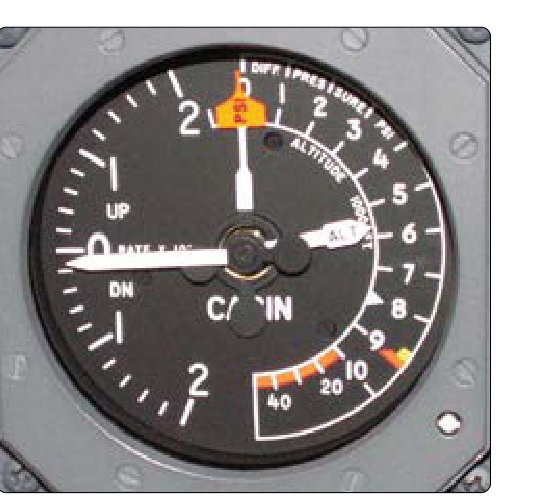
Flight crew must continuously monitor three primary pressurization instruments:
- Cabin Altitude Gauge: Shows the equivalent pressure altitude inside the fuselage. Normal cruise values are 6,000–8,000 feet.
- Cabin Rate-of-Change Indicator (Cabin Variometer): Shows how quickly cabin altitude is rising or falling in feet per minute. Should be smooth and comfortable — typically under 500 fpm during normal operations.
- Differential Pressure Gauge: Shows the pressure difference between cabin and ambient. Must not exceed the aircraft's maximum certified ΔP.
Many modern aircraft integrate these readouts into the Electronic Centralized Aircraft Monitor (ECAM) or Engine Indicating and Crew Alerting System (EICAS), with amber and red caution/warning messages triggered by abnormal values.
Memory Aid
A helpful way to remember the three pressurization instruments is CAD: Cabin altitude, Altitude rate (cabin rate of change), Differential pressure. Scan all three together just as you would scan the primary flight instruments — each one alone is incomplete, but together they give a full picture of pressurization health.
Preflight and Operational Considerations
Before every flight, crew must verify that the pressurization controller has the correct destination field elevation programmed (or set manually), that oxygen system pressure is adequate, and that the aircraft passes a pressurization system check as specified in the aircraft flight manual (AFM). A missed destination elevation entry is a classic error — if the controller expects sea level but the destination is Denver (5,431 feet), the cabin could be above the target altitude at landing, causing a noticeable pressure bump and potentially a runway exceedance of normal ΔP as the system corrects.
Common Test Traps
- Cabin altitude vs. aircraft altitude: Exam questions often swap these. The cabin altitude is what occupants experience; the aircraft altitude is where the airplane is. At FL 350 with a cabin altitude of 7,000 feet, differential pressure is the difference — not the aircraft's altitude minus 7,000 feet in the simplistic sense, but the actual pressure difference in PSI.
- The 10,000-foot oxygen trigger: Many candidates confuse the 10,000-foot cabin altitude threshold (oxygen required) with the 12,500-foot flight altitude thresholds in Part 91. For Part 121 passenger operations, 10,000 feet cabin altitude is the key number.
- Time of Useful Consciousness shortens with altitude: TUC at 25,000 feet is several minutes; at 40,000 feet it may be 15–20 seconds. Do not confuse these — higher altitude means drastically shorter TUC.
- One pilot above FL 350: The rule requires one pilot to wear an oxygen mask at all times above FL 350 unless both are wearing masks; the exception under 121.333(c)(1) for one pilot to be without a mask applies below FL 350, not FL 410.
- Positive vs. negative relief valves: Positive relief valves prevent over-pressurization (cabin pressure too high relative to outside). Negative relief valves prevent the outside pressure from exceeding cabin pressure (negative differential), which can occur during a rapid descent. Both are passive and automatic — the crew does not control them directly.