Every pilot who has flown cross-country knows the fatigue of holding steady back-pressure for an hour or more. Trim systems exist to eliminate that workload, allowing the pilot to "dial in" a hands-off equilibrium for a given flight condition. For the aviation maintenance technician (AMT) working on airframes, trim systems are equally important: they are flight-critical components whose correct rigging, adjustment, and inspection directly affect aircraft controllability and airworthiness. This article covers the three principal types of aerodynamic trim devices — trim tabs, servo tabs, and anti-servo tabs — explaining how each works, why it matters, and what the FAA knowledge test expects you to know.
All three devices are small, hinged surfaces attached to the trailing edge of a primary control surface (elevator, rudder, or aileron). Despite their modest size, they generate meaningful aerodynamic moments that either assist the pilot, replace direct pilot effort, or deliberately resist it. Understanding the differences among them is foundational to both maintenance practice and airframe written-test success.
Trim Tabs
The conventional trim tab is the most common aerodynamic trim device in general aviation. It is a small hinged panel mounted at the trailing edge of a primary control surface and is moved independently of that surface. When the pilot rotates the elevator trim wheel in the cockpit, a mechanical linkage (cable, push-pull rod, or jackscrew) deflects the trim tab — and the trim tab moves in the opposite direction to the desired control-surface motion.
Here is why: deflecting the trim tab downward increases the camber on the lower side of the elevator trailing edge, generating a local aerodynamic force that pushes that portion of the elevator upward. The elevator as a whole pivots trailing-edge-up, producing nose-up pitch. The trim tab has essentially redirected aerodynamic energy to hold the control surface in the desired position without the pilot exerting any continuous force. Once set, the trim tab generates exactly enough hinge moment to balance the aerodynamic load trying to return the elevator to neutral.
A critical maintenance point: because the trim tab moves opposite to the control surface, rigging checks must verify this relationship explicitly. A reversed trim cable is one of the most dangerous rigging errors possible — nose-up trim input would produce nose-down pitch, which could be catastrophic at rotation or during go-around. 14 CFR Part 43 maintenance records must document any rigging work, and a functional check must confirm proper direction of travel before return to service.
Trim Tab Construction and Inspection
Trim tabs are typically constructed of aluminum alloy sheet, though composite materials are used on newer designs. They attach to the primary surface via a hinge line and are driven by a dedicated actuator separate from the main control circuit. Inspections focus on: hinge condition and security, absence of excessive play (which causes flutter), proper travel limits (verified against the Aircraft Flight Manual or Type Certificate Data Sheet), smooth actuation without binding, and security of the actuator attach fitting. Surface damage, corrosion, or delamination of a composite tab can alter its aerodynamic balance and trigger flutter — a potentially destructive oscillation that can destroy a control surface in seconds.
Servo Tabs (or Flying Tabs)
A servo tab — sometimes called a flying tab — takes a fundamentally different approach. Instead of the pilot directly moving the primary control surface through cables or pushrods, the pilot's control input moves only the small servo tab. The aerodynamic force generated by that tab then drives the larger primary control surface to the appropriate position. In other words, the primary surface is aerodynamically powered by the tab rather than by direct mechanical linkage to the pilot.
The practical benefit is a dramatic reduction in cockpit control forces, which made servo tabs popular on large transport-category and early jet-era aircraft where the aerodynamic loads on large surfaces would otherwise require unacceptably high stick forces. On these aircraft, the tab bears the primary control load; the control surface effectively floats to the angle the tab dictates.
The maintenance implication is significant: because the primary surface is not directly connected to the cockpit controls (except through the tab linkage), correct rigging of the tab-to-surface relationship is everything. If a servo tab linkage fails, the pilot may have no aerodynamic authority over that surface. Aircraft using servo tabs therefore require careful attention to linkage integrity, bearing condition, and travel limits. Ground functional checks must confirm that cockpit input produces the correct tab deflection and, consequently, the correct primary surface movement.
Servo tabs are less common on modern fly-by-wire designs, but they remain present on many older large aircraft still in service, making familiarity with them essential for AMTs working MRO environments.
Anti-Servo Tabs
The anti-servo tab moves in the same direction as the primary control surface, which is the exact opposite of a conventional trim tab. Because it deflects with the surface rather than against it, it generates an aerodynamic force that opposes the surface deflection — adding artificial feel and resistance to control inputs rather than reducing them.
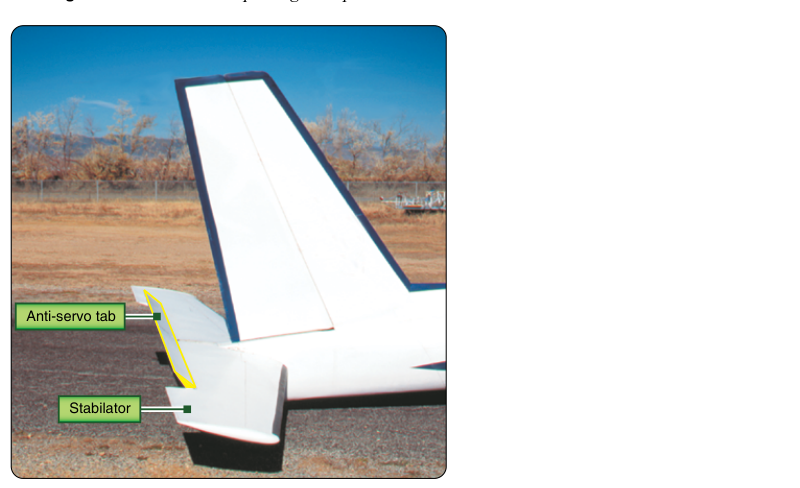
Why would a designer want to make controls feel heavier? The answer lies in aircraft with all-moving (stabilator) horizontal tail surfaces, most famously the Piper Cherokee family and similar designs. A stabilator pivots as a single unit; because the entire surface moves, it is extremely powerful and aerodynamically sensitive. Without an opposing force, even small pilot inputs can produce large, abrupt pitch changes, and the surface can tend to over-travel or feel dangerously light. The anti-servo tab provides the necessary artificial feel gradient, giving the pilot progressive resistance proportional to deflection — similar to what a conventional fixed stabilizer/elevator arrangement provides naturally through the hinge moment of the separate elevator.
On many stabilator designs, the anti-servo tab simultaneously serves a trim function: the pilot's trim input shifts the neutral position of the tab, thereby shifting the equilibrium position of the stabilator and trimming the aircraft longitudinally — just like a conventional trim tab, but via the anti-servo mechanism.
Maintenance Considerations for Anti-Servo Tabs
Because the anti-servo tab is essential to providing safe control feel on stabilator-equipped aircraft, any discrepancy in its rigging is a serious airworthiness concern. If the tab is incorrectly rigged to move opposite the stabilator (converting it functionally into a conventional trim tab), control forces could become dangerously light, leaving the pilot with an over-sensitive pitch control. AMTs must verify direction of travel against the manufacturer's Maintenance Manual and Aircraft Flight Manual. As with all tabs, hinge play, balance, and surface integrity inspections are mandatory during 100-hour and annual inspections per 14 CFR Part 43, §43.15 and the scope and detail items of Appendix D.
Why Trim Systems Matter for Airworthiness
Trim systems affect two fundamental airworthiness qualities: controllability (the ability to maneuver the aircraft) and stability (the tendency to return to equilibrium). A mis-rigged trim tab can shift the aircraft's trim speed, increasing workload or masking a dangerous out-of-trim condition. In extreme cases — such as a jammed elevator trim in the full nose-down or full nose-up position — a trim system failure can be catastrophic if not caught during preflight. This is why trim system checks are explicitly listed in most normal checklists and why rigging is strictly governed by manufacturer data and 14 CFR.
Flutter is the other major hazard. Any hinge looseness, excess play in control system bearings, or surface imbalance can allow a tab or control surface to enter flutter at certain airspeeds. Flutter begins as a rapid oscillation that can grow exponentially and destroy a surface in a matter of seconds. Proper mass balance of control surfaces and tabs, verified after any repair, is a non-negotiable airworthiness requirement addressed in the Aircraft Maintenance Manual and FAA guidance.
Key Numbers and Rules
- Direction of travel — trim tab: moves opposite to the primary control surface to relieve pilot control forces.
- Direction of travel — servo tab: moves opposite to the primary surface (like a trim tab), but the pilot input drives the tab rather than the surface directly.
- Direction of travel — anti-servo tab: moves in the same direction as the primary surface, increasing control resistance and providing feel.
- Travel limits: always verified against the Type Certificate Data Sheet (TCDS) or Aircraft Flight Manual; deviations require re-rigging before return to service.
- Rigging authority: 14 CFR Part 43 governs maintenance; all rigging adjustments must be recorded in maintenance records per 14 CFR §43.9.
- Functional check: required after any rigging change — confirm correct direction of cockpit-to-surface travel, full range of motion, and absence of binding or excessive play.
- Flutter prevention: control surface and tab balance must be restored after any repair involving surface material addition or removal; rebalance per manufacturer data.
Common Test Traps
- Confusing servo and trim tabs: Both move opposite to the primary surface, but on a servo tab the pilot input goes to the tab, not the surface. The exam may describe the control linkage arrangement to distinguish them — read carefully.
- Anti-servo tab direction: Students consistently misremember this. Anti-servo tabs move WITH the primary surface, not against it. "Anti" refers to the force produced (opposing deflection), not the direction of tab movement.
- Reversed rigging scenario: A question may describe a symptom (trim produces opposite pitch effect) and ask for the cause — a reversed trim cable or incorrect tab linkage attachment is the answer.
- Servo tab failure mode: Because there is no direct mechanical link between the cockpit and the primary surface on a servo-tab system, a tab linkage failure means loss of that control axis — not just loss of trim.
- Hinge play and flutter: Excessive hinge play is not merely a maintenance defect to note — it is a flutter risk requiring immediate corrective action before flight. The test expects you to know that any out-of-tolerance play is an airworthiness concern, not a "monitor and re-inspect" item.