Part 107 Airspace, LAANC, and Authorizations Explained
By Aviation Test Prep Team · · Updated
Part 107 Airspace, LAANC, and Authorizations Explained
If you're preparing for your Part 107 airspace knowledge test, few topics carry more weight — or cause more confusion — than understanding where you can legally fly your drone, when you need an authorization, and how the Low Altitude Authorization and Notification Capability (LAANC) system fits into the picture. Whether you're studying for the UAG exam for the first time or renewing your Remote Pilot Certificate, this guide breaks down every airspace class, explains the LAANC process step by step, and shows you how to stay compliant in the field.
📖 Studying for the written test? See the full reference in our library: Airspace Authorization Under Part 107 and LAANC →
Why Part 107 Airspace Rules Matter So Much
The FAA designed Part 107 to integrate small unmanned aircraft systems (sUAS) safely into the National Airspace System (NAS). Because drones share the sky with manned aircraft — including airliners descending into busy airports — the rules about Part 107 airspace authorization exist to protect everyone. Violating airspace restrictions isn't just a test-day problem; in the real world it can result in certificate revocation, civil penalties, or worse.
The FAA's Airspace Classification System divides U.S. airspace into six classes — A, B, C, D, E, and G — plus special use airspace. As a remote pilot, your operational decisions depend heavily on which class surrounds your planned flight area and what altitude that class begins.
A Quick Tour of the Six Airspace Classes
Class A
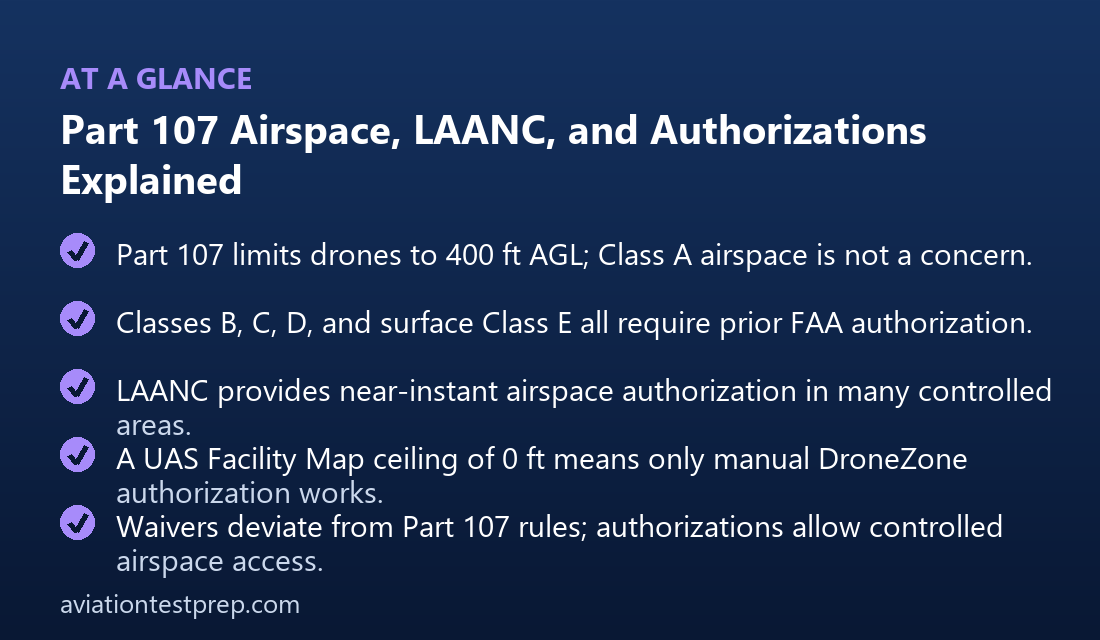
Class A airspace extends from 18,000 feet MSL to FL600. Because Part 107 limits drone operations to a maximum altitude of 400 feet AGL (with some exceptions near structures), you will essentially never operate in Class A. No authorization is available or needed for this class under normal sUAS operations.
Class B
Class B surrounds the nation's busiest airports and is depicted on sectional charts as solid blue lines arranged in an upside-down wedding-cake shape. Operating in Class B airspace requires prior FAA authorization. LAANC can provide that authorization automatically in many Class B locations, but the drone pilot must receive a specific authorization before flight — not just a notification.
Class C
Class C airspace surrounds airports with an operational control tower and a significant amount of instrument traffic. It typically extends from the surface to 4,000 feet AGL and has an outer ring to 20 nautical miles. Like Class B, you need prior authorization to fly in Class C, and LAANC covers many of these locations.
Class D
Class D airspace exists around airports with an operating control tower that don't meet Class C or B criteria. It generally extends from the surface to about 2,500 feet AGL. Part 107 remote pilots need authorization to fly in Class D — again, often obtainable via LAANC.
Class E
Class E is controlled airspace that isn't Class A, B, C, or D. It begins at various altitudes depending on location — sometimes 700 feet AGL, sometimes 1,200 feet AGL, and in some areas at the surface (depicted with a dashed magenta line). Surface-level Class E requires authorization just like the tower-controlled classes. Class E that begins above 700 feet AGL does not require authorization for Part 107 flights below that floor, but pilots must still be aware of the floor altitude.
Class G
Class G is uncontrolled airspace. In most of the country it extends from the surface up to 700 or 1,200 feet AGL (where Class E begins). No FAA authorization is required to fly in Class G, making it the most operationally flexible environment for drone pilots. That said, all other Part 107 rules — altitude limits, visual line of sight, right-of-way, etc. — still apply.
Special Use and Other Restricted Areas
Beyond the six classes, remote pilots must also respect:
- Prohibited Areas (e.g., P-56 over the White House) — flight is forbidden under any circumstances.
- Restricted Areas — flight requires permission from the controlling agency during active hours.
- Temporary Flight Restrictions (TFRs) — issued for events, disasters, or VIP movements; check NOTAMs before every flight.
- Stadiums and Sporting Events — Part 107 prohibits drone operations within 3 nautical miles of certain stadiums during specific events without a waiver.
- National Security Areas (NSAs) and MOAs — military operations areas require extra vigilance and may carry their own restrictions.
Always cross-reference the FAA's B4UFLY app and the FAA DroneZone before launching to check for active TFRs and overlapping restrictions.
What Is LAANC and How Does It Work?
The Low Altitude Authorization and Notification Capability (LAANC) is a collaborative program between the FAA and approved UAS Service Suppliers (USS). It automates the process of requesting and receiving airspace authorization for flights in controlled airspace below certain altitude ceilings.
Before LAANC existed, remote pilots had to submit a manual authorization request through the FAA DroneZone and wait days or even weeks for a response. LAANC compresses that timeline to seconds in most cases. Here's how the process works:
- Open a LAANC-enabled app (such as Aloft, Kittyhawk, or another FAA-approved USS provider).
- Plan your flight by drawing or selecting your operational area on the map.
- Review the UAS Facility Map (UASFM) ceiling for that grid square — this is the maximum altitude the FAA has pre-approved for automatic authorization in that area. Ceilings can range from 0 to 400 feet AGL.
- Request authorization through the app. If your requested altitude is at or below the UASFM ceiling, approval is typically near-instantaneous.
- Fly with your authorization — keep it accessible (digitally or printed) in case an FAA inspector or law enforcement officer asks.
If the UASFM ceiling for your location is 0 feet — meaning no automatic authorization is available — you must submit a manual FAA DroneZone request, which takes longer and requires a more detailed justification of your operation.
UAS Facility Maps: Reading the Grid
UAS Facility Maps are published by the FAA and are available through the FAA DroneZone and many third-party apps. Each grid square around a controlled airport has an assigned altitude ceiling that reflects the FAA's assessment of where sUAS traffic can safely operate without conflicting with manned aircraft approach and departure paths. Understanding how to read these maps is a core skill tested on the UAG knowledge exam.
Key points to remember:
- A ceiling of 0 feet means automatic authorization is unavailable — you must apply manually via DroneZone.
- Ceilings closer to the airport are generally lower; they increase as you move farther from the runway environment.
- LAANC authorization applies only to the altitude you requested — you cannot climb above it mid-flight without a new authorization.
Waivers vs. Authorizations: What's the Difference?
These two terms are sometimes confused, but they are legally distinct:
- An authorization allows you to fly in controlled airspace that would otherwise be off-limits. LAANC provides airspace authorizations automatically in many cases.
- A waiver allows you to deviate from a specific Part 107 operational rule — such as flying over people, flying at night (before the 2021 night rule update), or flying beyond visual line of sight. Waivers require a formal application through the FAA DroneZone and a detailed safety case. They are not the same as airspace authorizations.
Studying Part 107 Airspace for the UAG Exam
The FAA's Airspace Classification and LAANC system account for a significant portion of questions on the UAG knowledge test. Mastering this topic means being able to identify airspace classes from sectional chart symbols, determine when authorization is required, and understand the LAANC process end to end.
At Aviation Test Prep, our
Ready to pass your FAA written exam?