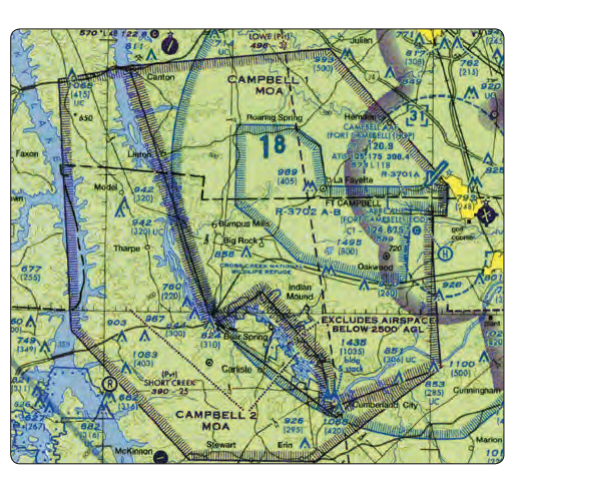
When you scan a sectional chart, you'll notice large shaded regions outlined in magenta or blue, often accompanied by names like "Tombstone MOA" or "Warning Area 291." Two of the most commonly encountered types of special-use airspace for the cross-country VFR pilot are Military Operations Areas (MOAs) and Alert Areas. Neither one automatically prohibits civilian flight, but flying through them uninformed is a genuine safety hazard. Understanding what happens inside these areas, when they are active, and how to get current status information is a practical skill that could save your life — and it's also a reliable topic on the FAA Private Pilot Knowledge Test.
This article covers both airspace types in depth: their definitions, chart depictions, altitude and time limits, ATC services (or lack thereof), and the step-by-step habits you should build before and during any flight that takes you near military airspace.
What Is a Military Operations Area?
A Military Operations Area is a block of airspace with defined vertical and lateral limits established to separate certain military activities from IFR traffic. The activities conducted inside an active MOA include air combat maneuvering, aerobatics, low-altitude tactics, formation flying, and high-speed intercepts. These are dynamic, often unpredictable maneuvers flown by high-performance aircraft whose pilots are heads-down on tactical tasks — not scanning for Cessnas.
On a VFR sectional chart, MOAs are depicted with a magenta dashed (segmented) boundary line. The name of the MOA and the word "MOA" appear inside the boundary. Adjacent to the area, a small box lists the defining altitudes (floor and ceiling) along with the hours of operation. Ceilings can extend up to but not including 18,000 feet MSL (Class A airspace begins there), and floors commonly start from the surface or as low as a few hundred feet AGL for low-level training. Always read the specific altitudes for each MOA because they vary enormously.
Active vs. Inactive MOAs
This is the crucial distinction most students overlook. VFR pilots are legally permitted to fly through an MOA at any time — there is no regulatory prohibition for VFR aircraft. However, the Aeronautical Information Manual (AIM) strongly advises pilots to avoid MOAs when they are active. The risk is real: military jets maneuvering at 400+ knots with limited see-and-avoid capability share the same airspace with you. When the MOA is inactive, it carries no more significance than ordinary airspace — you may transit freely.
The question, then, is always: Is this MOA active right now? The published hours of operation give you a starting point, but MOAs are frequently scheduled on an "other times by NOTAM" basis, meaning activity can be authorized outside published hours with little notice. The only reliable method is to contact the controlling agency directly. You can do this by calling the Flight Service Station (FSS) — accessible by dialing 1-800-WX-BRIEF — or by contacting the appropriate ARTCC (Air Route Traffic Control Center) frequency listed on the chart. You can also check NOTAMs during preflight planning. The controlling agency can tell you definitively whether the MOA is hot (active) or cold (inactive) and, if hot, can sometimes provide traffic advisories.
What Is an Alert Area?
An Alert Area is airspace that may contain a high volume of pilot training activity or an unusual type of aerial activity. Unlike MOAs, which are specifically tied to military tactical maneuvers, Alert Areas can encompass any location where an unusually high density of flight operations exists — including civilian flight training. A classic example is an area surrounding a busy flight academy where students practice maneuvers and touch-and-goes at all hours.
On a sectional chart, Alert Areas are depicted with a magenta boundary (similar to MOAs) and are labeled with the designation "A-" followed by a number (for example, "A-211"). The altitudes and hours may or may not be restricted; the key point is that all aircraft operating within an Alert Area — both military and civilian — share responsibility for collision avoidance. There is no controlling authority issuing advisories; it is purely a heads-up designation telling every pilot: watch out, this area is unusually busy.
Unlike Prohibited or Restricted Areas, Alert Areas impose no regulatory restrictions on any pilot. You are permitted to fly through them freely, but you are expected to do so with heightened vigilance. Alert Areas appear frequently around military airfields, parachute drop zones, and civilian aerobatic practice areas.
How MOAs and Alert Areas Compare
Both area types are classified as special-use airspace under FAA regulations and the AIM, yet they differ in important ways:
- Who uses them: MOAs are established specifically for military training. Alert Areas are established for any concentrated aviation activity, military or civilian.
- Regulatory impact on VFR pilots: Neither type prohibits VFR flight, but MOAs involve far more hazardous military maneuvering and should be avoided when active.
- Controlling authority: MOAs have a designated controlling agency you can contact for real-time status. Alert Areas have no controlling authority — awareness is the only tool.
- Chart depiction: MOAs use the label "MOA"; Alert Areas use the prefix "A-" with a number. Both use similar magenta dashed boundary styles on sectional charts.
- IFR traffic: ATC separates IFR aircraft from active MOAs, but provides no such separation from Alert Areas.
Key Numbers and Rules
- MOA floors often start at 1,200 feet AGL for low-level training, though specific altitudes vary — always check the chart legend box.
- MOA ceilings generally reach up to but do not include 18,000 feet MSL (where Class A begins).
- ATC separates IFR traffic from active MOAs but does not separate VFR traffic — VFR pilots are on their own.
- Alert Areas carry the designator "A-" followed by a number; they impose no flight restrictions.
- When transiting an active MOA VFR, the AIM advises contacting the controlling ARTCC or FSS to request traffic information and advisories.
- MOA status can change via NOTAM; published times alone are not conclusive — always verify before flight.
- Both MOA and Alert Area boundaries and altitudes are depicted on VFR sectional charts and low-altitude en route charts.
Practical Cockpit Habits
Good airspace management starts before you leave the ground. During preflight planning, identify every MOA and Alert Area along your route, note their published altitudes and hours, and determine the appropriate frequency or phone number to check status. During your weather brief with Flight Service, ask specifically whether any MOAs along your route are active. If you get into the cockpit and realize an MOA that was cold during planning has just gone hot via NOTAM, your options are to deviate around it, climb or descend out of its altitude band, or accept the risk — a risk the AIM explicitly cautions against.
In flight, if you're approaching an MOA and remain unsure of its status, contact the ARTCC on the frequency charted near the MOA boundary. Even if the controller cannot provide formal separation, they can advise you of known military activity and pass along traffic information. Keep your transponder on and your Mode C altitude encoding active; military controllers and pilots are better able to see and avoid a target that's squawking.
If you do transit an active MOA with ATC advisories, fly predictably — hold your altitude and heading as steadily as possible so radar returns are easy to track. Brief yourself on the exit point before entering so you're not fumbling with charts while jets streak past your wingtip.
Common Test Traps
- "MOAs prohibit VFR flight." False. VFR pilots may legally enter MOAs at any time; the danger is practical, not regulatory.
- Confusing MOAs with Restricted or Prohibited Areas. Restricted and Prohibited Areas do have regulatory teeth — unauthorized entry can violate federal regulations. MOAs and Alert Areas do not restrict entry.
- Assuming published hours are definitive. "Other times by NOTAM" is the catch. Always check NOTAMs and contact Flight Service or ARTCC for real-time status.
- Forgetting that ATC separates IFR — not VFR — from active MOAs. If you're VFR, ATC is not keeping you away from military jets. That responsibility is yours.
- Misreading the chart depiction. Knowing that Alert Areas start with "A-" and MOAs include the word "MOA" seems obvious, but under test pressure (and on busy sectional excerpts) students frequently mix them up with Warning Areas ("W-") or Restricted Areas ("R-").
Building solid airspace awareness around MOAs and Alert Areas is one of the marks of a truly prepared VFR pilot. These designations exist because the airspace is genuinely hazardous when active — treating them seriously, checking status before every flight, and maintaining extra vigilance in the cockpit will keep you and your passengers safe while the military trains the pilots who protect the skies you fly in.