A holding pattern is far more than a racetrack drawn on a chart. It is a precisely defined block of protected airspace, engineered to keep aircraft safely separated from terrain, obstacles, and other traffic while pilots await clearance to continue. That protection only works when every aircraft in the hold flies within the speeds and altitudes the pattern was designed for. Exceed those parameters and you may bust out of protected airspace without ever knowing it. Understanding the FAA's speed limits and altitude structure for holding patterns is therefore not just exam knowledge — it is the foundation of safe instrument flying.
This article covers the specific speed limits the FAA publishes for holding patterns at different altitude bands, why those limits exist, how altitude ties into the geometry of the pattern, and the practical cockpit techniques instrument pilots use to stay inside the protected zone every time.
Why Holding Pattern Geometry Depends on Speed
A holding pattern's protected airspace is calculated using the fastest aircraft that might legally fly that pattern. Engineers draw an oval "buffer zone" around the published inbound course, accounting for wind drift, pilot technique, and bank angle. When a faster aircraft turns at the same bank angle as a slower one, it traces a much wider arc. If real-world airspeed consistently exceeds the design speed, the wingtip of the turn-arc protrudes outside the protected zone — a situation that can place you closer to terrain or obstructions than the chart assumes.
This is the core reason the FAA publishes maximum holding airspeeds: they define the outer boundary of the oval that was drawn when the airspace was certified. Fly faster, and that oval no longer protects you.
The FAA's Published Holding Speed Limits
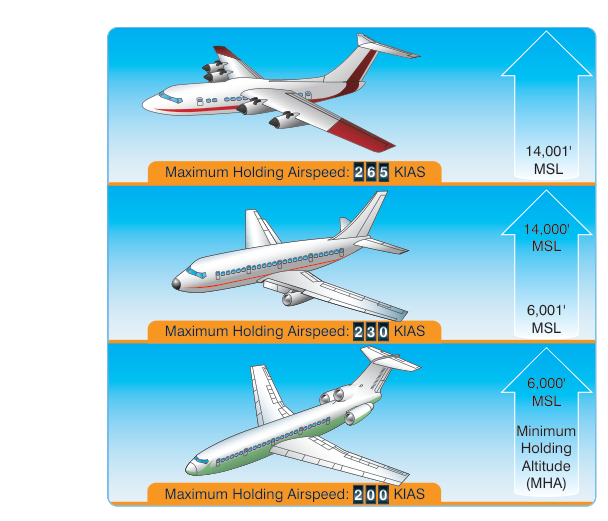
The FAA specifies maximum holding airspeeds in the AIM and in the Instrument Procedures Handbook (FAA-H-8083-16). The limits are expressed in indicated airspeed (KIAS) and are grouped by altitude band. There are three primary tiers for civil aircraft:
- At or below 6,000 feet MSL: Maximum 200 KIAS
- Above 6,000 feet MSL up to and including 14,000 feet MSL: Maximum 230 KIAS
- Above 14,000 feet MSL: Maximum 265 KIAS
These numbers apply to all civil holding patterns unless a lower speed is charted on the procedure. Some published holds — particularly those associated with terminal arrival procedures or approach transitions — carry a lower depicted airspeed. When that speed appears in a box on the chart, it supersedes the altitude-tiered maximums above. Always comply with the more restrictive limit.
Turbine Versus Propeller Aircraft
While the three-tier table applies broadly, certain high-performance turbine aircraft operating under specific instrument flight rules (IFR) procedures may receive a different limit if published on the chart. ATC also has authority to issue a lower speed restriction as part of your holding clearance (for example, "hold at the fix, maintain 170 knots or less"). That instruction becomes your limit regardless of your altitude. Conversely, ATC cannot authorize you to exceed the published maximum — only the FAA procedure itself or an emergency declaration can do that.
Altitude and the Holding Structure
Your assigned holding altitude is issued by ATC as a specific altitude to maintain, not merely to reach and then wander around. Holding clearances sound like: "Cleared to the DUNNO intersection, hold northeast on the 045 radial, left turns, maintain 8,000 feet, expect further clearance at 1530." You must maintain 8,000 feet throughout the pattern — both on the inbound leg and the outbound leg.
Altitude also directly determines which speed tier applies. If you are assigned 6,000 feet exactly, the limit is 200 KIAS ("at or below 6,000"). If you are assigned 6,500 feet, the limit becomes 230 KIAS. This seemingly small difference matters during a checkride or a real clearance, because examiners frequently assign altitudes that straddle the boundaries to see if the applicant applies the correct tier.
When ATC Assigns a Block Altitude
Occasionally ATC will clear you to "hold between 6,000 and 8,000" — a block altitude assignment. The AIM does not publish a specific rule for which altitude within a block governs the applicable speed tier, so in this situation pilots should treat the more restrictive (lower) tier as the operative limit unless ATC specifies otherwise, and should confirm intentions with ATC if there is any doubt. In the example above, that would mean complying with the 200-KIAS limit associated with the 6,000-foot floor unless ATC clarifies.
Practical Cockpit Application
The moment you receive a holding clearance, your mental checklist should address speed immediately — even before you execute the entry. Here is a practical flow:
- Identify your assigned altitude and confirm which speed tier applies.
- Slow to the maximum (or below) before reaching the fix if possible, so you enter the pattern already at a legal speed. The AIM notes that pilots should slow to holding speed when 3 minutes or less from the fix, or when receiving the clearance if already within 3 minutes.
- Check for a charted speed restriction. If one is published, honor the lower of the charted limit and the altitude-tier limit.
- Verify ATC has not added a speed restriction as part of your clearance.
Most general aviation training aircraft cruise well below 200 KIAS, so speed limits rarely present a practical constraint during initial instrument training. For pilots flying faster aircraft — turboprops, light jets, and high-performance pistons — the limits become operationally significant and must be crosschecked during every hold.
Timing and Leg Length as a Function of Speed
Holding pattern leg lengths are standardized in time: the inbound leg is 1 minute at or below 14,000 feet MSL, and 1.5 minutes above 14,000 feet MSL. The outbound leg timing is adjusted so that the inbound leg comes out to that target length after accounting for wind. Notice that these time standards align with the altitude-tier boundaries. This is intentional — at higher altitudes, aircraft fly faster, so the pattern must be flown for longer to achieve a protected oval of appropriate size.
When a holding fix is depicted with a DME distance instead of a time limit (a "DME hold"), the published mileage defines leg length regardless of altitude or speed. In this case, speed management still matters for obstacle clearance geometry, but the outbound leg is terminated at the charted DME value, not by a stopwatch.
Key Numbers and Rules
- At or below 6,000 ft MSL: 200 KIAS maximum
- 6,001–14,000 ft MSL: 230 KIAS maximum
- Above 14,000 ft MSL: 265 KIAS maximum
- Inbound leg time: 1 minute at or below 14,000 ft; 1.5 minutes above 14,000 ft
- Speed reduction timing: Begin slowing to holding speed when 3 minutes or less from the fix
- Charted speeds override altitude-tier limits when they are more restrictive
- ATC speed restrictions in the clearance must also be honored as maximums
- Standard bank angle in holds is 3° per second (standard rate) or 30° bank, whichever requires less bank
Common Test Traps
- Confusing "at or below" with "below." The 200-KIAS limit applies at exactly 6,000 feet MSL. An altitude of 6,000 ft is still in the 200-KIAS tier. 6,001 ft moves you to 230 KIAS. Test questions frequently use exactly 6,000 or 14,000 to catch students who apply the wrong tier.
- Ignoring charted speed restrictions. The altitude-tier table is a default. A lower charted speed (shown in a box on the approach or en route chart) supersedes it. Missing this is a common source of wrong answers.
- Applying timing rules to the wrong altitude tier. Students sometimes use 1-minute legs at altitudes above 14,000 feet, where 1.5-minute legs are required. Associating the longer leg with the higher altitude tier helps prevent this.
- Assuming TAS is what matters. Speed limits in holding patterns are in indicated airspeed (KIAS), not TAS. At high altitudes, your TAS may be considerably higher than IAS, but compliance is judged by the IAS on your airspeed indicator.
- Forgetting the 3-minute rule for speed reduction. The AIM specifies that you should be at or below holding speed 3 minutes prior to the fix. Waiting until you are overhead the fix to slow down is incorrect procedure and can cause you to overshoot the pattern on the first circuit.
Mastering holding pattern speeds and altitude limits is one of those topics where the rules seem mechanical until you realize why they exist. The math behind protected airspace is unforgiving — geometry does not care whether you forgot which speed tier applied. Fly within the published limits, slow down early, and know the boundaries cold, and you will always have the airspace the chart promises you.