Carbon monoxide (CO) is one of the most insidious hazards in aviation. It is colorless, odorless, and tasteless, yet even low concentrations can impair a pilot's judgment and coordination before any physical symptom is recognized. In piston-powered aircraft, CO can enter the cabin through leaks in the exhaust system that connect to the cabin heat system — a design path that makes CO contamination an ever-present threat if maintenance is not performed diligently. For the Aviation Maintenance Technician (AMT) working on airframe systems, understanding how to inspect CO detection equipment and verify the integrity of the ventilation system is not optional — it is a fundamental safety responsibility grounded in FAA guidance and 14 CFR airworthiness requirements.
This article covers the sources of CO in aircraft, how detection devices work, the inspection procedures for both detection equipment and ventilation components, and the regulatory framework that governs this work. Whether you are preparing for the AMT Airframe knowledge test or heading out to the hangar, mastering this topic could save lives.
How Carbon Monoxide Enters the Cabin
In most light general aviation aircraft, cabin heat is supplied by a combustion air heat exchanger — a shroud or muff that surrounds the exhaust system. Ram air passes over the hot exhaust pipes or muffler, absorbs heat, and is then ducted into the cabin. This elegant simplicity has a serious drawback: any crack, pinhole, or joint failure in the exhaust system allows CO-laden combustion gases to mix directly with the cabin heating air. Because the pressure differential draws air inward when the heat valve is open, even tiny exhaust leaks can produce dangerous CO concentrations inside the cockpit within minutes.
Additional pathways include leaking firewall seals, deteriorated cabin door and window seals (especially if an exhaust stack is near an opening), and poorly designed or improperly modified exhaust augmenter tubes. In turbocharged aircraft, a cracked turbocharger housing or failed exhaust gasket can also introduce CO into the engine compartment, which may then migrate to the cabin through any gap in the firewall. Carbon monoxide is produced by incomplete combustion — meaning a rich mixture, a partially blocked exhaust, or a malfunctioning engine can increase CO output even through an otherwise sound system.
Carbon Monoxide Detection Devices
Because human senses cannot detect CO, passive and active detection devices must be relied upon. AMTs must be familiar with both types to inspect, install, and verify them correctly.
Chemical Spot Detectors
The most common low-cost CO detector used in general aviation is the chemical spot card, sometimes called a CO indicator card or blister card. These devices use a chemical indicator compound, often based on a palladium salt on a substrate, that changes color from a tan or yellow baseline to a progressively darker brown or black when exposed to CO. The color change is irreversible, which means once darkened, the detector must be replaced; it cannot be reset. AMTs should verify that installed spot detectors have not already been exposed to CO and darkened, and that the device has not exceeded its manufacturer-specified service life (often six to twelve months). A spot detector that has been stored in high humidity or has aged beyond its service life may fail to respond accurately.
Electronic CO Detectors
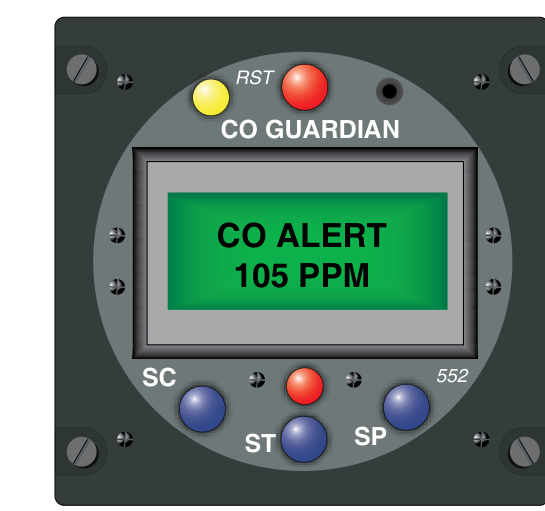
Electronic detectors use an electrochemical or metal-oxide semiconductor sensor to continuously monitor CO concentration and provide an audible or visual alarm when a threshold is exceeded. Alarm thresholds are set by the manufacturer and vary by product and TSO/PMA approval basis rather than being fixed by a single FAA-mandated ppm value. These units offer significant advantages: they are quantitative, they alarm before symptoms develop, and they can be tested. During inspection, the AMT should verify that the unit powers on, that the alarm function can be tested per the manufacturer's procedure, and that the sensor has not exceeded its rated service life (electrochemical sensors vary by manufacturer, commonly in the range of several years). Battery condition must be confirmed on battery-powered units. If the aircraft is equipped with a panel-mounted electronic CO detector, inspect the wiring for chafing, secure attachment, and proper fuse or circuit breaker protection consistent with the installation data.
Ventilation System Inspection
The ventilation system in a light aircraft typically consists of ram air inlets, control valves, ducting, cabin heat valves, defrost outlets, and fresh-air vents. Each component is a potential point of failure that could either allow CO to enter or deny fresh air to the occupants. The inspection must be thorough and systematic.
Exhaust System and Heat Exchanger
Because the heat exchanger is the primary CO entry point, it deserves the most rigorous attention. The AMT must visually inspect the entire exhaust system — stacks, pipes, risers, muffler, and any augmenter tubes — for cracks, holes, burned spots, discoloration suggesting hot spots, loose clamps, failed welds, and deteriorated gaskets. A borescope is valuable for examining internal muffler baffles, which can crack and collapse without any external indication. The heat muff or shroud itself should be removed if possible and inspected for cracks or corrosion. Many manufacturers specify a pressure or smoke test of the exhaust system: the system is pressurized at low pressure (typically 1 to 2 psi) with the outlets blocked, and the inspector looks for soap-bubble indications of leaks at joints and welds. Alternatively, some shops use a two-cycle engine exhaust smoke machine to flood the system and detect escaping smoke. Any crack or leak found is cause for immediate removal from service until repaired.
Ducting and Cabin Seals
Flexible ducting connecting the heat muff to the cabin should be inspected for collapsed sections, cracks, missing or deteriorated clamps, and separation from fittings. Even a duct that looks intact on the outside may be delaminating or cracked internally. The firewall should be inspected for any penetration that is not properly sealed with fire-resistant sealant. Openings around control cables, wiring bundles, fuel lines, and plumbing are all potential CO entry points if seals have degraded. Cabin door seals and window seals should be pliable and intact; hardened or missing rubber seals near exhaust outlets can allow exhaust fumes to be drawn in during flight.
Cabin Air Control Valves and Fresh-Air Inlets
The heat and fresh-air control valves must move freely through their full range and seal completely in the closed position. A valve that fails to fully close can allow heated (potentially CO-contaminated) air to enter when the pilot believes the system is off. Conversely, a sticking valve can deny fresh air. RAM air inlet screens should be clear of obstructions such as insect nests, debris, or ice-induced blockage. Outlet vents inside the cabin should be clear and the louvers operable.
Regulatory and Airworthiness Framework
Airworthiness standards for transport and normal/utility/acrobatic category aircraft address ventilation requirements and the prohibition of exhaust gas entry into the cabin. Under 14 CFR §23.831 (Ventilation, applicable to aircraft certificated under pre-2017 Part 23 amendments), aircraft must be designed so that exhaust gases cannot contaminate the cockpit or cabin in dangerous concentrations. Aircraft certificated under the current performance-based Part 23 (Amendment 23-64 and later) meet equivalent requirements through applicable consensus standards, such as those published by ASTM. For the AMT, the critical regulatory hooks are 14 CFR §91.409 (inspection requirements), the applicable manufacturer's maintenance manual (which is part of the aircraft's type design), and any applicable Airworthiness Directives (ADs) targeting exhaust system components. Many mufflers and exhaust assemblies on common training aircraft have had ADs issued specifically because of CO-related in-flight incidents. The AMT must check the AD record and confirm compliance before returning an aircraft to service.
FAA guidance materials, including Special Airworthiness Information Bulletins and applicable Advisory Circulars, have highlighted the importance of functioning CO detection in aircraft that use exhaust heat exchangers, particularly those used in flight training where occupants may not recognize early symptoms. The Pilot's Handbook of Aeronautical Knowledge (FAA-H-8083-25) also addresses CO poisoning symptoms — headache, dizziness, and drowsiness — to help pilots recognize exposure, but the AMT's job is to prevent the exposure from occurring in the first place.
Key Numbers and Rules
- Electronic detector alarm thresholds — set by the manufacturer and vary by product and approval basis; there is no single FAA-mandated ppm alarm value for aviation CO detectors.
- CO physiological effects — symptoms such as headache, dizziness, and disorientation vary with concentration, exposure duration, altitude, and individual factors; incapacitation risk increases as exposure and concentration rise.
- Chemical spot detectors — service life typically 6–12 months per manufacturer; must be replaced after any CO exposure (color change is irreversible).
- Electronic sensor service life — varies by manufacturer and product; verify per manufacturer's data.
- Exhaust system pressure test — commonly 1–2 psi; exact value per manufacturer's maintenance manual.
- ADs — always check for exhaust system and muffler ADs before returning to service; noncompliance renders the aircraft unairworthy under 14 CFR §39.7.
- Firewall seals — all penetrations must be sealed with fire-resistant material; any unsealed gap is an airworthiness defect.
Common Test Traps
- Assuming visual inspection is enough for the muffler. Internal muffler baffles can crack without any external sign. A pressure or smoke test, or borescope inspection, is required to detect internal failures — visual alone is insufficient.
- Confusing CO detector types. Chemical spot detectors are passive and irreversible — once they change color, they must be replaced. Electronic detectors can be tested and reset. Mixing up these characteristics is a common knowledge-test error.
- Overlooking service life limits. An expired chemical spot detector may show no color change even when CO is present, providing false assurance. The AMT must verify the manufacturing or installation date against the service life limit.
- Forgetting that the heat valve is the critical interface. A leaking heat valve that does not fully close can allow CO entry even when the pilot has turned off cabin heat. This valve must seal completely, not just move freely.
- Skipping the AD search for exhaust components. Exhaust systems on many common aircraft models have been subject to mandatory replacement or inspection intervals under ADs. Failing to check AD compliance before sign-off is both a regulatory violation and a serious safety lapse.