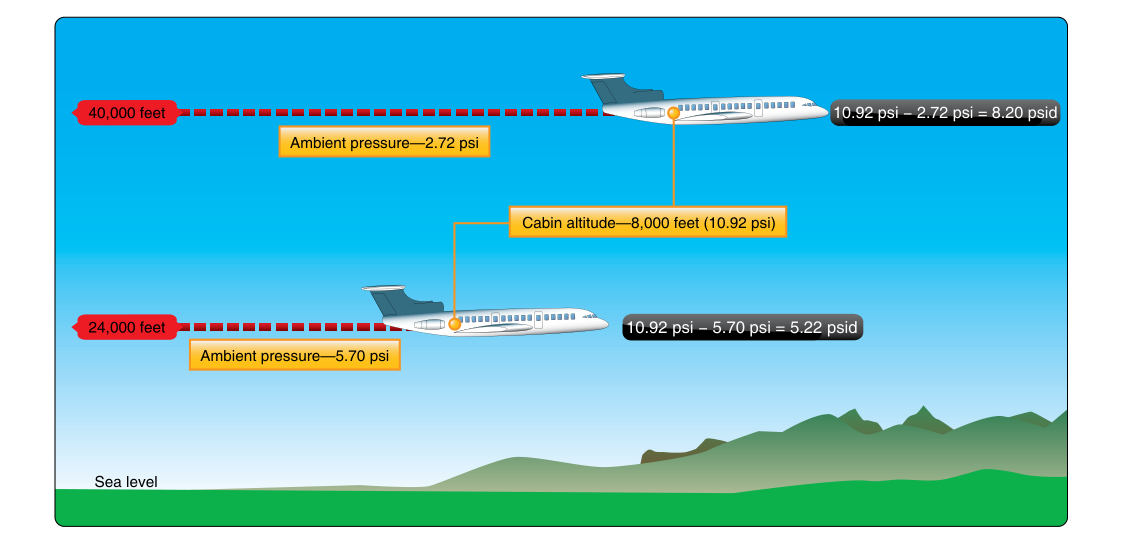
As a turbine-powered aircraft climbs through the atmosphere, the air outside grows increasingly thin and cold. Without some form of pressurization, passengers and crew would suffer from hypoxia, decompression sickness, and a host of other physiological problems at altitudes above roughly 10,000 feet MSL. The solution is to pump conditioned air into the fuselage and seal the cabin so that a higher-than-ambient pressure is maintained inside the aircraft. The difference between that interior cabin pressure and the outside ambient pressure is called the cabin differential pressure, and it is one of the most structurally significant forces acting on a transport-category airframe.
Understanding how differential pressure is created, how it is controlled, and — critically — what its maximum allowable limits are is fundamental knowledge for any Aviation Maintenance Technician (AMT) working on airframe systems. Exceeding the maximum differential pressure limit can overstress the fuselage shell, windows, doors, and pressure bulkheads, potentially leading to catastrophic failure. This article examines the physics, the hardware, and the regulatory framework that governs cabin pressurization limits.
How Cabin Differential Pressure Works
The pressurization system draws bleed air from the aircraft's turbine engines (or, in some modern designs, from electric compressors), cools and conditions it, and delivers it into the cabin. A pressurization controller — sometimes called a cabin pressure controller or autopressurization module — manages an outflow valve located typically near the aft fuselage. By restricting how quickly air escapes through that outflow valve, the system maintains a cabin altitude considerably lower than the aircraft's cruising altitude.
The cabin differential pressure (often abbreviated ∆P or diff P) is expressed in pounds per square inch differential (PSID) or, in some texts, in inches of mercury differential. It is calculated simply as:
∆P = Pcabin − Pambient
For example, at 35,000 feet MSL, standard atmosphere ambient pressure is approximately 3.46 psi. If the cabin is maintained at an equivalent altitude of 8,000 feet (approximately 10.92 psi), the arithmetic difference works out to approximately 7.46 PSID — though this is higher than the certificated maximum differential of most transport-category jets, so in practice the pressurization controller would limit the cabin altitude increase (transitioning into differential mode, as described below) well before ∆P reached that level. This illustrates why aircraft-specific maximum differential limits, not simple arithmetic, govern real-world cabin altitude schedules.
Isobaric and Differential Control Modes
Most pressurization systems operate in two basic modes. In isobaric mode, the system holds the cabin at a fixed pressure altitude (commonly 6,000–8,000 feet equivalent) as the aircraft climbs, as long as doing so does not exceed the aircraft's maximum differential pressure limit. Once the aircraft climbs high enough that maintaining the isobaric cabin altitude would require more differential pressure than the structure can safely handle, the system automatically transitions to differential mode, where ∆P is held at its maximum rated value and the cabin altitude is allowed to rise slowly with further aircraft climb. These two modes reflect the balance between crew/passenger comfort and structural safety.
Structural Significance of Differential Pressure
The fuselage of a pressurized aircraft is essentially a pressure vessel — a cylindrical shell designed to withstand repeated cycles of pressurization and depressurization. Each flight represents one pressurization cycle, and the accumulation of these cycles over years of service produces metal fatigue. Engineers calculate the fatigue life of the fuselage skin, frames, longerons, and lap joints based on the maximum differential pressures the aircraft will experience. This is why exceeding the maximum differential limit — even briefly — is a serious maintenance and airworthiness event that must be documented and may require an engineering inspection before further flight.
The fuselage skin is placed in hoop stress and longitudinal stress by pressurization. Hoop stress (circumferential) is twice the longitudinal (axial) stress for a cylindrical vessel. Because cracks tend to propagate perpendicular to the direction of highest stress, the greater hoop stress causes overpressure-related cracks to tend to run longitudinally (lengthwise) along the fuselage skin. Windows and doors represent stress concentrations and are engineered with doublers and frames to handle these loads, but they remain vulnerable if differential pressures exceed design limits.
Maximum Differential Pressure Limits
Every pressurized aircraft has a maximum differential pressure limit established by the manufacturer and approved by the FAA as part of the type certification process under 14 CFR Part 25 (for transport category) or Part 23 (for smaller aircraft). This limit is the highest ∆P the fuselage structure is certified to safely sustain in normal operation, and it must be placarded and documented in the Aircraft Flight Manual (AFM) and Maintenance Manual.
Typical maximum differential pressure values for common aircraft types give a useful frame of reference. Many large transport-category jets are certified to a maximum differential in the range of approximately 8.35–8.65 PSID (the exact value depends on the specific Boeing 737 variant). Some business jets and regional aircraft use values in the range of 8.0–9.0 PSID, while smaller pressurized piston and turboprop aircraft may be certified to 5.0–6.5 PSID. These are aircraft-specific values; the AMT must always consult the applicable Aircraft Maintenance Manual (AMM) rather than relying on generalizations.
Limit vs. Relief Pressure
There is an important distinction between the maximum normal differential limit and the relief valve setting. The positive pressure relief valve (PPRV) is a safety device that opens automatically if differential pressure exceeds a threshold slightly above the normal maximum limit, preventing structural overpressure. The relief valve setting is therefore higher than the normal operating maximum — for instance, if normal max diff is approximately 8.6 PSID, the PPRV might be set to open a small margin above that value. The exact opening pressure is aircraft-specific and documented in the AMM. The PPRV is not a normal operating control; it is an emergency protection device. Technicians must verify the PPRV opens at its specified pressure during scheduled maintenance checks and must never adjust it outside of manufacturer specifications.
Aircraft also incorporate a negative pressure relief valve (NPRV), which prevents the outside ambient pressure from exceeding cabin pressure — a condition that can occur during rapid descents. The exact opening differential for this valve is aircraft-specific and is documented in the applicable AMM; technicians should always confirm the type-specific value rather than assume a generic figure. This valve prevents inward-acting loads on the fuselage that the structure may not be designed to handle in the same way as outward-acting pressurization loads.
Why Maximum Differential Limits Matter for the AMT
From a maintenance perspective, the differential pressure limit drives several important tasks. First, the pressurization controller must be calibrated so that it commands the outflow valve to maintain differential pressure within limits at all flight levels. Second, all pressure-sensing lines, transducers, and gauges that feed the controller and the flight deck differential pressure indicator must be checked for accuracy during scheduled inspections. An inaccurate sensor could allow the system to overpressurize without triggering a cockpit warning.
Third, the pressure bulkheads — particularly the aft pressure bulkhead — must be inspected for corrosion, cracking, and fastener integrity. The aft bulkhead separates the pressurized cabin from the unpressurized tail section and carries the full differential pressure load across its face. Any deterioration of this structure is an urgent airworthiness concern. History has demonstrated that inadequately repaired or corroded pressure bulkheads can fail catastrophically, as illustrated by several well-known accidents investigated by the NTSB.
Fourth, if a pressurization exceedance is recorded by the flight data recorder (FDR) or reported by the crew, the AMT must follow the manufacturer's specific exceedance inspection procedures, which may include a detailed visual inspection of skin panels, window frames, door surrounds, and structural fasteners before the aircraft may return to service.
Key Numbers and Rules
- Cabin differential pressure (∆P) = cabin pressure minus ambient pressure, expressed in PSID.
- Typical cabin altitude target in cruise: 6,000–8,000 feet equivalent for passenger comfort and regulatory compliance.
- Typical max differential for large transport jets: approximately 8.0–9.0 PSID (aircraft-specific; always verify in the AMM).
- Positive pressure relief valve (PPRV) opens above the normal maximum differential — it is a protective device, not a normal control.
- Negative pressure relief valve (NPRV) protects against outside pressure exceeding cabin pressure; the exact opening differential is aircraft-specific and documented in the AMM.
- 14 CFR Part 25, including sections such as §25.365 and §25.841, establishes airworthiness standards for pressurization systems in transport-category aircraft, including structural proof-pressure and burst-pressure test requirements.
- Any pressurization exceedance must be documented and an inspection performed per manufacturer guidance before further pressurized flight.
- Differential pressure gauges and pressurization controllers are subject to periodic calibration checks per the aircraft's Airworthiness Limitations and maintenance schedule.
Common Test Traps
- Confusing cabin altitude with differential pressure. Cabin altitude is the equivalent pressure altitude inside the cabin (e.g., 8,000 feet); differential pressure is the mathematical difference between cabin and ambient pressure in PSID. They are related but not the same thing — the FAA written test exploits this distinction.
- Assuming the relief valve is the normal pressure limit. The PPRV opens above the normal maximum differential. The normal operating limit is lower than the relief setting. The PPRV is not supposed to open on every flight.
- Forgetting the negative pressure relief valve. Students often focus only on overpressure scenarios. The NPRV protects against the structurally dangerous condition of outside pressure exceeding cabin pressure during rapid descent.
- Thinking hoop stress and longitudinal stress are equal. In a cylindrical pressure vessel, hoop (circumferential) stress is twice the longitudinal stress. This means the fuselage skin is more likely to crack lengthwise than circumferentially under overpressure.
- Skipping the exceedance inspection. A common trap question asks what action is required after a pressurization exceedance. The correct answer involves a manufacturer-specified inspection — not simply logging the event and continuing flight.