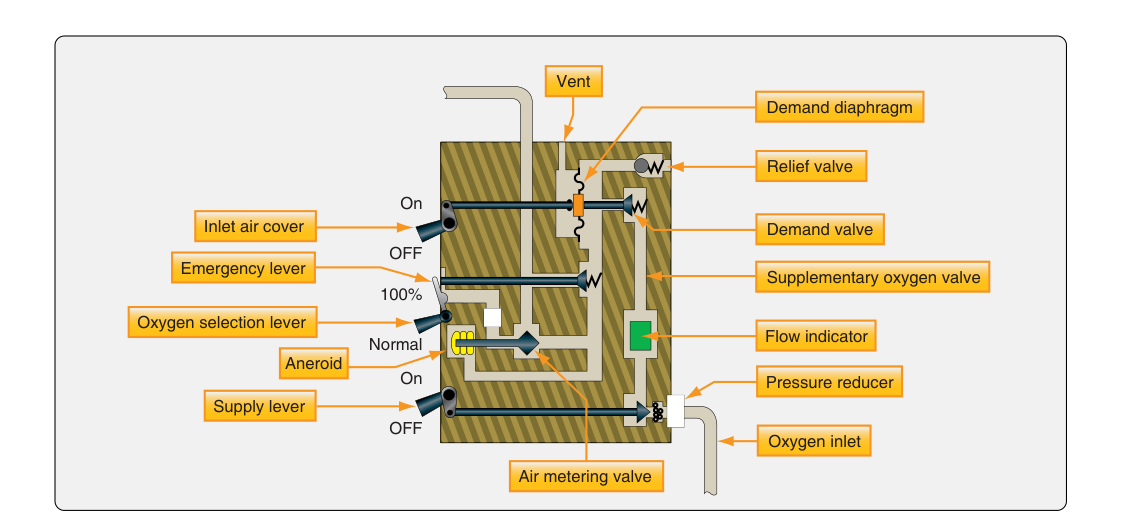
Supplemental oxygen is one of the most critical life-support systems on any aircraft. As altitude increases, atmospheric pressure drops and the partial pressure of oxygen falls with it. Above 10,000 feet, the body begins to lose efficiency in absorbing oxygen, and above 25,000 feet, unpressurized exposure becomes immediately life-threatening. Aircraft oxygen systems are engineered to counter this physiological reality, and they come in three fundamental designs: continuous flow, diluter-demand, and pressure-demand. Every airframe technician must understand how each type works, where it is used, how it is maintained, and how the regulations and operational limits govern it.
This article provides a thorough treatment of all three system types—their operating principles, components, altitude applicability, regulatory basis, and the practical maintenance considerations that appear on the AMT Airframe knowledge test and in real-world hangar work.
The Physiology Behind the Systems
The human body needs oxygen at an adequate partial pressure—not simply an adequate percentage of the surrounding gas mixture. At sea level, the atmosphere is about 21% oxygen at roughly 14.7 psi, providing a partial pressure of oxygen sufficient to saturate hemoglobin. As altitude climbs, total pressure falls and so does the partial pressure of every gas in the mix. By roughly 34,000 feet, the partial pressure of atmospheric oxygen equals what pure oxygen at sea level provides only when supplemented—meaning a pressure-demand system must actually push oxygen above ambient pressure into the lungs to sustain consciousness. Each oxygen system type is engineered to match a specific range of this physiological challenge.
Continuous Flow Systems
The simplest and most common oxygen system found in general aviation aircraft is the continuous flow system. As the name implies, it delivers a steady, uninterrupted stream of oxygen to the user regardless of whether the person is inhaling or exhaling. The oxygen flows from a high-pressure storage cylinder—typically charged to around 1,800–2,000 psi—through a regulator that reduces pressure to a usable level, then through individual flow restrictors or a flow-control unit calibrated to deliver a specific flow rate, and finally to the user through a cannula or rebreather mask.
The rebreather bag (also called a reservoir bag) used with continuous flow masks serves an important function: it collects oxygen that flows during exhalation so that the next inhalation draws from a concentrated reservoir rather than purely from ambient air. Without this bag, a significant portion of the delivered oxygen would simply be wasted during the exhale phase. Even so, continuous flow systems are inherently less efficient than demand systems because they deliver oxygen continuously whether the user needs it or not.
Continuous flow systems are generally suited for cabin altitudes up to approximately 25,000 feet when proper masks and flow rates are used, though for passenger use they are commonly rated for lower cabin altitudes. They are found extensively as passenger emergency oxygen systems on transport-category aircraft—the familiar yellow drop-down masks use a chemical oxygen generator (a chlorate candle) to produce continuous flow oxygen for a limited time, typically 12–22 minutes, which is sufficient for a rapid emergency descent.
From a maintenance standpoint, continuous flow systems require periodic inspection of cylinder pressure, hydrostatic testing of cylinders on required schedules, leak checks of all fittings and lines, inspection of flow restrictors for contamination or blockage, and verification that masks and reservoir bags are serviceable. Oxygen system components must be kept scrupulously free of petroleum-based lubricants and contaminants, as high-pressure oxygen in contact with hydrocarbons presents a serious fire and explosion risk.
Diluter-Demand Systems
A diluter-demand system represents a significant step up in sophistication and efficiency. Rather than flowing continuously, it delivers oxygen only on demand—that is, only when the user inhales, triggered by the slight negative pressure created at the mask during inspiration. This on-demand delivery dramatically reduces oxygen consumption compared to a continuous flow system.
The key feature that differentiates a diluter-demand system from a simple demand system is the diluter mechanism. A diluter valve, controlled by an aneroid or mechanical altitude-sensing device, automatically mixes cabin air with the oxygen supply in proportions that vary with altitude. At lower altitudes where cabin air still contains adequate oxygen at usable partial pressures, the system dilutes the delivered gas with more cabin air and less pure oxygen. As altitude increases, the diluter progressively reduces the cabin air component and increases the proportion of pure oxygen. At the system's upper altitude limit, it can deliver 100% oxygen on demand with no dilution. The pilot or user typically has a selector that allows manual override to 100% oxygen at any altitude—useful if smoke or contamination is in the cabin air.
Diluter-demand systems are well-suited for altitudes up to approximately 40,000 feet. They are the standard crew oxygen system on many turboprop and jet aircraft operating in the flight levels. The tight-sealing oronasal mask required by diluter-demand systems must fit the face properly—a poor seal allows cabin air in and defeats the purpose of altitude-compensated oxygen delivery. Maintenance of diluter-demand systems includes functional testing of the demand valve mechanism, verification of the diluter valve operation across altitude ranges, mask fit and seal inspection, regulator calibration checks, and thorough leak testing.
Pressure-Demand Systems
Above approximately 40,000 feet, even breathing 100% pure oxygen at ambient pressure is not sufficient to maintain consciousness—the partial pressure of oxygen is simply too low for hemoglobin to absorb adequate amounts. At these extreme altitudes, a pressure-demand system becomes necessary. This system works on the same demand principle as the diluter-demand type, but adds a critical capability: it delivers oxygen at a positive pressure above ambient, actively inflating the lungs rather than simply making enriched gas available for inhalation.
Pressure-demand regulators are spring-loaded or mechanically biased to maintain a slight positive pressure inside the mask at all times, even during exhalation. This means the user must actively exhale against this positive pressure, a technique that requires training and a pressure-demand-rated flight suit or counter-pressure garment at the highest altitudes. Without such a garment, the positive pressure in the lungs can cause barotrauma and cardiovascular stress. Full-pressure suits, as used in U-2 or extreme high-altitude research aircraft, integrate with pressure-demand oxygen systems to provide total body counter-pressure.
Pressure-demand systems are rated for operation from approximately 40,000 feet to the limits of human physiological tolerance with appropriate pressure suits, and are mandatory crew equipment on aircraft that routinely operate above 40,000 feet. Their components include heavy-duty demand valves, pressure-relief features, and robust regulator assemblies rated for the pressures involved. Maintenance is particularly demanding: regulators must be tested on calibrated benches to verify correct cracking pressure, positive-pressure delivery, and relief valve function. All seals and fittings must be in excellent condition given the physiological consequences of a malfunction at extreme altitude.
Key Numbers and Rules
- Continuous flow: Usable to approximately 25,000 feet; oxygen flows constantly; reservoir bag improves efficiency; common in GA and as passenger emergency systems.
- Diluter-demand: Usable to approximately 40,000 feet; oxygen delivered only during inhalation; diluter mixes cabin air at lower altitudes, 100% O₂ at upper limits; requires a sealing oronasal mask.
- Pressure-demand: Required above approximately 40,000 feet; delivers O₂ at positive pressure above ambient; requires trained users and potentially pressure suits or counter-pressure garments.
- Oxygen cylinder hydrostatic testing: Required every 5 years for most aviation cylinders; inspection per manufacturer and 14 CFR requirements.
- No petroleum lubricants: Aviation oxygen systems must never be contaminated with oil or grease; oxygen-compatible lubricants (e.g., silicone-based) only, per manufacturer specifications.
- Cylinder color coding: Aviation breathing oxygen cylinders are typically identified with a green color and labeled to distinguish them from other gas types; never use industrial oxygen in aircraft systems.
- 14 CFR Part 91.211: Establishes supplemental oxygen requirements for pilots and passengers based on cabin pressure altitude and duration of exposure.
Why It Matters for Airframe Technicians
As an airframe technician, you may not fly the aircraft, but a deficiency in an oxygen system you maintain could be fatal to those who do. Oxygen systems demand meticulous attention to cleanliness, correct assembly, and functional testing. A continuous flow restrictor that is partially blocked will starve a passenger of oxygen without any obvious warning. A diluter-demand valve that sticks open will waste cylinder pressure; one that sticks closed will deprive the crew of oxygen at altitude. A pressure-demand regulator delivering insufficient positive pressure at 45,000 feet leaves the crew with seconds of useful consciousness.
Beyond immediate safety, improper oxygen system maintenance can create fire hazards. High-pressure oxygen reacts vigorously with hydrocarbons and organic contaminants. Always use only approved oxygen-compatible tools, cleaning agents, and lubricants, and never allow any petroleum product near an oxygen system component.
Common Test Traps
- Confusing continuous flow with demand systems: Continuous flow delivers oxygen at all times; demand systems deliver only during inhalation. A common distractor asks which is more oxygen-efficient—the answer is always the demand-type systems.
- Altitude limits mixed up: Students often transpose the 25,000-foot and 40,000-foot limits. Remember: continuous flow tops out around 25,000 feet, diluter-demand around 40,000 feet, and pressure-demand is needed above that.
- The diluter function: Test questions may describe a system that mixes cabin air at low altitudes and ask you to identify it—this is a diluter-demand system, not a simple demand or continuous flow system.
- Chemical oxygen generators: These are a form of continuous flow oxygen, not demand oxygen. They cannot be turned off once activated and provide oxygen for a fixed duration only.
- Petroleum contamination: Any question about lubricants or cleaning agents near oxygen systems should raise a flag—only oxygen-compatible (non-petroleum) materials are acceptable, and contamination is a fire/explosion hazard, not merely a maintenance deficiency.