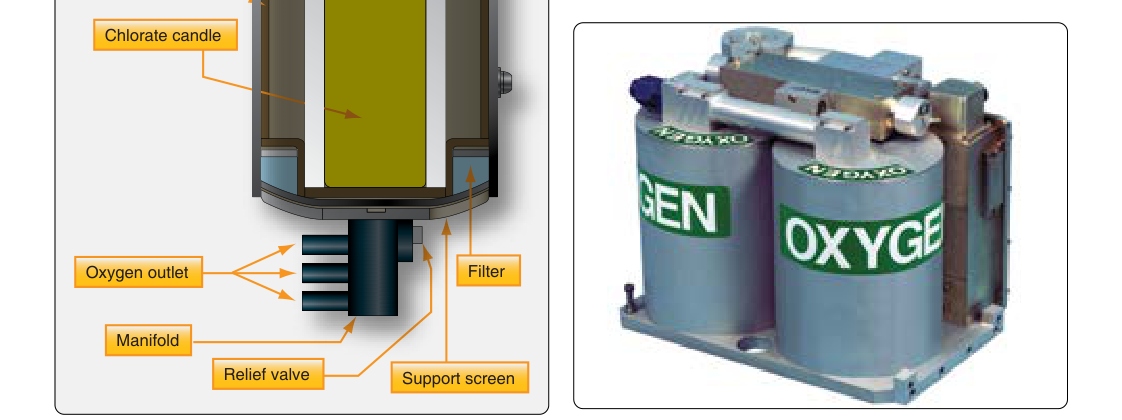
Chemical oxygen generators are a remarkable piece of life-safety equipment found in virtually every transport-category airliner and many regional and business aircraft. When a passenger reaches up and pulls a dangling oxygen mask, the triggering mechanism that starts a chemical reaction is what delivers breathable oxygen — not a pressurized tank. For the Aviation Maintenance Technician (AMT), understanding exactly how these generators work, and strictly following the servicing precautions that govern them, is not just an exam topic: it is a matter of crew and passenger survival.
This article covers the operating chemistry, mechanical design, activation sequence, service life considerations, and the critical safety precautions that govern storage, installation, and removal of chemical oxygen generators in aircraft cabin systems.
How Chemical Oxygen Generators Work
Chemical oxygen generators — sometimes called continuous-flow chemical generators or solid-state oxygen generators — produce oxygen through a thermite-like exothermic chemical reaction. The core chemical involved is sodium chlorate (NaClO₃), mixed with small amounts of iron powder and other stabilizing agents. When the reaction is initiated, the sodium chlorate decomposes according to the general reaction:
2 NaClO₃ → 2 NaCl + 3 O₂
Iron powder acts as a fuel to sustain the heat of the reaction (typically around 450–600 °F / 230–315 °C internally), while barium peroxide and other additives help control the burn rate and filter chlorine gas from the output. The oxygen produced is relatively pure and flows directly through a lightweight hose and regulator to the connected masks. The entire canister exterior can reach temperatures dangerous enough to cause burns or ignite nearby flammable materials — a critical point for technicians handling spent or activated units.
Activation Mechanism
The generator is initiated by a firing pin and percussion cap assembly, similar in concept to a firearm's primer. When a passenger pulls down on the mask lanyard, a spring-loaded firing pin strikes the percussion cap, which provides the initial heat impulse to start the sodium chlorate decomposition. Alternatively, some designs use an electrically initiated squib. Once started, the reaction is self-sustaining and cannot be stopped. The oxygen flow continues for a designed duration — typically 12 to 22 minutes depending on the generator model and the number of masks connected — until the chemical core is exhausted.
Each generator unit feeds a fixed number of masks, commonly two to four, through a manifold. Flow rates and mask design are coordinated to deliver adequate oxygen concentration at altitude, typically at least 30% oxygen by volume, which compensates for the reduced partial pressure of oxygen at cabin altitude during a decompression event.
Mechanical Design and Aircraft Installation
Generators are housed in small cylindrical or rectangular metal canisters installed in overhead compartment panels, lavatories, and crew station areas. They are mounted with the outlet port directed toward the mask assembly and the firing pin accessible — indirectly — through the lanyard pull mechanism. The canister body is sealed; there are no serviceable internal components. The unit is replaced as an assembly when it has been activated or when it reaches its service life expiration date, whichever comes first.
Manufacturers establish service life limits — commonly two to four years for many transport-category units, though the specific limit is always found in the aircraft's maintenance manual and the generator's data placard. Beyond that date, the chemical core may have degraded to a point where it will not sustain full oxygen output, or where decomposition products have compromised seal integrity.
Why It Matters: Safety and Regulatory Basis
The FAA requires that transport-category aircraft operating under 14 CFR Part 121 and Part 135 carry supplemental oxygen for passengers based on cabin pressure altitude, with graduated requirements: oxygen must be provided to a portion of passengers when cabin pressure altitude is between 10,000 and 14,000 feet for more than 30 minutes, and to all occupants whenever cabin pressure altitude exceeds 15,000 feet, per 14 CFR §121.333. Chemical generators fulfill this requirement economically and with a reliability advantage over pressurized systems: there are no high-pressure cylinders that could rupture, no valves that could freeze, and no heavy storage tanks spread throughout the overhead panels.
However, that same exothermic reaction that makes generators practical also makes them a significant fire and heat hazard if mishandled. The aviation industry has experienced serious incidents — including cargo fires — attributed to improperly packaged or activated generators. For this reason, spent or uninstalled generators are regulated as hazardous materials under DOT regulations, and the FAA's guidance aligns with those requirements.
Key Numbers and Rules
- Oxygen generation duration: Typically 12 to 22 minutes of continuous flow per activation, depending on unit and number of masks connected.
- Internal operating temperature: The chemical core burns at approximately 450–600 °F (230–315 °C); the canister exterior can reach temperatures capable of causing burns or igniting flammable materials.
- Service life: Usually 2 to 4 years from manufacture date — always verify in the aircraft maintenance manual and the generator's placard; never extend beyond the published limit.
- Replacement trigger: Replace immediately upon activation OR upon reaching the expiration date, whichever occurs first.
- Non-resettable: Once initiated, a chemical generator cannot be stopped, reset, or reused. There are no serviceable internal parts.
- Hazmat classification: Unspent generators are classified as oxidizers; spent (activated) generators may still be hot and are treated as hazardous material until confirmed fully cooled and inert.
- Handling temperature: Allow a spent generator to cool for at least one hour — or per the manufacturer's specific guidance — before handling or packaging.
Servicing Precautions for the AMT
The following precautions are drawn from the principles in the FAA Aviation Maintenance Handbook (FAA-H-8083-30) and are universally applied through aircraft manufacturer maintenance manuals:
1. Never expose an uninstalled generator to heat, shock, or impact. The percussion cap can be inadvertently fired by a sharp blow. Generators must be carried and stored carefully, away from heat sources, sparks, and open flame. They must never be dropped.
2. Keep generators away from flammable or combustible materials. Because the canister exterior reaches extreme temperatures during operation, never store an uninstalled or potentially activated generator near fuel lines, hydraulic fluid, aircraft insulation blankets, or paper products. If an activated generator is discovered in a maintenance environment, isolate it on a non-combustible surface.
3. Verify expiration dates before installation. Inspect the data placard on every generator during scheduled maintenance. An expired generator must be removed and replaced regardless of appearance; chemical degradation is not visible externally.
4. Do not disassemble or modify a generator. The internal components are sealed by design and are not meant to be accessed. Attempting to disassemble a generator risks inadvertent activation and severe burn injury.
5. Use the correct replacement unit. Chemical generators are not interchangeable between all aircraft types. Each unit is matched to the specific mask assembly, manifold configuration, and flow requirements. Always cross-reference the part number in the aircraft maintenance manual and the parts catalog before installation.
6. Follow hazmat procedures for disposal. Activated generators must be disposed of according to applicable DOT and local regulations. They cannot simply be placed in general trash. The aircraft operator's maintenance procedures will specify the approved disposal method, which typically involves allowing the unit to fully cool, placing it in a fireproof container, and coordinating with an approved hazmat disposal service.
7. Inspect mask lanyards and deployment doors carefully. The firing pin mechanism is spring-loaded and held in place by a retaining pin or safety clip. During maintenance, confirm that safety devices are in place and that overhead door mechanisms have not been inadvertently dislodged. A mask panel that opens unexpectedly can fire the generator.
Common Test Traps
- Confusing activated and unactivated hazard status: Both unspent (oxidizer) and spent (still-hot) generators are hazardous, but for different reasons. The test may ask which stage presents a fire risk from heat — that is the spent, activated generator immediately after use.
- Assuming generators can be stopped once initiated: The reaction is self-sustaining and irreversible. No valve, no action by a technician, and no aircraft system can halt oxygen production once started. This is a fundamental design characteristic, not a malfunction.
- Service life vs. condition: A generator that looks brand new but is past its expiration date must be replaced. Expiration date governs, not physical appearance or whether the unit has been activated.
- Interchangeability: Test questions sometimes imply that any generator of similar size can be substituted. This is false — part numbers must match the aircraft manufacturer's specification exactly.
- Cooling time before handling: A freshly activated generator may still be dangerously hot well after oxygen flow has stopped. Technicians who handle a spent unit too soon risk serious burns. Always allow the full cooling period specified by the manufacturer before packaging or transport.