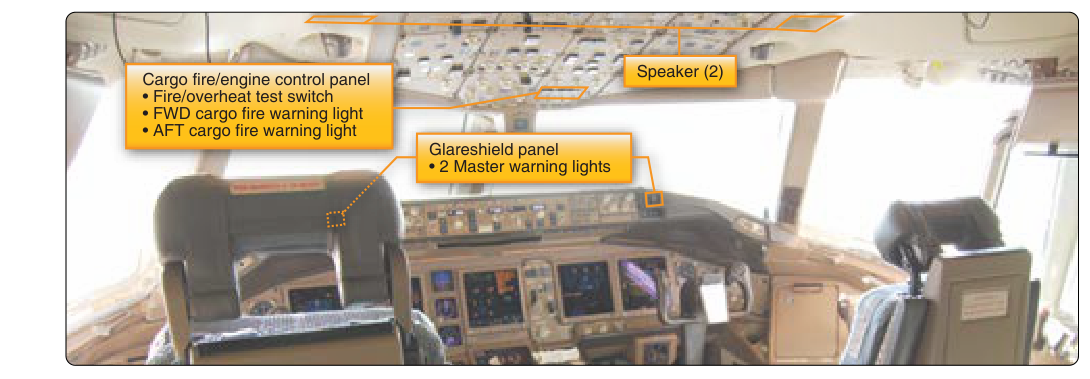
Cargo compartment fires represent one of the most serious hazards aboard transport-category aircraft. Unlike an engine fire visible to the flight crew, a cargo hold fire can smolder undetected and grow catastrophically before any indication reaches the cockpit. The FAA mandates specific fire detection and suppression systems based on how cargo compartments are classified, and understanding these classifications, the equipment involved, and the operational limitations is essential knowledge for Airline Transport Pilot (ATP) certificate applicants and working airline pilots alike.
This article examines how cargo compartment fire systems work, why they are designed the way they are, and the specific regulatory and operational standards you need to know for both the ATP knowledge test and practical real-world application.
Cargo Compartment Classifications
Before understanding the suppression systems themselves, you must understand how 14 CFR Part 25 classifies cargo compartments, because the classification directly determines what detection and suppression equipment is required. The FAA recognizes five classes of cargo compartments, labeled Class A through Class E, each defined by crew access and the nature of fire control available.
- Class A: A compartment small enough that a crew member can reach any part of it with a hand-held extinguisher while standing in the cargo area, and the compartment is clearly visible to the crew. Class A compartments require a smoke or fire detector system that provides a warning at the pilot or flight engineer station, but a built-in suppression system is not required because a crew member can physically access the area.
- Class B: Large enough to require a crew member to enter the compartment to fight a fire, but ventilation is controllable and an approved fire extinguisher can be used. Class B compartments require both a smoke/fire detector and sufficient access for a crew member to use a hand extinguisher, along with a means to exclude hazardous quantities of smoke or fire-extinguishing agent from any other areas of the aircraft.
- Class C: A compartment that is NOT accessible in flight but that has a built-in fire suppression system and controllable ventilation. This is the most common classification for belly cargo compartments on large commercial aircraft. Class C compartments must have a smoke/fire detector, a built-in extinguishing or suppression system capable of controlling a fire (using approved agents such as Halon 1301 or approved Halon alternatives), and the ability to control airflow and ventilation to limit oxygen supply to the fire.
- Class D: (Now largely obsolete in modern transport aircraft.) These compartments were designed so that a fire would be completely confined within the compartment without endangering the airplane or occupants, relying on limited airflow and oxygen to contain — not necessarily instantly extinguish — a fire. They required no active suppression system, only airtight construction limiting oxygen supply, but Amendment 25-93 removed Class D as an allowable classification for new type certificates because real-world testing demonstrated the class D concept did not adequately control fires as intended.
- Class E: Used on freighter aircraft where the entire main deck is a cargo compartment. Class E compartments require a smoke or other fire detector, a means to shut off ventilating airflow, and the ability to prevent smoke or fire-extinguishing agents from entering the crew compartment. A built-in suppression agent discharge system is not required, but smoke control and airflow shutoff are mandatory.
Fire Detection Systems
Cargo compartment fire detection relies primarily on smoke detectors, specifically photoelectric or ionization-type units. Transport aircraft typically use photoelectric (light-scattering) detectors because they are more responsive to the smoldering, low-heat fires that are most common in cargo holds — the kind produced by improperly packed lithium batteries, smoldering cardboard, or hazardous materials that begin to off-gas before open combustion occurs.
Detectors are strategically located throughout the cargo hold. Many modern systems draw air samples through ducts to a centralized detector, rather than relying solely on detectors mounted in the cargo space itself. This sampling-type system is especially effective because it can rapidly detect trace amounts of combustion products even in large, high-volume cargo compartments. When the detector senses smoke or combustion byproducts above a threshold level, it triggers a warning in the cockpit — usually an amber or red CARGO FIRE annunciator light, accompanied by an aural alert.
It is important to understand that detection systems do not suppress the fire; they only alert the crew. The suppression action is a separate system, and the crew must follow the appropriate checklist to activate it in Class C compartments.
Fire Suppression Systems
Class C cargo compartments use fixed fire-suppression systems that discharge a fire-suppression agent directly into the cargo hold. Historically, Halon 1301 (bromotrifluoromethane) was the agent of choice because of its exceptional effectiveness at low concentrations and its relatively low toxicity compared to other halogenated agents. Halon 1301 suppresses combustion primarily by interrupting the chemical chain reaction of fire rather than displacing oxygen or cooling the fuel, making it highly effective even in partially ventilated spaces.
Due to environmental regulations (Halon depletes stratospheric ozone), aviation industry and regulatory bodies have worked to develop approved Halon alternatives. However, as of current FAA standards, Halon 1301 remains the benchmark, and many aircraft still operate with it. New aircraft designs are incorporating approved clean-agent alternatives that must demonstrate equivalency to Halon 1301 in suppression effectiveness.
The suppression system in a typical Class C compartment is divided into two phases:
- High-Rate Discharge (HRD) bottle: A high-pressure cylinder that discharges a large volume of suppression agent rapidly — typically within a few seconds — to knock down the active fire quickly. This is the initial suppression shot, activated by the flight crew from the cockpit when a CARGO FIRE warning is confirmed.
- Metered discharge (low-rate) bottles: One or more additional cylinders that discharge slowly over an extended period (30 minutes to several hours) to maintain a suppressive concentration of agent in the compartment for the remainder of the flight until landing. This keeps the fire from re-igniting during descent and landing, buying time for the crew to divert and for emergency responders to meet the aircraft.
The crew cannot visually confirm fire suppression in an inaccessible Class C compartment, so the continued metered discharge is critical. Even after the HRD bottle fires and the warning light extinguishes or reduces, the metered agent continues to flow to prevent re-ignition. Flight crews must land as soon as practicable at the nearest suitable airport after a cargo fire event — this is a fundamental ATP operational principle.
Ventilation Control
An equally important element of cargo compartment fire management is ventilation control. In Class C and Class E compartments, the crew must be able to shut off airflow to and from the cargo area. Limiting ventilation starves the fire of fresh oxygen and prevents the spread of smoke into other aircraft areas. It also ensures that the suppression agent discharged into the compartment is not diluted or purged by continuous airflow. Flight crew checklists for cargo fire always include steps to isolate cargo compartment ventilation as part of the suppression strategy.
Why It Matters Operationally
Several catastrophic accidents in aviation history have been caused by cargo compartment fires that were not detected quickly enough or could not be suppressed. The combination of early detection, effective suppression agent, metered-duration discharge, and ventilation shutoff represents layers of defense that provide the flight crew sufficient time to land safely. Understanding these systems is not merely academic — it directly informs the decision to divert, the priority given to a cargo fire warning versus other alerts, and communication with air traffic control and airport emergency services.
Modern aircraft like the Boeing 787 and Airbus A350 integrate cargo fire detection and suppression monitoring into their electronic centralized aircraft monitoring (ECAM) or engine-indicating and crew-alerting system (EICAS) displays, giving crews immediate system status, recommended crew actions, and remaining agent quantities in a single integrated interface.
Key Numbers and Rules
- Class C is the classification requiring both a built-in suppression system AND smoke detection — the most commonly tested distinction.
- Halon 1301 is the traditional suppression agent; it suppresses fire by chemical chain reaction interruption, not oxygen displacement.
- Metered discharge duration is designed to last at least long enough for the aircraft to divert and land — typically 30 minutes to several hours depending on aircraft design and certification requirements.
- Photoelectric detectors are preferred in cargo holds due to their sensitivity to slow, smoldering fires.
- Class D compartments have been removed as an allowable classification for new type certificates (Amendment 25-93) due to demonstrated inadequacy in controlling fires as intended.
- After any confirmed cargo fire, the crew must treat it as an emergency and land as soon as practicable at the nearest suitable airport per aircraft operating procedures and 14 CFR Part 91/121 emergency authority.
Common Test Traps
- Confusing Class C and Class E: Both require smoke detection and ventilation control, but only Class C requires a built-in suppression system. Class E (freighter main decks) does NOT require installed suppression agent discharge.
- Assuming Halon displaces oxygen: Halon 1301 works by chemical chain reaction interruption, not oxygen displacement. CO₂ displaces oxygen; Halon does not primarily operate that way.
- Forgetting the metered discharge purpose: The HRD bottle knocks down the fire; the metered bottles maintain suppressive concentration. Students often think one discharge is enough.
- Class D still being valid: Class D has been removed as an allowable classification for new type certificate designs (Amendment 25-93). Do not confuse historical knowledge with current standards.
- Thinking the fire warning light going out means the fire is out: The crew cannot confirm suppression in an inaccessible compartment. Diversion and immediate landing are required regardless of warning light status changes.