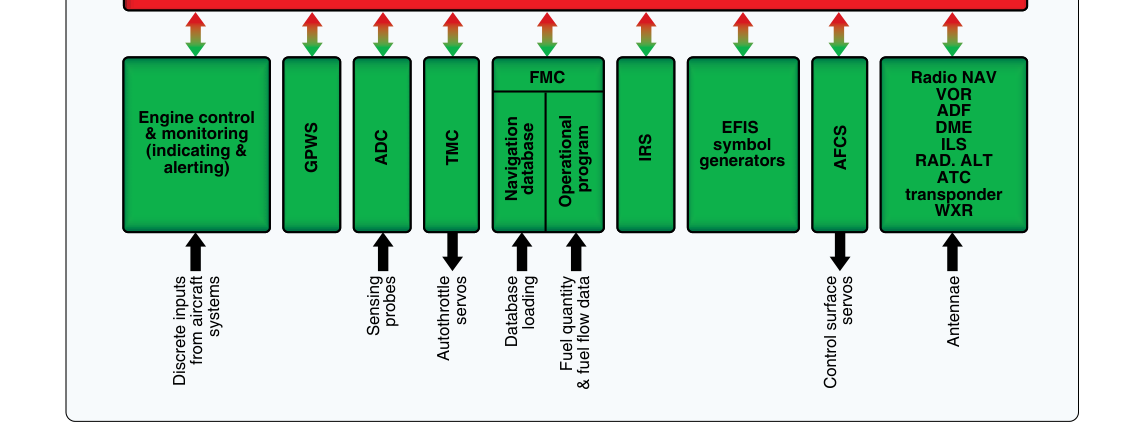
A Flight Management System (FMS) is the central avionics computer that unifies navigation, performance management, and flight planning into one integrated suite. Rather than relying on a single radio aid, the FMS fuses data from multiple independent sensors—Inertial Reference Systems (IRS), GPS receivers, VOR, DME, and air data computers—and applies a weighted blending algorithm to produce the most accurate, reliable position and flight path solution available at any moment. Pilots interact with this system through the Control Display Unit (CDU), a keyboard-and-screen interface sometimes called the Multi-Function Control Display Unit (MCDU) on Airbus-family aircraft. Through the CDU, crews enter route waypoints, Standard Instrument Departures (SIDs), en route airways, Standard Terminal Arrival Routes (STARs), approach procedures, and all performance initialization data before departure and throughout the flight.
How the FMS Builds and Manages the Flight Path
FMS navigation operates in two primary dimensions that work together to define a complete four-dimensional (4D) trajectory: lateral navigation (LNAV) and vertical navigation (VNAV).
Lateral Navigation (LNAV)
LNAV defines the horizontal flight path—the precise sequence of waypoints, course segments, and procedure transitions that form the route. The FMS computes the track between each waypoint using great-circle geometry and then commands the autopilot's roll channel to maintain that track. Each leg type in the navigation database follows a specific path terminator code (such as TF for Track-to-Fix, CF for Course-to-Fix, or RF for Radius-to-Fix), which tells the FMS exactly how to sequence and transition between segments. RF legs, which are constant-radius arcs around a defined center point, are particularly important for modern RNP Authorization Required (RNP AR) approaches, which can demand lateral accuracy as tight as 0.1 nautical mile (RNP 0.1). When the autopilot is coupled in LNAV mode, the aircraft steers automatically along the computed lateral path, freeing the crew to monitor system performance and manage other tasks.
Vertical Navigation (VNAV)
VNAV governs the vertical profile: climb thrust and speed targets, cruise altitude, step-climb points, descent path angle, and any altitude or speed constraints associated with waypoints in the route. The FMS computes an energy-efficient Top of Climb (TOC) and Top of Descent (TOD) based on current weight, winds, cost index, and aircraft performance data stored in the onboard performance database. During descent, VNAV calculates a continuous path—often a 3° profile matching an ILS-equivalent glide angle—and commands the autopilot's pitch channel and autothrottle to follow it. Altitude constraints loaded from a STAR or approach procedure (such as "at or above FL180 at ALPHA," or "cross BRAVO at 10,000 ft at 250 kt") are honored automatically by the VNAV mode, provided the crew has verified that the loaded procedure matches the current charted procedure.
Together, LNAV and VNAV allow the FMS to fly a complete 4D trajectory—latitude, longitude, altitude, and time—enabling Required Time of Arrival (RTA) functions used in Performance-Based Navigation (PBN) and airline schedule management. LNAV can be engaged independently of VNAV, but true 4D trajectory management requires both modes active and verified.
Performance Modes and Cost Index
Beyond navigation, the FMS manages the aircraft's performance through a certified, aircraft-specific aerodynamic and engine model stored in the performance database. This database is matched to the type certificate data for that airframe and engine combination and forms the computational foundation for every speed, thrust, and altitude recommendation the FMS makes.
Performance Initialization
Before departure, the crew enters critical performance data through the CDU: Zero Fuel Weight (ZFW), planned fuel load (giving the FMS gross weight at any point in the flight), cruise altitude, and Cost Index. The FMS uses this data to compute V-speeds (V1, VR, V2 on many aircraft types), optimum step-climb altitudes, fuel predictions, and expected landing weight. It also calculates VAPP—the approach reference speed adjusted for actual landing weight and conditions. Errors here are safety-critical: an incorrect ZFW, for example, causes the FMS to generate wrong V-speeds, an incorrect TOD point, and inaccurate fuel burn predictions throughout the flight. This is why crew verification of the performance initialization page is a required procedure before every departure, not merely a best practice.
Cost Index (CI)
The Cost Index is a dimensionless number, typically ranging from 0 to 999 (the exact scale varies by aircraft type), that represents the airline's economic trade-off between the cost of time and the cost of fuel. Specifically, CI = (time-related cost per hour) ÷ (fuel cost per unit of weight or volume). A Cost Index of zero directs the FMS to compute Maximum Range Cruise (MRC) speed—the speed that achieves the greatest distance per unit of fuel, minimizing burn at the expense of a longer flight time. A high Cost Index commands a faster speed, closer to maximum operating speed (VMO/MMO), reducing flight time but increasing fuel burn. Airlines adjust the CI based on fuel prices, schedule constraints, passenger connection value, and crew costs. Pilots must understand that a higher CI always means more fuel burned and less time en route—never the reverse.
Sensor Blending, RNP, and RNAV
The FMS continuously monitors the accuracy and integrity of all navigation sensors and applies a weighting scheme to blend them. GPS typically receives the highest weight when available because of its geometric accuracy, but the FMS cross-checks GPS position against IRS-derived position and DME/DME position fixes. If a sensor degrades or fails a consistency check, the FMS automatically reduces or removes its contribution, and the crew receives an alert. This sensor management underpins the aircraft's ability to meet Required Navigation Performance (RNP) values—the total system error (TSE) must remain within the specified RNP value for the operation being conducted, whether that is RNP 2 on an oceanic track or RNP 0.3 on a standard RNAV approach. The FMS computes Actual Navigation Performance (ANP), sometimes called Estimated Position Uncertainty (EPU), and compares it in real time to the required RNP. If ANP exceeds RNP, the crew must take action—requesting a different routing or abandoning an approach—because the navigation integrity required for the procedure can no longer be guaranteed.
Navigation Database and AIRAC Currency
The FMS navigation database contains all waypoints, airways, procedure legs, altitude constraints, speed limits, and transition data for the geographic regions of operation. This database is updated on a 28-day AIRAC cycle, the same international standard that governs chart publication. Operating with an expired navigation database is permissible for certain general navigation tasks but is not authorized for flying published RNAV or RNP instrument procedures, because procedure coding in the database must exactly match the currently charted procedure. Crews must verify database currency as part of the preflight FMS initialization process and confirm that loaded SIDs, STARs, and approaches match current charts—because a procedure may be charted identically yet have subtly different constraints in an older database cycle.
Key Numbers and Rules
- 28-day AIRAC cycle: The mandatory update interval for the FMS navigation database.
- RNP values: Range from RNP 10 (oceanic) down to RNP 0.1 (RNP AR approaches); the FMS must demonstrate ANP ≤ RNP at all times during the procedure.
- Cost Index 0: Commands Maximum Range Cruise speed (minimum fuel burn, maximum range).
- High Cost Index: Commands a faster speed schedule approaching VMO/MMO, increasing fuel burn while reducing flight time.
- ZFW entry: Must be accurate to within manufacturer-specified limits; errors propagate to V-speeds, TOD, and fuel predictions.
- RF leg: Requires RNP AR qualification and a certified FMS; cannot be flown without both.
- 4D trajectory: Requires both LNAV and VNAV active; LNAV alone provides only lateral guidance.
Common Test Traps
- LNAV without VNAV: LNAV can operate independently and provide lateral steering, but the full 4D trajectory—including time-of-arrival management—requires VNAV as well. Many questions probe this distinction.
- Cost Index and fuel burn direction: A higher CI commands faster speeds and burns more fuel, not less. The trap is assuming that "optimal" CI always means fuel savings.
- Expired database and instrument procedures: An expired database does not disable all FMS navigation, but it renders the system unauthorized for published RNAV/RNP procedures. The question often asks specifically about instrument procedure authorization.
- ANP vs. RNP: If ANP (actual system error estimate) exceeds the required RNP value, the crew must act—the FMS will alert, and the procedure cannot continue safely. Questions sometimes conflate these two values.
- Performance initialization verification: The FMS does not independently verify that crew-entered weight data is correct. It accepts what is entered. Crew cross-check against loadsheet values is the only safeguard.
Memory Aid
"LNAV steers left and right; VNAV manages the height." For Cost Index: "CI zero saves fuel; CI high saves time—and costs fuel."