Why Vision Limitations Matter for Traffic Detection
Clear skies and good visibility do not guarantee that a pilot will see conflicting traffic. The human eye has several built-in limitations that can make a fast-closing aircraft almost invisible until it is dangerously close. Understanding these physiological facts—and pairing that knowledge with proven scanning techniques—is one of the most important aeromedical skills a commercial pilot can develop. The FAA's Pilot's Handbook of Aeronautical Knowledge (PHAK) and the Risk Management Handbook both emphasize that the see-and-avoid concept depends entirely on the pilot understanding how and why the eye can fail.
How the Eye Works—and Where It Fails
The Fovea and Central Vision
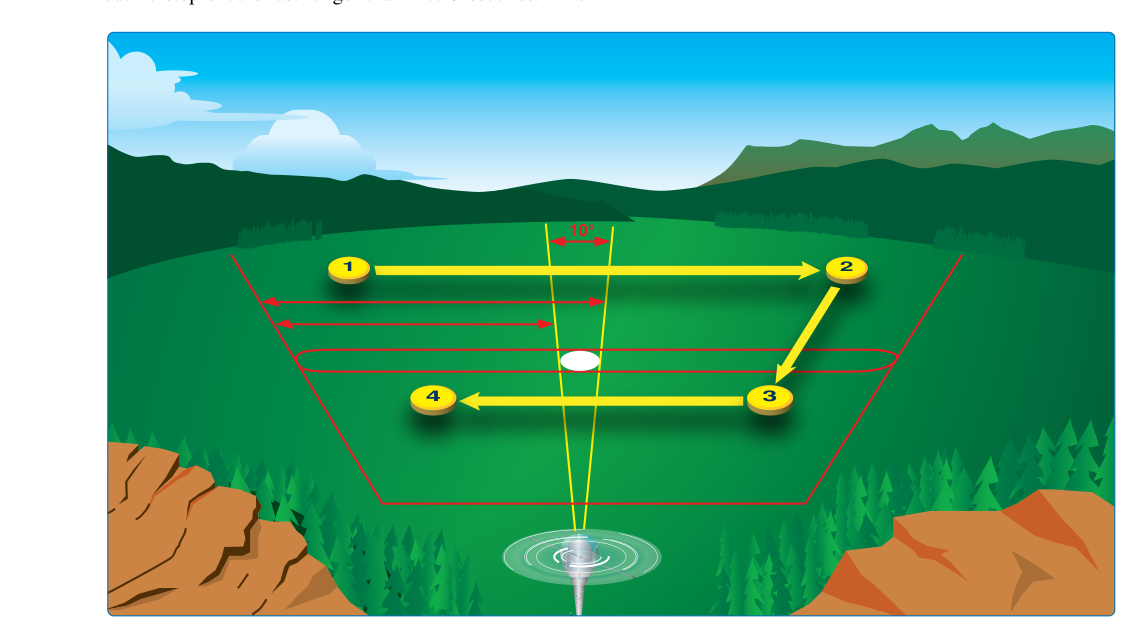
The retina contains two types of photoreceptors: rods and cones. Cones are densely packed in a small central region called the fovea, which subtends roughly 10 degrees of your total visual field. The fovea provides your sharpest color vision and your best ability to resolve fine detail. Everything you read, everything you consciously examine, is processed by foveal (central) vision.
The rest of the retina—the peripheral retina—is dominated by rods. Rods are extremely sensitive to motion and to dim light, but they resolve very little detail. This distinction is critical: an aircraft on a steady collision course produces no apparent motion relative to your line of sight—it simply grows larger. Because it does not move, it provides almost no stimulus to the motion-sensitive peripheral rods. The aircraft may sit perfectly camouflaged against the sky unless you point your fovea directly at it.
Empty-Field Myopia
When the eye has nothing to focus on—such as a featureless blue sky—it does not relax to infinity. Instead it settles at a resting focal distance of roughly 1 to 3 meters in front of the pilot. This phenomenon is called empty-field myopia. An aircraft miles away is simply out of focus and may not trigger conscious detection even if it falls within the pilot's central visual field. Regularly refocusing on a distant object or cloud helps break this tendency.
The Blind Spot
Each eye has a physiological blind spot where the optic nerve exits the retina. With two eyes open, each eye's blind spot is covered by the other eye's field of view, so binocular vision normally compensates. However, a pilot wearing a patch, or an aircraft positioned in exactly the right geometry, could fall into that blind spot momentarily.
Narrow Field of Sharpest Vision
Because the fovea covers only about 10 degrees, and truly sharp detail vision is limited to about the central 3 degrees of that cone, a pilot staring straight ahead can only resolve detail in a very small window. An aircraft 10 degrees off center may be blurry enough to escape recognition, even in good visibility. This is why random eye wandering is not an adequate substitute for a deliberate scan.
Time Required for the Eye to Refocus
Each time you shift your gaze to a new point in the sky, the eye must accommodate—refocus—to the new distance. This takes approximately 1 second. If a pilot moves the eye too quickly, the brain never receives a sharp image from any sector. Effective scanning therefore demands that each segment of the sky receive at least 1 second of dwell time, and ideally slightly longer.
The Closing Speed Problem
Commercial pilots must also understand the geometry of a collision course. Two aircraft approaching head-on at a combined closing speed of 400 knots are covering roughly 6.7 nautical miles per minute. At that rate, a target that first becomes recognizable at 7 miles provides only about 60 seconds of reaction time—and some of that time is consumed by detection, recognition, decision-making, and control input. The FAA notes that the reaction time needed to detect, recognize, and avoid traffic can easily consume most or all of that margin. This underscores why technique—not simply intention—determines whether see-and-avoid works.
Systematic Scanning Techniques
The Block Scanning Method
The FAA recommends a technique known as block scanning, sometimes called the sector scan. The pilot divides the forward visual field into a series of overlapping rectangular segments, each approximately 10 to 15 degrees wide. The eye moves methodically from one block to the next, pausing at least 1 second in each block to allow accommodation and foveal registration. The sequence typically begins at one side, moves across the forward hemisphere in steps, and then returns.
The pause in each block is non-negotiable. A pilot who sweeps continuously from left to right without stopping is doing almost nothing useful from a detection standpoint—the eye never has time to form a sharp image in any sector.
Movement Pattern
A common movement pattern is to scan from the far left of the windscreen in 10-to-15-degree steps toward the far right, then drop slightly in elevation and return right-to-left, covering both the horizon level and a band above and below it. The greatest threat sector is the area within roughly 60 degrees either side of the nose, because aircraft in that zone are most likely to be on a converging or head-on course. More scanning time and more care should be devoted to that forward sector.
Clearing Turns
Before entering practice areas, during climbs or descents, and whenever the cockpit or aircraft structure limits visibility, pilots should perform clearing turns—turns of at least 90 degrees (and often 180 degrees) to scan areas that were previously blocked. Clearing turns are required discipline before any practice maneuver, and failure to make them is a common cause of near-midair collisions during training.
Cockpit Duties and Eyes-Outside Balance
FAA research has shown that pilots spend a significant portion of flight time looking inside the cockpit at instruments, charts, or avionics. Every moment of inside reference is a moment of zero outside scan. The recommended habit is to complete an inside task, return eyes outside for a thorough scan, then return inside for the next task—never staying inside for prolonged periods. Autopilot use, if available, can reduce workload and free time for a better outside scan, but it does not substitute for it.
Using Peripheral Vision and Motion Cues
Although peripheral vision cannot resolve detail, it is sensitive to motion. An aircraft that is not on a collision course will appear to move across your visual field, and peripheral rods may alert you to look directly at it. Conversely, an aircraft on a true collision course will appear stationary but will grow in apparent size. Pilots should be alert to any object in the windscreen that seems to hold a fixed position and grow—this is a classic warning sign of a closing aircraft.
Environmental and Equipment Factors
Haze, sun angle, and windscreen scratches all degrade detection performance. Flying into a low sun can effectively blind a pilot to traffic in that sector entirely. Sunglasses that meet optical quality standards help reduce glare without distorting color perception. Tinted windscreens may shift color cues. ADS-B In displays and traffic alert systems (such as TCAS, where installed) provide a significant safety backup but do not replace visual scanning—not all aircraft are equipped with ADS-B Out, and regulatory requirements for equipage vary.
Stress, Fatigue, and Task Saturation
Aeromedical factors like fatigue, hypoxia, and stress all degrade the quality and frequency of the outside scan. A fatigued pilot tends to fixate—staring at one spot for too long—rather than executing a systematic block scan. High workload phases such as the traffic pattern, approach, and initial climb are precisely the phases where scan technique is most likely to break down and where the collision risk is highest due to traffic density.
Memory Aid
To remember the key elements of an effective scan, use the phrase STOP and LOOK: Sector by sector, Two eyes focused at distance, Overlapping blocks, Pause at least one second—then Look for any fixed or growing object, Outside more than inside, Occasionally clear turns before maneuvers, Keep scanning throughout the flight. While not an official FAA acronym, it captures the habits that the PHAK and Risk Management Handbook describe as essential to effective see-and-avoid technique.
Common Test Traps
- Empty-field myopia distance: The eye's resting focal point in a featureless sky is roughly 1–3 meters—not at infinity. Many students incorrectly assume the relaxed eye focuses far away.
- Collision-course aircraft appear stationary: An aircraft on a true collision course shows no lateral movement—it simply grows. Students sometimes expect a converging aircraft to move visibly across the windscreen before it is a threat.
- Continuous sweeping is not scanning: Moving the eyes quickly and continuously across the sky provides almost no useful information because the eye never has time to accommodate in any sector. The FAA specifically requires pausing in each block.
- The fovea covers only about 10 degrees: Some students overestimate central sharp vision. The area of truly fine detail (about 3 degrees) is tiny, making a systematic sector scan essential rather than optional.
- ADS-B In does not replace visual scanning: Traffic advisory systems are supplements. Not all aircraft are visible on traffic displays, and the regulatory see-and-avoid responsibility remains with the pilot-in-command regardless of installed technology.