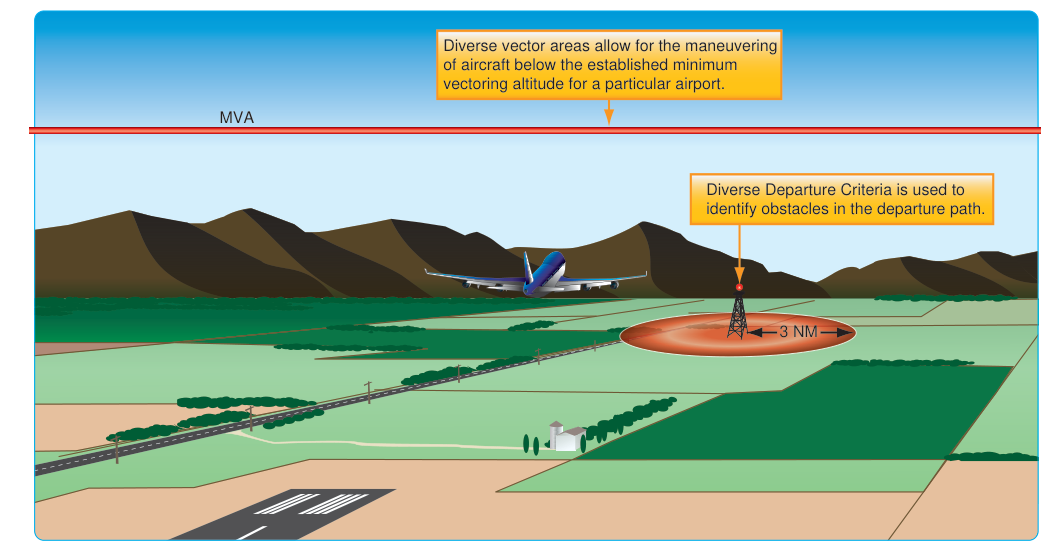
When you file IFR and taxi to the runway expecting to fly a published Standard Instrument Departure (SID) or Obstacle Departure Procedure (ODP), there is a real chance the controller will instead say something like, "Radar vectors for departure, fly runway heading, climb and maintain 3,000." That instruction sounds simple enough, but it raises an important question: how does ATC know that sending you off in that direction at that altitude keeps you clear of terrain and obstacles? The answer, in many cases, is the Diverse Vector Area (DVA). Understanding what a DVA is, where it applies, and what it means for your responsibilities as the pilot in command is fundamental instrument flying knowledge and a well-tested subject on the FAA Instrument Rating knowledge exam.
This article walks through the full picture of ATC radar vectors on departure — why they exist, how the DVA defines the protected airspace, what happens when no DVA exists, and exactly what you need to do (and not do) to stay safe during that critical early phase of flight.
The Basics of IFR Departure and Obstacle Clearance
Every IFR departure must account for obstacles in the surrounding environment. When you fly a published SID or ODP, the procedure designer has already surveyed the terrain and engineered the climb gradient, turns, and altitudes so that a normally-performing aircraft will clear all obstacles by the required margins. The pilot's job is simply to follow the procedure as published.
But ATC has an operational need for flexibility. Traffic sequencing, runway changes, weather deviations, and workload all lead controllers to issue radar vectors rather than a published procedure. When ATC takes you off a published procedure with a radar vector, the responsibility for obstacle clearance shifts — at least partially — to the system that authorized the vector. That system is codified in the concept of the Diverse Vector Area.
What Is a Diverse Vector Area (DVA)?
A Diverse Vector Area is a defined volume of airspace, assessed by the instrument procedure designer, within which ATC is authorized to provide radar vectors to departing IFR aircraft while still maintaining the required obstacle clearance. The FAA's terminal instrument procedure (TERPS) criteria govern how a DVA is established. Specifically, the area is evaluated to confirm that any heading an aircraft might be assigned — not just the runway heading — will keep that aircraft clear of obstacles during climb, provided the aircraft maintains a minimum climb gradient (typically 200 feet per nautical mile, the standard IFR departure climb gradient) and stays at or above the assigned altitude.
The DVA has both a lateral boundary and a floor altitude. The lateral extent of a DVA is not a fixed, standardized distance — it is established individually for each airport through the TERPS evaluation, based on the surrounding terrain and obstacles, and there is no single commonly cited distance (such as a flat 3 NM radius) that applies generally across airports. When ATC vectors you inside the DVA, the agency has effectively pre-certified that any vector it issues within that space is safe, assuming your aircraft can maintain the standard climb performance.
DVA information is communicated to pilots primarily through two channels. First, a note in the takeoff minimums and (obstacle) departure procedures section of a Terminal Procedures Publication (TPP, commonly called the approach plate booklet) may explicitly state that a DVA has been established and may describe any associated climb gradient or ceiling/visibility requirements. Second, instrument procedure charts may carry a note such as "Diverse departures authorized. Radar required." Always check the takeoff minimums section of the TPP for the departure airport before every IFR flight — it is not enough to assume that because a DVA exists, there are no constraints.
How ATC Uses the DVA in Practice
When departure control assigns you a heading other than the published procedure, the controller is operating with the understanding that the DVA protects your flight path. The typical scenario unfolds like this: after takeoff, the tower clears you and you contact departure control, which issues a vector — say, "Turn left heading 270, climb and maintain 4,000." The controller has verified that heading 270 falls within the DVA, and that 4,000 feet (or the intermediate altitudes you will pass through during the climb) provides the required obstacle clearance.
Your task as pilot in command is to comply with the instruction while maintaining aircraft control. You are NOT expected to independently verify obstacle clearance in the real-time sense — that is what the DVA certification provides. However, you absolutely ARE expected to climb at or above the standard climb gradient. If your aircraft cannot achieve 200 feet per nautical mile due to weight, density altitude, or performance degradation, you must advise ATC and, if necessary, decline the vector or request a different procedure. The DVA guarantee is predicated on standard climb performance.
When No DVA Exists: The Pilot's Responsibility
Not every airport has a DVA. Many smaller airports, airports surrounded by significant terrain, or those without radar coverage simply have not been evaluated for diverse departures. In those cases, if ATC issues a radar vector that takes you off a published ODP or SID, the regulatory responsibility is clear: the pilot in command must ensure obstacle clearance until reaching a safe altitude.
The Aeronautical Information Manual (AIM) is explicit on this point. If vectored off a published departure procedure in an area with no DVA, the pilot should either request to remain on the published procedure or, if accepting the vector, understand that obstacle avoidance becomes the pilot's responsibility. In practical terms, this means knowing your Minimum Vectoring Altitude (MVA) or Minimum IFR Altitude (MIA) for the area, being aware of local terrain and obstacles, and not accepting vectors that you believe compromise safety.
The MVA is the lowest altitude ATC may assign for radar vectoring, and it generally provides at least 1,000 feet of obstacle clearance in non-mountainous areas and 2,000 feet in designated mountainous areas, per FAA Order 7110.65; note that these are baseline minimums, and specific values can vary in defined circumstances near an airport where a documented procedure supports a different value. MVA charts are not published for pilot use; they are internal ATC documents. As a pilot, you rely on ATC to honor these minimums, but situational awareness of terrain remains your professional obligation.
Climb Gradients and Departure Visibility Requirements
Even within a DVA, the takeoff minimums page may impose additional requirements. If the instrument procedure designer determined that diverse departures require a climb gradient greater than the standard 200 feet per nautical mile — say, 300 or even 400 feet per nautical mile due to nearby terrain — this nonstandard takeoff minimum will be noted with an inverted black triangle (the ▼ symbol) on NACO-style charts, alerting you to check the takeoff minimums section carefully.
Similarly, ceiling and visibility requirements may be listed. Some airports specify that diverse departures under radar vectors are only authorized when the ceiling is at or above a certain height above airport elevation, ensuring the controller has radar contact before you enter cloud and potentially encounter terrain. Accepting a vector when you know conditions fall below these stated requirements is a significant error that could remove the obstacle protection you are counting on.
Key Numbers and Rules
- Standard IFR climb gradient: 200 feet per nautical mile. This is the baseline performance assumption for all departure obstacle clearance evaluations, including the DVA.
- MVA obstacle clearance: 1,000 feet in non-mountainous areas; 2,000 feet in designated mountainous areas — the minimums ATC must observe when issuing vectors, per FAA Order 7110.65.
- DVA lateral limit: Established individually for each airport by the TERPS evaluation; there is no standard or commonly cited lateral distance that applies across airports.
- Takeoff minimums symbol: The inverted triangle (▼) on instrument approach and departure charts signals that nonstandard takeoff minimums or departure procedures exist — always look up the details.
- Pilot responsibility without DVA: If no DVA exists and ATC vectors you off a published procedure, obstacle clearance becomes the pilot's responsibility until reaching a safe altitude.
- Radar (or approved surveillance) required: ATC must have radar or equivalent surveillance to issue any vectors, including those within a DVA. This is a general requirement of radar vectoring, not a feature unique to the DVA itself.
Common Test Traps
- Assuming a DVA always exists. Many FAA test questions hinge on the distinction between airports with and without DVAs. Remember: without a DVA, the pilot is responsible for obstacle clearance when accepting vectors off a published procedure.
- Ignoring the takeoff minimums page. Students often study approach plates but overlook the takeoff minimums section. This section contains DVA notes, nonstandard climb gradient requirements, and ceiling/visibility restrictions that are directly tested.
- Confusing MVA with MDA or DA. The Minimum Vectoring Altitude applies to ATC radar vectoring and is not the same as a Minimum Descent Altitude or Decision Altitude on an approach. MVA charts are ATC tools, not published pilot documents.
- Forgetting the climb gradient assumption. The DVA protects obstacle clearance only if you maintain at least 200 feet per nautical mile (or a higher gradient if noted). A sluggish climb due to high density altitude removes the protection the DVA provides.
- Thinking ATC bears all responsibility. While ATC manages separation and applies the DVA, the pilot in command retains final authority and responsibility for safe operation. If an assigned vector seems to point toward terrain in VMC, you have both the right and the duty to question or refuse it.
Putting It Together
The Diverse Vector Area is essentially a pre-flight safety analysis built into the airspace structure around an airport, allowing ATC to do its job — sequence traffic efficiently — without compromising the terrain clearance that every IFR departure demands. As an instrument-rated pilot, your role is to know whether a DVA exists at your departure airport, understand any climb gradient or weather constraints attached to it, and maintain the climb performance the system assumes. When those conditions are met, accepting a radar vector on departure is routine and safe. When they are not, you have both the right and the responsibility to say so.