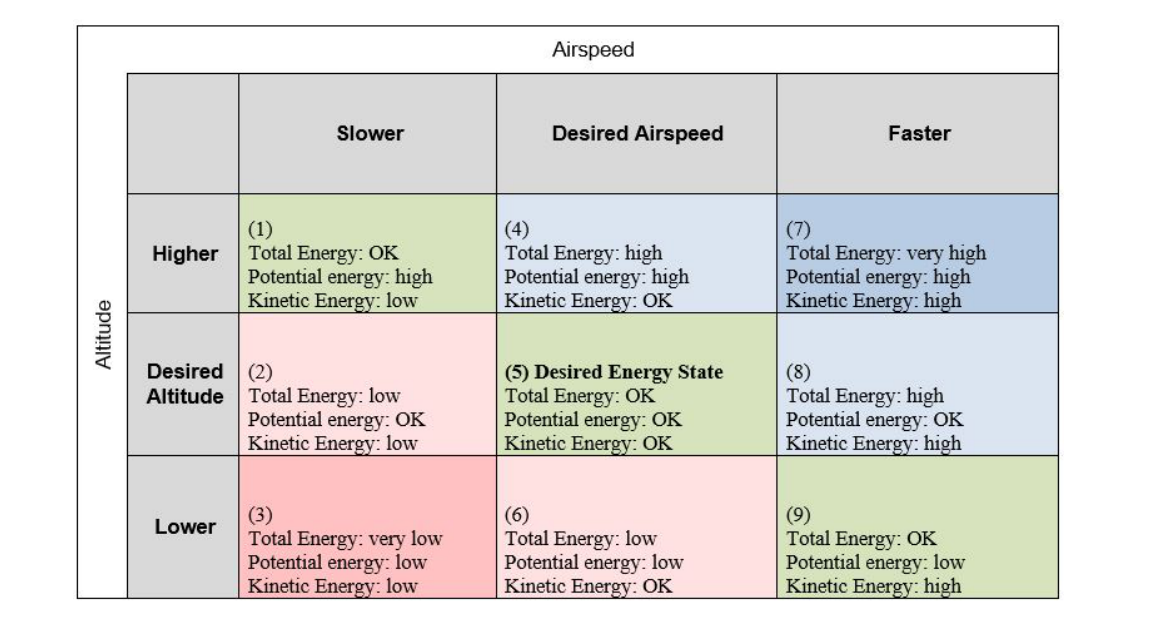
Modern transport-category aircraft are remarkably capable of managing their own speed, thrust, and trajectory through sophisticated automation. Yet accident investigations repeatedly highlight a troubling pattern: pilots who allow automated systems to fly the aircraft without maintaining a clear mental model of what the airplane is actually doing with its energy. Energy state awareness — understanding, at every moment, how much kinetic energy (airspeed) and potential energy (altitude) the aircraft possesses, and how rapidly those quantities are changing — is one of the most critically evaluated competencies on the ATP certificate and in airline training programs governed by 14 CFR Part 121.
The FAA's Risk Management Handbook (FAA-H-8083-2) frames energy management as a foundational risk-mitigation skill, and the Pilot's Handbook of Aeronautical Knowledge (FAA-H-8083-25) explains how thrust, drag, lift, and weight interact to determine an aircraft's total energy at any moment. When a pilot fully delegates aircraft control to an autoflight system without actively monitoring those parameters, the result is a dangerous gap between what the crew thinks is happening and what the airplane is actually doing — a condition sometimes called automation surprise.
What Energy State Really Means
An aircraft's energy state is the sum of its kinetic energy (a function of mass and velocity — essentially airspeed) and its potential energy (a function of mass and altitude). A useful way to think about it: a high, fast airplane has abundant energy; a low, slow airplane has very little. Between those extremes lies an infinite range of combinations, and the pilot's job — whether flying manually or supervising automation — is to ensure the aircraft always has the right combination for the current phase of flight.
In automated flight, the Flight Management System (FMS) continuously computes an energy trajectory based on the programmed route, speed targets, altitude constraints, and performance data. The autothrottle (or auto-thrust system) manages thrust to satisfy speed targets, while the autopilot manages pitch and bank to satisfy altitude and track targets. These two channels are deeply interrelated: if the autothrottle reduces thrust to slow the aircraft, and the autopilot simultaneously pitches up to capture an altitude, the aircraft may bleed energy faster than the crew anticipates. Conversely, a descent at idle thrust combined with a level-off command can produce a speed exceedance if the crew is not monitoring the energy picture.
How Automation Affects Energy Monitoring
The critical insight from the FAA's Instrument Flying Handbook (FAA-H-8083-15) is that increasing levels of automation do not reduce the pilot's responsibility — they change its nature. Rather than directly controlling pitch and thrust with hands and feet, the monitoring pilot must read the automation's intent from the flight mode annunciator (FMA), the autoflight control panel selections, and the primary flight display, then project that intent forward to verify the airplane will arrive at each upcoming constraint in an acceptable energy state.
Several automation-specific hazards can erode energy state awareness:
- Mode confusion: The autoflight system may be in a mode the crew did not intend or no longer remembers selecting. If VNAV PATH has transitioned to VNAV SPD without a crew acknowledgment, the aircraft may be descending at idle thrust and accelerating rather than maintaining a computed path. Reading and understanding the FMA is the primary defense.
- Managed versus selected guidance: In managed speed mode, the FMS commands a speed optimized for economy or procedure requirements. If an ATC speed restriction is not entered correctly, the airplane may be flying faster or slower than required, arriving at a fix with too much or too little energy.
- Autothrottle retardation on approach: During an automated approach, some autothrottle systems retard thrust to idle at a fixed point before touchdown. If the aircraft is high and fast on the approach, the autothrottle retarding to idle does not guarantee the energy problem will be resolved — the aircraft may still float or require an aggressive flare.
- Automation complacency: Research cited by the FAA's Aviation Instructor's Handbook (FAA-H-8083-9) notes that highly reliable automation can induce complacency, reducing the crew's scan rate and their willingness to intervene. Pilots may trust the system to self-correct rather than recognizing that some energy deviations demand immediate manual intervention.
- Thrust asymmetry and drag surprises: An unreported or unnoticed failure in one autothrottle channel, or an inadvertent speed brake deployment forgotten during a complex clearance, can alter the energy state faster than a passively monitoring crew will detect.
The Pilot's Monitoring Role
The ATP Airman Certification Standards (ACS) explicitly evaluate a candidate's ability to monitor and cross-check automated systems, recognize deviations, and intervene appropriately. This is not a passive role. The monitoring pilot (PM) is expected to maintain a continuous, active scan that includes: current airspeed relative to target, trend (accelerating or decelerating), altitude and vertical speed relative to the clearance and any approach constraints, thrust lever position relative to the commanded mode, and the FMA to confirm that active modes match crew intent.
A practical cross-check technique is the energy bracket: at every significant waypoint or step-down fix, the crew should mentally verify that speed is within the acceptable band for that fix and that altitude will be reached before the fix, not after. If the airplane is simultaneously above profile and fast, it is energy-high — a serious condition that becomes critical in the terminal environment where options for correction narrow rapidly. If it is below profile and slow, it is energy-low, which on approach can precede an aerodynamic stall or CFIT event.
Why Energy State Awareness Matters for Safety
The consequences of poor energy state awareness in automated flight are well-documented in accident data reviewed by the NTSB and summarized in FAA advisory materials. Unstabilized approaches — a leading cause of approach and landing accidents — frequently originate from an undetected energy-high condition in the terminal area that the crew failed to correct early enough. Stabilized approach criteria, as described in FAA Advisory Circular 120-71A and widely adopted in airline operations specifications and training programs, typically call for the aircraft to be on the correct flight path, at the correct airspeed, in the correct configuration, with thrust set appropriately for the approach by a defined gate altitude — commonly 1,000 feet AGL in IMC or 500 feet AGL in VMC under many carriers' SOPs. An energy-high aircraft that is still decelerating at 800 feet AGL is not stabilized, regardless of what the automation shows on the FMA.
The Risk Management Handbook (FAA-H-8083-2) also connects energy state awareness to threat and error management (TEM). An unexpected ATC speed restriction, a late runway change, or a wind-shear encounter are all external threats that alter the aircraft's energy state. Recognizing the threat early and projecting its energy consequences — before the FMS has had time to recalculate — is a hallmark of expert crew performance.
Key Numbers and Rules
- Stabilized approach gate: commonly 1,000 ft AGL in IMC; 500 ft AGL in VMC, per widely used industry guidance such as AC 120-71A — the aircraft must meet all stabilized criteria or execute a go-around.
- Speed tolerance on approach: Commonly expressed as target speed +10/-5 knots from VREF as an industry-standard SOP guideline (exact values set by airline SOPs and the aircraft AFM), reflected in guidance such as AC 120-71A rather than a fixed FAA regulatory number.
- FMA verification: The crew should verbalize and cross-check FMA changes at every mode transition — at minimum on takeoff, at thrust reduction, at top of descent, and at approach mode capture.
- Autothrottle authority limits: Understand the specific aircraft's thrust lever range in each autothrottle mode; in some aircraft the autothrottle does not protect against stall in all configurations.
- Go-around decision altitude: If energy cannot be managed to achieve stabilization by the gate, the go-around must be initiated immediately — delay is the most common fatal error in unstabilized approach accidents.
Memory Aid
Use the mnemonic FAST to structure your energy state cross-check during automated flight:
- F — FMA: Are the active flight modes what the crew intended and appropriate for this phase of flight?
- A — Airspeed: Is current speed on target, and is the trend (accelerating or decelerating) correct for the situation?
- S — Spool/Thrust: Are the thrust levers and autothrottle in the expected position, producing the expected power?
- T — Track and Altitude: Is the aircraft on the correct lateral and vertical path, and will it meet the next constraint on profile?
Running the FAST check at every significant event — mode change, altitude constraint, speed change, configuration change — keeps the crew's mental model synchronized with the airplane's actual energy state.
Common Test Traps
- Assuming automation equals safety: A common distractor implies that engaging the autopilot and autothrottle relieves the crew of energy management responsibility. It does not — it changes the monitoring task but does not eliminate it.
- Confusing FMA modes: Questions may describe a scenario where the aircraft is in an unexpected VNAV SPD or FLC mode and ask what the energy consequence will be. Know that speed-priority vertical modes may allow altitude deviations to satisfy a speed target.
- Ignoring configuration drag: Forgetting that extended flaps or gear dramatically increase drag — and therefore accelerate energy loss — is a classic energy-state trap on automated approach segments.
- Misidentifying the stabilization gate: Some questions conflate the 500-foot and 1,000-foot gates. Remember: 1,000 ft AGL is commonly used in IMC, 500 ft AGL in VMC, though some carriers' SOPs vary the gate altitude by approach type and conditions rather than applying one figure uniformly.
- Delayed go-around decision: Test items may present a scenario where an aircraft is unstabilized at the gate and ask the best action. The correct answer is always an immediate go-around — continuing is never the right choice below the gate if stabilized criteria are not met.