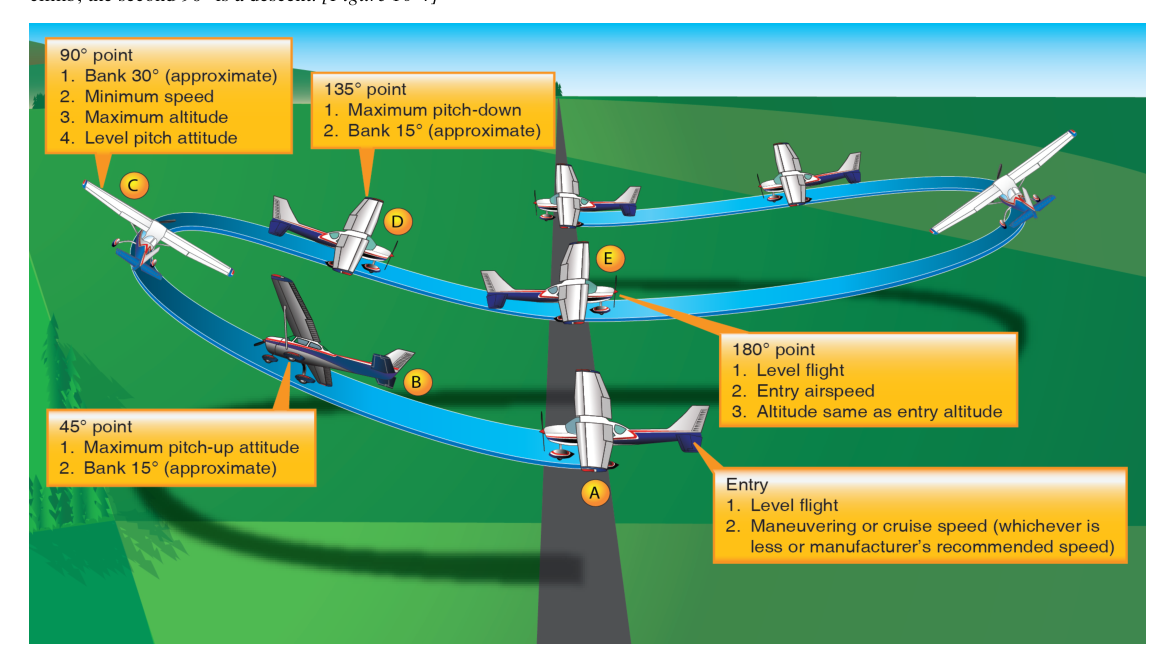
The lazy eight stands apart from every other commercial pilot maneuver because it is never truly finished — the moment the second half ends, the airplane is already set up to begin again in the opposite direction. The FAA Airplane Flying Handbook (FAA-H-8083-3) calls it the maneuver that best develops subconscious feel for the airplane precisely because it is flown almost entirely by reference to outside visual cues, with no level attitude held for more than an instant. That continuous, flowing quality is exactly what makes it the ideal tool for revealing coordination and energy management deficiencies that straight-and-level flight completely conceals.
This article breaks the maneuver down geometrically, explains the underlying physics at each reference point, identifies the most common errors and their root causes, and frames the performance standards you will be judged against on the commercial pilot practical test.
What the Lazy Eight Actually Is
The name describes the flight path: viewed from above and to the side, the airplane traces a figure-8 lying on its side — a lazy eight. The maneuver consists of two symmetrical 180° arcs, one to each side, each blending a climbing turn into a descending turn. Maximum bank is approximately 30°; the maneuver is not about steep banks. Instead, it is about the precise, ever-changing relationship among pitch attitude, bank angle, and airspeed across 360° of heading change. No single attitude is held; every control input is progressive and smooth.
Entry is from straight-and-level coordinated cruise flight. Before beginning, select a prominent reference point on the horizon oriented 90° to your starting heading — a road, a tree line, or a section line all work. That reference marks the peak of each half. You will also use the horizon itself at the 45° and 135° points and your original heading as the wings-level recovery point at 180°. Good outside visual reference is non-negotiable because the maneuver is performed by feel and visual reference, not by instrument cross-check.
Energy Management: The Physics Underneath the Geometry
Altitude and airspeed are two forms of the same total energy. The lazy eight makes that principle visceral. During the climbing arc of each half, the airplane trades kinetic energy (airspeed) for potential energy (altitude). During the descending arc, it converts that altitude back into airspeed. If the trade is executed correctly, the airplane arrives at the 180° point at precisely the entry altitude and entry airspeed — a perfect energy-neutral cycle. Any coordination error disturbs the exchange and produces an asymmetric, lopsided figure-eight.
Power management reinforces this concept. Most manufacturers specify an entry airspeed at or below the design maneuvering speed (VA), often roughly 10 knots below normal cruise, accomplished with a modest power reduction before entry. Once established, power is held constant throughout both halves. The pilot does not chase airspeed with throttle changes; instead, pitch and bank attitudes do all the work. This forces the pilot to manage energy through attitude alone — exactly the habit the maneuver is designed to build.
The Geometry of Each 180° Arc
Each half of the maneuver has four clearly identifiable reference points. Understanding what should be happening at each one — and why — is the foundation for both flying and evaluating the maneuver.
Entry (0°): Establish and Commit
From straight-and-level at the entry airspeed, simultaneously begin raising the nose and rolling into the bank. The rate of pitch increase and the rate of roll-in must be coordinated from the very first moment. A common beginner mistake is rolling first and then raising the nose, which front-loads the bank and produces a steep, fast entry rather than the slow, graceful build that characterizes a proper lazy eight.
The 45° Point: Maximum Pitch-Up, Minimum Bank
At 45° of heading change, the nose should be at its highest pitch attitude — approximately 15° to 20° above the horizon in most light trainers — while the bank is still relatively shallow at about 15°. The airplane is climbing and turning simultaneously, but it has not yet committed fully to the bank. Rudder pressure is critical here: as pitch rises and airspeed begins to decrease, left-turning tendencies (in a conventional propeller aircraft) intensify. Insufficient right rudder causes the nose to yaw left and the ball to slide out, degrading both coordination and the symmetry of the arc. The pilot must be proactively managing rudder pressure, not reacting to the yaw after it develops.
The 90° Point: The Peak — Slowest Speed, Steepest Bank
At 90° of heading change — directly abeam the horizon reference — the airplane reaches the apex of the arc. Three things converge here simultaneously: the pitch attitude passes back through the horizon (neither climbing nor descending), the bank angle reaches its maximum of approximately 30°, and the airspeed is at its minimum for the maneuver — approaching, but not reaching, the airplane's stall speed for that configuration and bank angle (meaning it has slowed well below entry speed). This convergence is not a coincidence — it is the result of properly distributed pitch and bank inputs throughout the first 90°. If the pilot arrived at the 90° point with too much bank and too little pitch during the climb, airspeed is too high and altitude gain is insufficient. If pitch was over-applied early, airspeed has decayed dangerously and the bank may be lagging.
The 135° Point: Maximum Pitch-Down, Decreasing Bank
As the descent arc begins, the nose continues to drop below the horizon, reaching approximately 15° to 20° below the horizon at 135° of heading change, while the bank angle is now unwinding back toward about 15°. Airspeed is increasing as the airplane descends. The coordination challenge reverses: as airspeed builds and propeller effects change, the rudder workload shifts. The pilot must roll out of the bank and raise the nose simultaneously so that the airplane arrives at the 180° point in a precise, coordinated, wings-level attitude.
The 180° Point: Symmetry Confirmed or Exposed
At 180° of heading change, the airplane must be wings-level, at the original entry altitude (±100 feet per the Airmen Certification Standards), at the entry airspeed, and in coordinated flight — immediately ready to begin the second half in the opposite direction without any stabilization pause. The 180° point is the report card. Any error accumulated over the previous half-circle shows up here as an altitude deviation, an airspeed deviation, or a wings-not-quite-level moment that disrupts the transition.
Common Errors and Their Root Causes
- Gaining too much altitude before the 90° point: Caused by raising the nose too aggressively early. The airplane arrives at the peak with airspeed well below target — a potential safety issue near stall in the bank.
- Losing altitude before the 90° point: Caused by allowing the bank to steepen too quickly relative to the pitch increase. The arc becomes a descending turn instead of a climbing turn.
- Skidding or slipping through the arc: Inadequate or imprecise rudder management. In the climbing portion, insufficient right rudder (in a left-turning-tendency aircraft) is the most common culprit.
- Asymmetrical halves: If the first 180° arc is flown differently from the second, the maneuver lacks the flowing, mirrored quality the FAA expects. Consistent reference-point discipline cures this.
- Altitude or airspeed deviation at the 180° point: The net result of any coordination or energy management error propagating through the entire arc.
Key Numbers and ACS Standards
- Entry airspeed: at or below VA, typically about 10 kt below cruise
- Maximum bank angle: approximately 30° at the 90° point
- Maximum pitch-up and pitch-down: approximately 15°–20° at the 45° and 135° points respectively
- Altitude tolerance at the 180° recovery: ±100 feet
- Coordination standard: coordinated flight (ball centered) throughout
- Power: constant after entry — no throttle chasing
Common Test Traps
- Confusing the steepest bank point (90°) with the highest pitch point (45°) — they are not the same.
- Assuming power changes are required mid-maneuver — they are not; constant power is standard.
- Forgetting that the slowest airspeed occurs at the 90° point, not at the highest pitch attitude (45°). The airplane is still slowing as it transitions from peak pitch to peak bank.
- Neglecting rudder management during the climbing arc, especially in aircraft with strong left-turning tendencies.
- Treating the 180° recovery as a rest point — the ACS expects an immediate entry into the second half.
The In-the-Cockpit Angle
Fly the lazy eight by painting a picture with the nose. Pick your horizon reference point, fix your eyes on it as you approach the 90° mark, and let the nose rise and fall symmetrically around it. Your feet should be continuously active — not making large corrections, but maintaining constant light pressure that keeps the ball centered as pitch and bank evolve. If the maneuver feels mechanical or choppy, slow down the roll-in rate and let the pitch attitude build ahead of the bank angle. Smoothness is not an aesthetic preference here; it is the direct indicator of correct energy management. A pilot who can fly a lazy eight to ACS standards has internalized the relationship between attitude and energy at a level that will serve them throughout their entire flying career.