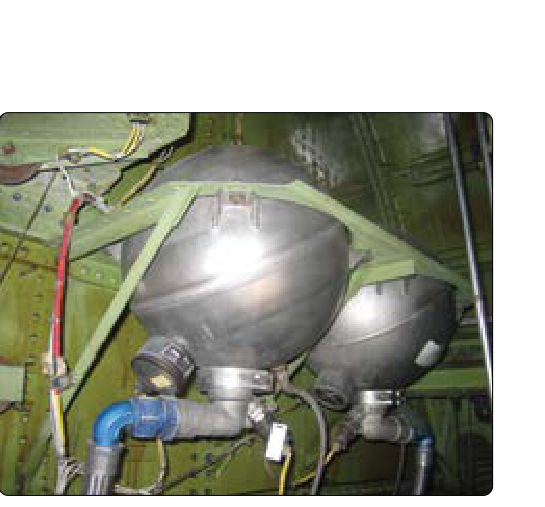
When an engine fire warning light illuminates in a cockpit, the crew's immediate defense is the High-Rate-of-Discharge (HRD) fire extinguisher system. Unlike slow-release pressurized canisters, an HRD bottle is engineered to flood an engine nacelle, wheel well, or APU compartment with extinguishing agent in a matter of seconds — fast enough to overwhelm a rapidly developing fire before structural damage becomes irreversible. For the Aviation Maintenance Technician (AMT) working on powerplant fire protection systems, knowing exactly how these containers are built, how they are tested, and what condemns them is not merely a knowledge-test requirement; it is a direct contribution to flight safety.
This article covers HRD bottle construction materials and design features, the pressurizing agents and extinguishing agents used, hydrostatic testing and service-life rules, visual and tactile inspection criteria, cartridge and discharge head inspection, and the common errors that appear on FAA AMT Powerplant knowledge tests.
Construction of the HRD Bottle
An HRD fire extinguisher container — commonly called a "bottle" regardless of its actual shape — is a high-pressure vessel machined or formed from either stainless steel or titanium alloy. Both materials offer the corrosion resistance and tensile strength needed to withstand the internal pressures required by the system, as well as the wide temperature range encountered in aircraft service (from sub-zero cruise altitudes to the heat radiating from an operating engine nacelle).
The bottle's shape is typically spherical or cylindrical with hemispherical end caps. A spherical geometry distributes internal pressure evenly across the entire wall, minimizing stress concentrations and allowing a thinner, lighter wall for a given pressure rating — a critical advantage in aircraft weight budgets. Cylindrical bottles with domed ends are also common where mounting geometry makes a sphere impractical.
Discharge Head and Cartridge
Mounted to the bottle outlet is the discharge head, which contains the explosive or electrically initiated cartridge (sometimes called a squib). When the flight crew pulls the fire-extinguisher handle and presses the discharge switch, electrical current fires the cartridge. The cartridge's explosive force ruptures or drives open a seal disk — sometimes called a frangible disk or burst disk — allowing the pressurized extinguishing agent to flow through the discharge tube and into the protected compartment through spray nozzles or perforated tubing.
Many transport-category aircraft use a two-shot system: two separate HRD bottles are installed per engine, each with its own cartridge and discharge valve, so the crew can make a second discharge attempt if the fire persists after the first shot. However, the number of bottles and shots is aircraft-specific per the type design, and not every transport-category aircraft uses this arrangement — the AMT must always consult the specific aircraft's maintenance manual for its fire extinguishing system configuration. Where installed, the bottles are plumbed so that either can be directed to either engine (or to the APU) through selector valves, depending on the aircraft design.
Pressurizing Agent
The bottle is pressurized with dry nitrogen to provide the driving force that expels the extinguishing agent. Nitrogen is chemically inert, non-flammable, and does not react with the extinguishing agent or corrode the container walls. The nitrogen pressure is held at a specified value (typically in the range of 600 psi or higher, though the exact value is model-specific and listed in the manufacturer's maintenance manual) and is maintained throughout the service life of the charged bottle.
Extinguishing Agent
Halon 1301 (bromotrifluoromethane) was the predominant agent used in aviation HRD systems for decades because of its exceptional fire-suppression efficiency at low concentrations. The Montreal Protocol called for developed countries to phase out production and consumption of halons, including Halon 1301, by January 1, 1994; this phase-out is carried out through national regulations (in the United States, under the Clean Air Act Title VI) rather than by the Protocol itself directly banning production. As a result, new production of Halon 1301 is effectively prohibited in the U.S. and other developed nations, but recycled Halon 1301 remains legal and widely used in existing aircraft systems. Some newer aircraft and replacement systems use alternative agents such as HFC-125 (pentafluoroethane) or combinations approved by the FAA under supplemental type certificates. The AMT must verify that any replacement agent is approved for the specific aircraft and that recharge quantities match the manufacturer's specifications exactly, because both under-filling and over-filling affect extinguishing effectiveness and bottle pressure.
Pressure and Weight Checks — The Primary Service Indicators
An HRD bottle that looks perfect on the outside may be unserviceable if its internal condition has degraded. Two measurements form the cornerstone of routine HRD bottle serviceability checks.
Pressure check: Each bottle has a pressure gauge or a pressure indicator (a pop-out or thermal indicator) visible from outside the nacelle or accessible for direct gauge reading. The gauge reading must fall within the green arc specified on the gauge or within the pressure range published in the aircraft maintenance manual for the ambient temperature at the time of inspection. Because gas pressure changes with temperature, most maintenance manuals include a pressure-versus-temperature chart; the AMT must determine ambient nacelle temperature and compare the measured pressure to the allowable range at that temperature. A reading in the red (low-pressure) zone means the bottle has leaked and must be removed and recharged or replaced.
Weight check: Many HRD systems — particularly those with liquid agent like Halon — also require periodic weighing of the bottle. The bottle is removed, disconnected from the discharge head (with appropriate electrical safety precautions to prevent inadvertent cartridge firing), and weighed on a calibrated scale. The measured weight is compared to the minimum allowable weight stamped or placarded on the container. If the bottle's weight has dropped below the minimum by more than the tolerance specified (often as little as a few ounces), the agent has leaked and the bottle is unserviceable. Both checks — pressure AND weight — may be required depending on the aircraft type, and neither check alone is always sufficient.
Hydrostatic Testing and Service Life
Like all aircraft high-pressure cylinders, HRD bottles are subject to hydrostatic testing at specified intervals. During a hydrostatic test, the bottle is completely emptied, filled with water or another incompressible fluid, and pressurized to a test pressure above its working pressure. For many DOT-regulated portable cylinders, this test pressure is commonly set at 5/3 of the service (rated) pressure, or approximately 167%; however, HRD bottles are aircraft parts rather than DOT-regulated shipping cylinders, and the actual hydrostatic test pressure for a given HRD bottle is specified by the bottle or aircraft manufacturer's maintenance manual and may differ from the generic DOT factor. The technician measures expansion during pressurization and checks for permanent deformation or leakage after pressure is released. Excessive permanent volumetric expansion condemns the bottle.
The hydrostatic test interval and the bottle's maximum service life (beyond which it must be retired regardless of condition) are specified by the manufacturer and referenced in the aircraft maintenance manual. These intervals are mandatory, calendar-based limits — not merely suggestions. An HRD bottle that has exceeded its hydrostatic test due date is unairworthy even if its pressure and weight are within limits. The test date is typically stamped on the bottle neck or on a metal tag attached to the container.
Visual and Physical Inspection Criteria
During scheduled inspections, the AMT performs a detailed visual examination of the bottle and associated plumbing. Conditions that condemn an HRD bottle or require further evaluation include:
- Corrosion: Surface corrosion on stainless steel or titanium bottles is unusual but can occur at crevices or where dissimilar metals contact the bottle surface. Any pitting, intergranular corrosion, or corrosion that cannot be removed with light polishing must be evaluated against manufacturer limits; deep pitting on the pressure vessel itself is cause for rejection.
- Dents and mechanical damage: Any dent, gouge, arc strike, or impact damage on the bottle shell must be measured against allowable limits. Because a dent reduces the effective wall cross-section and introduces stress concentrations, even relatively small dents in critical areas may be rejectable.
- Damaged or leaking fittings: Threaded fittings, safety plugs, and discharge head connections must show no sign of thread damage, cross-threading, or seeping agent. A faint residue of Halon around a fitting threads indicates internal leakage.
- Thermal damage: Discoloration, paint blistering, or distortion suggests the bottle was exposed to excessive heat — possibly from the very fire it was intended to fight. Such bottles must be removed from service regardless of gauge readings.
- Illegible markings: If the manufacturer's identification plate, hydrostatic test date stamp, or minimum weight markings are unreadable, the bottle cannot be returned to service without re-identification through manufacturer records.
Cartridge Inspection and Safety Precautions
The explosive cartridge (squib) in the discharge head has its own service-life limit, typically expressed as a calendar interval from the date of manufacture. The AMT must verify the cartridge has not exceeded this limit and must inspect the electrical connector pins for corrosion, bent pins, and security of the connector body. During any inspection or maintenance that brings personnel near the discharge head, the electrical connector must be disconnected and safetied before work begins — an inadvertent discharge inside a hangar can injure personnel and damage the aircraft. Many operators also install a safety pin through the discharge head mechanism as an additional ground-handling safeguard.
Key Numbers and Rules
- HRD bottles are constructed of stainless steel or titanium alloy.
- Pressurized with dry nitrogen; agent is typically Halon 1301 or an approved substitute.
- Pressure check must be compared to a temperature-corrected pressure chart — not just the gauge face alone.
- Weight check tolerance is model-specific; even a small loss (a few ounces) can condemn the bottle.
- Hydrostatic test pressure is aircraft/bottle-manufacturer specified; a common generic DOT portable-cylinder factor is 5/3 of service pressure (approximately 167%), but the applicable HRD bottle test pressure comes from the manufacturer's maintenance manual.
- Both hydrostatic test interval and maximum service life are mandatory calendar limits.
- Cartridge squib has its own calendar-based service life from date of manufacture.
- Always disconnect and safe the electrical connector before handling the discharge head.
Common Test Traps
- Pressure check without temperature correction: The FAA frequently tests whether the AMT knows that a pressure reading must be evaluated against the ambient temperature using a manufacturer's chart — not simply verified against a fixed value printed on the gauge face.
- Pressure check alone vs. weight check: Some questions imply that a correct pressure reading alone confirms serviceability. In many systems, both pressure AND weight must be verified; a bottle can show correct pressure yet be low on agent if gas has partially replaced leaked liquid.
- Hydrostatic test date vs. service life: Students confuse the periodic hydrostatic test interval (recurring) with the maximum retirement life (one-time limit). A bottle must be retired at its life limit even if it just passed a hydrostatic test.
- Agent substitution without approval: Replacing Halon 1301 with any alternative agent requires FAA approval (STC or manufacturer approval); an AMT cannot simply substitute an agent that seems chemically similar.
- Cartridge safety: Forgetting to disconnect the squib connector before handling the discharge head is both a test trap and a genuine safety hazard — always disconnect and safe first.