Every instrument approach procedure includes a missed approach segment — the published escape route you must follow any time you cannot land safely from an instrument approach. Whether you reach the missed approach point (MAP) without the runway in sight, lose visual contact after descending below minimums, or simply decide a go-around is necessary, executing the published missed approach procedure correctly is one of the most critical skills in IFR flying. Yet many instrument students spend the bulk of their study time focused on the descent phase and treat the missed approach as an afterthought. This article corrects that imbalance by walking through exactly how missed approaches are depicted on approach charts and what the climb gradient requirements really mean in practice.
Understanding missed approach procedures requires familiarity with two intertwined elements: the charted textual and graphical depiction of the procedure and the standard and non-standard climb gradients that define whether your aircraft can legally and safely execute it. Both appear on every instrument approach chart and both are regularly tested on the FAA Instrument Rating knowledge exam.
How Missed Approach Procedures Are Depicted
On FAA instrument approach procedure (IAP) charts — produced by the National Aeronautical Charting Office (NACO) and commonly referred to as approach plates — the missed approach procedure appears in two places simultaneously.
First, the textual description is printed in the notes box at the top of the chart, directly beneath the briefing strip. It describes the missed approach in plain language, for example: "Climb to 500 feet, then climbing left turn to 2,000 feet direct WAKER LOM and hold." This text is the primary, authoritative instruction. Read it before every approach briefing.
Second, the graphical depiction appears in the plan view (the overhead map view) of the chart. The missed approach track is drawn as a dashed line, often with an arrow, showing the initial climbing path and the route to the holding fix or intermediate fix where you will be issued further clearance. The dashed-line convention is universal across U.S. IAP charts and distinguishes the missed approach path from the solid-line approach course.
The missed approach point (MAP) itself is charted specifically for each approach type. On a precision approach (ILS, LPV), the MAP is defined by reaching the decision altitude/height (DA/DH); there is no geographic fix — you must act the moment your altimeter reads DA. On non-precision approaches (VOR, NDB, LNAV), the MAP is typically defined by a fix, a distance on DME, a time from the FAF, or the runway threshold, whichever the procedure specifies. The MAP symbol on the plan view is usually shown as "MAP" with a flag or identifier.
Holding patterns associated with the missed approach are depicted in the plan view with the standard racetrack symbol. The holding fix, inbound course, direction of turns, and leg length (if non-standard) are all labeled. You must be prepared to enter this hold on the first attempt, because ATC expects you to fly the published missed approach and hold until you receive a new clearance or are re-sequenced for another approach.
Climb Gradient Requirements
Here is where many pilots are surprised: instrument approach procedures are designed around a standard obstacle clearance climb gradient of 200 feet per nautical mile (ft/NM) from the MAP to the specified altitude or fix. This is the default assumption baked into every approach unless otherwise noted. If your aircraft can achieve 200 ft/NM during the missed approach, you meet the baseline obstacle clearance criteria for that segment.
To put 200 ft/NM in relatable terms: at a groundspeed of 90 knots, 200 ft/NM equates to a climb rate of approximately 300 feet per minute (fpm). At 120 knots groundspeed, the same gradient requires roughly 400 fpm. The formula is straightforward: required climb rate (fpm) = gradient (ft/NM) × groundspeed (knots) ÷ 60. Practice this arithmetic because the knowledge test presents it in several forms.
Non-Standard Climb Gradients
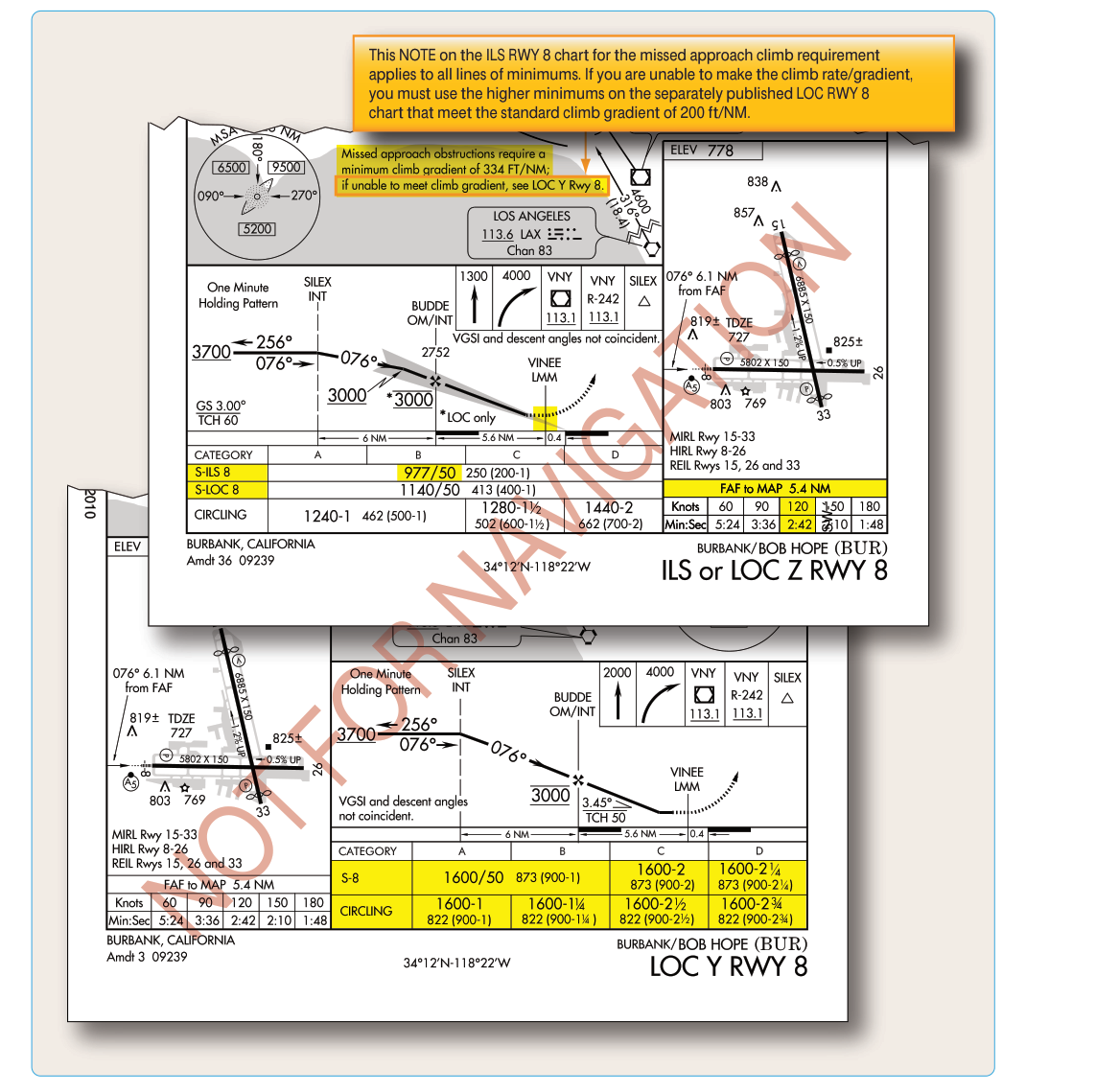
When the terrain or obstacles near an airport demand a steeper departure path in the missed approach segment, the procedure designer publishes a non-standard climb gradient. These are charted explicitly as a required climb gradient in ft/NM — for example, "Climb gradient of 390 ft/NM required to 1,800 feet." On NACO charts, this information appears in the notes section of the chart and is also shown in the plan view near the missed approach track. On Jeppesen charts, non-standard climb gradients are prominently noted in the briefing strip.
A non-standard climb gradient is not a suggestion. If your aircraft cannot meet the published gradient — due to aircraft performance, density altitude, weight, or a combination — you are not authorized to fly that approach under IFR unless you can ensure obstacle clearance by another means. There is no regulatory provision for simply hoping the gradient is achievable; the performance must be verified before the approach begins.
Some procedures publish an alternative missed approach procedure alongside the non-standard gradient. The alternate missed approach provides a shallower gradient path (often with a different routing), but it usually comes with higher weather minimums because it may not clear all obstacles until a greater altitude is reached. When an alternate missed approach is published, the chart will show both options clearly, and the associated minimums for each will differ in the minimums box.
Why Missed Approach Climb Gradients Matter
The reason climb gradients are so tightly specified comes down to terrain and obstacle clearance. After the MAP, particularly during the initial climbing turn, an aircraft at low altitude, low airspeed, and possibly in IMC has almost no margin for error. Procedure designers calculate the obstacle clearance surface using the aircraft's expected flight path; if the aircraft cannot climb as steeply as assumed, it may conflict with terrain, towers, or other obstacles that the procedure was designed to clear.
This risk is especially pronounced at airports surrounded by rising terrain, near mountainous areas, or at high-elevation airports where density altitude significantly degrades climb performance. Before flying any approach in such environments, obtain your aircraft's current climb performance data from the Pilot's Operating Handbook (POH) and compare it against the published gradient under actual conditions.
Key Numbers and Rules
- Standard missed approach climb gradient: 200 ft/NM from the MAP to the procedure's specified altitude.
- Climb rate formula: fpm = gradient (ft/NM) × groundspeed (kts) ÷ 60. Example: 200 ft/NM at 90 kts = 300 fpm.
- Non-standard gradients are published explicitly in ft/NM and must be verified against aircraft performance before beginning the approach.
- On precision approaches, the MAP is the decision altitude (DA) — a point in time and altitude, not a geographic fix.
- On non-precision approaches, the MAP is defined by a fix, DME distance, or computed time from the FAF.
- Missed approach instructions must be executed immediately upon reaching the MAP if the runway environment is not in sight and the required flight visibility does not exist.
- If you lose visual reference after descending below DA/MDA, you must immediately execute the missed approach — 14 CFR 91.175(e) is explicit on this point.
- ATC does not automatically know you are going missed. Declare the missed approach on frequency as you initiate the procedure.
Memory Aid: "MAP-CLIMB-HOLD"
When you reach the missed approach point, the sequence of actions is always the same: MAP — recognize you are at the missed approach point and that landing is not assured; CLIMB — add full power, establish a positive climb, retract flaps on schedule per the POH (not all at once), and follow the published track; HOLD — navigate to the published holding fix, enter the hold correctly, and contact ATC for further clearance. While not an official FAA acronym, this three-step sequence keeps priorities in order and prevents the most common error: hesitating at the MAP before committing to the climb.
Common Test Traps
- Confusing DA with MDA on the missed approach point: DA is a decision point — you must act when the altimeter hits that number. MDA is a floor — you may not descend below it, but you remain at MDA until the MAP fix or time is reached. The timing of the go-around decision differs significantly between the two.
- Ignoring non-standard climb gradients: The test may describe an aircraft's climb performance and ask whether the crew may legally conduct the approach. If the performance does not meet the published gradient, the answer is no — even if the weather is well above minimums.
- Misapplying the climb rate formula: The FAA test often gives groundspeed and gradient and asks for required climb rate in fpm, or vice versa. Remember that the formula uses groundspeed (not indicated airspeed); gradient (ft/NM) multiplied by groundspeed (NM/hr) yields a rate in feet per hour, and dividing by 60 converts that hourly rate into feet per minute.
- Assuming the published missed approach is always flyable in any conditions: High density altitude, aircraft weight near maximum, or an inoperative engine can all reduce climb performance below the required gradient — the pilot in command must verify performance before the approach, not after a missed approach is initiated.
- Forgetting to brief the missed approach before descending: 14 CFR and FAA instrument flying guidance consistently emphasize that the missed approach procedure must be reviewed and understood as part of the approach briefing. On the knowledge test, questions about the correct time to review the missed approach always point to before the approach begins.
Mastering missed approach depiction and climb gradient requirements is more than a test topic — it is a fundamental IFR survival skill. Every instrument approach you fly should end with a clear mental picture of what you will do if the runway does not appear. Brief it, verify your aircraft can meet the gradient, and be ready to execute without hesitation.