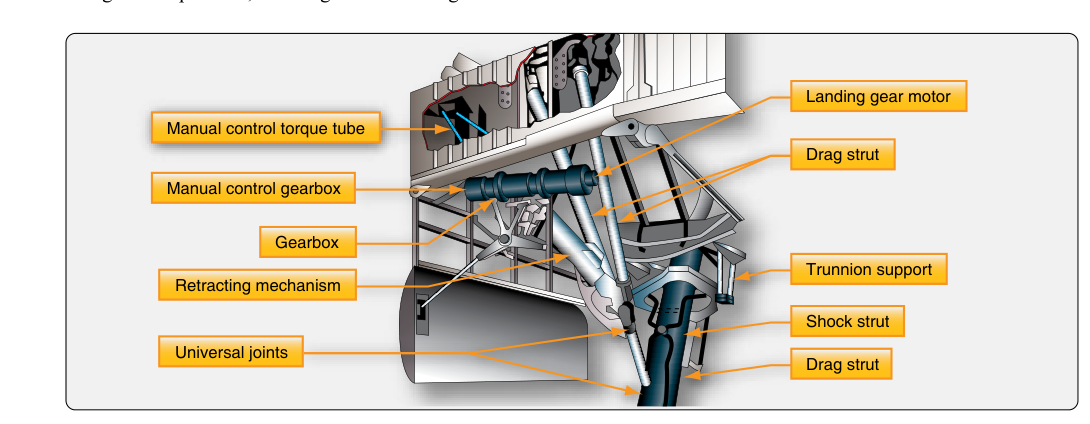
The landing gear system on a transport-category aircraft is one of the most safety-critical assemblies on the airplane. Unlike light general aviation aircraft where a pilot physically cranks or electrically motors the gear, transport aircraft rely on powerful hydraulic systems, redundant extension methods, and sophisticated sensing logic to manage gear position reliably across thousands of flights. For Airline Transport Pilot (ATP) candidates, a thorough understanding of retraction mechanics, free-fall emergency extension, and air/ground sensing is not only a written-test requirement — it directly informs sound operational judgment every time you push or pull the gear handle.
This article walks through each major subsystem in depth, explains the underlying engineering rationale, identifies the key numbers and rules examiners test, and highlights the conceptual traps that catch even experienced pilots off guard.
Landing Gear Retraction: Hydraulic Power and the Uplocking System
Most transport-category aircraft retract the main and nose landing gear using hydraulic actuators powered by one or more independent hydraulic systems. When the flight crew selects gear up after liftoff, a hydraulic selector valve routes pressurized fluid to the retraction side of each actuator. The gear swings into its wheel well and the uplocks — mechanical latches — engage to hold the gear firmly in the retracted position against aerodynamic and inertial loads. This is essential: if an uplock failed to engage, the gear could drift down under its own weight in flight, creating drag and an asymmetric condition.
The gear doors are sequenced as part of the same hydraulic circuit. Typically, door actuation is mechanically linked to, or electrically sequenced with, gear travel so that doors open before the gear moves and close after retraction is complete. Proper sequencing prevents the gear from contacting a partially open door — a potentially catastrophic structural event. Some designs use mechanical linkages that open doors automatically as the gear travels, while others use separate hydraulic or electric actuators controlled by proximity switches.
Gear downlocks operate on the same principle in reverse. During extension, hydraulic pressure drives the gear to the down position, and a downlock mechanism — often a locking brace or over-center link — snaps into place, holding the gear open even if hydraulic pressure is lost. A green gear-down-and-locked indication confirms the downlock is engaged; without it, even a visually extended gear may not be structurally capable of supporting the aircraft's weight on landing.
Free-Fall (Gravity) Emergency Extension
Every transport aircraft must provide a means to extend the landing gear independent of the normal hydraulic power source. The most common method is free-fall extension, also called gravity extension. In this procedure, the pilot opens an alternate gear release that disengages or bypasses the uplocks without requiring hydraulic pressure. Once the uplocks are released, gravity and aerodynamic forces pull the gear down and into the locked position.
The free-fall procedure is typically initiated through a dedicated alternate extension handle, lever, or panel — physically separate from the normal gear handle to prevent inadvertent selection. On some aircraft, the alternate extension system uses a small independent hydraulic accumulator to crack the uplock open before allowing gravity to do the rest. On others, a manual cable connected to the uplock mechanism is pulled by the crew. In all cases, the intent is the same: get the gear down and locked without relying on the primary hydraulic system.
Critical to a successful free-fall extension is aircraft speed and attitude. Most manufacturers specify a maximum speed for alternate extension — often the same as or slightly below the normal gear extension speed (VLO) — because the aerodynamic loads on the gear doors and struts increase rapidly with airspeed. A sideslip or yaw may also be used on some aircraft to help swing the main gear outboard and into the down-lock position. Always consult the Aircraft Flight Manual (AFM) or Quick Reference Handbook (QRH) procedure, because free-fall extension steps are aircraft-specific.
After free-fall extension, the gear doors may remain open or only partially closed because normal door sequencing depends on hydraulic pressure. This increases drag, which must be accounted for in approach performance. Additionally, retraction of the gear after a free-fall extension is generally not possible until normal hydraulic power is restored, so a go-around must be planned accordingly.
Air/Ground Sensing Systems
One of the most important, yet often under-studied, subsystems in transport aircraft is the air/ground sensing system, sometimes called the weight-on-wheels (WOW) system or squat switch system. This network of sensors tells the aircraft's various systems whether it is airborne or on the ground, and dozens of automatic functions depend on the correct signal.
The classic sensor is a squat switch (also called a ground sensing switch or weight-on-wheels switch) mounted on the main landing gear strut. When the aircraft is on the ground, the compressed strut closes the switch. When the gear extends in flight and the strut extends fully, the switch opens, signaling an airborne condition. Modern aircraft may use proximity sensors (inductive or magnetic) rather than mechanical switches for improved reliability and reduced maintenance.
The air/ground signal is used to enable or inhibit a large number of systems and protections, including:
- Gear retraction inhibit: Most aircraft include a ground safety switch or gear lever lock that prevents gear retraction while on the ground. If the squat switch indicates ground mode, the gear handle is mechanically or electrically locked in the down position, preventing an accidental retraction during taxi or while on the runway.
- Spoiler and thrust reverser arming: Ground spoilers and thrust reversers are typically armed by the crew before landing, but actual deployment or unlock is enabled at touchdown by the WOW signal, often in combination with wheel spin-up and/or strut compression logic — the specific arming-versus-deployment scheme varies by aircraft type.
- Autopilot and autothrottle behavior: Many autoflight systems transition to ground modes upon touchdown, reducing authority or disconnecting altogether.
- TCAS and GPWS inhibits: TCAS resolution advisories are inhibited below certain radio altitudes and TCAS typically transitions toward Standby or TA-only near the ground based primarily on radio altitude, while GPWS modes are similarly governed by altitude and aircraft configuration rather than the WOW signal alone; WOW is one input among several used to prevent nuisance alerts during ground operations.
- Pressurization and bleed air logic: Some pressurization controllers shift modes based on the air/ground signal.
A failed or incorrectly rigged squat switch is therefore far more than an annunciation problem — it can result in spoilers not deploying on landing, thrust reversers failing to unlock, or a gear retraction inhibit remaining active in flight. During preflight, maintenance personnel perform a landing gear rigging check to verify that squat switches activate at the correct strut extension.
Why It Matters: Operational and Safety Considerations
Gear-related accidents and incidents continue to appear in aviation safety databases, most often due to: gear-up landings resulting from distraction or checklist skipping; structural failures caused by landing on an unlocked gear; and system malfunctions exacerbated by crew misunderstanding of the alternate extension procedure. Understanding the system deeply — rather than just memorizing the handle positions — enables better decision-making when something goes wrong.
For example, a crew that understands the air/ground sensor logic will recognize that a faulty squat switch stuck in the ground position could prevent gear retraction after takeoff, while one stuck in the air position could allow inadvertent gear retraction on the ground or prevent automatic spoiler deployment on landing. Knowing which systems depend on the WOW signal helps crews troubleshoot unexpected behavior and communicate accurately with maintenance.
Key Numbers and Rules
- VLO (Landing Gear Operating Speed): The maximum speed at which the gear may be extended or retracted. Exceeding VLO during retraction and extension can damage gear doors and actuators.
- VLE (Landing Gear Extended Speed): The maximum speed at which the aircraft may be flown with the gear extended. On many designs VLE is equal to or higher than VLO, but this relationship is aircraft-specific rather than a universal rule, and some aircraft have a VLE lower than VLO depending on gear door and structural design.
- Downlock verification: A green light (or green light per gear position) confirms downlock engagement. Three green lights indicating gear down and locked are the standard expected indication before landing on a tricycle-gear transport aircraft, per checklist and AFM/QRH procedures.
- Free-fall speed limits: Alternate extension must be initiated at or below the speed specified in the AFM, which is commonly at or near VLO.
- Squat switch logic: The system reads ground mode when the main gear strut is compressed; air mode when the strut is fully extended.
Common Test Traps
- Confusing VLO and VLE: VLO is the operating speed (during gear movement); VLE is the extended speed (gear already down). They are different values and have different meanings. Exceeding VLO while the gear is in transit is especially damaging.
- Assuming free-fall requires no crew action: Free-fall extension is not fully automatic — it requires the crew to manually release the uplocks via the alternate extension procedure. It is not a passive backup.
- Overlooking door status after alternate extension: After a free-fall extension, gear doors often remain open, increasing drag. Performance calculations for the approach and go-around must reflect this.
- Thinking the gear lever lock only prevents accidental retraction: The ground safety interlock is driven by the air/ground sensor and has implications for every system that depends on WOW logic — not just the gear handle itself.
- Forgetting that a downlock indication is required, not just gear extension: Gear can be down but not locked. Only a confirmed downlock (green light) is operationally acceptable for landing. A gear down but unlocked is a gear-up landing in progress.