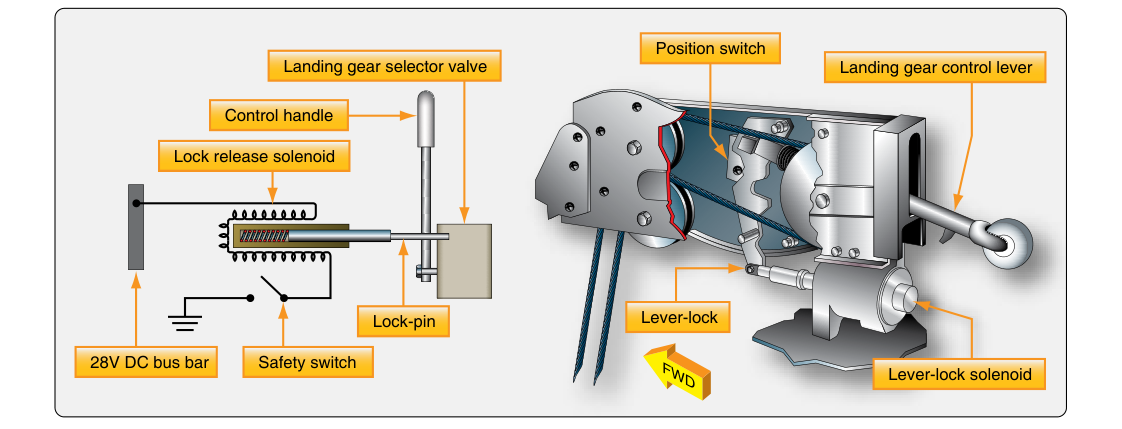
A gear-up landing ranks among the most preventable — and most expensive — accidents in general aviation. Every complex or high-performance airplane equipped with retractable landing gear must therefore include a warning system that alerts the pilot when the gear is not in the down-and-locked position at an inappropriate time. Understanding the logic behind these systems, including the critical role of the squat switch, is not merely an exam requirement; it is fundamental airmanship for any commercial pilot operating complex equipment.
How Gear Warning Systems Work
The FAA requires an aural warning device — typically a horn or buzzer — on retractable-gear aircraft that activates whenever a defined set of conditions indicates an imminent landing attempt with the gear retracted. Most systems monitor a combination of two or three parameters simultaneously.
Throttle Position as the Primary Trigger
On the majority of general aviation retractable-gear aircraft, the warning horn activates when throttle position is retarded toward idle and the gear is not down and locked. Some installations use manifold pressure as a proxy for throttle position; others incorporate a flap position sensor as an additional trigger (for example, activating the warning whenever flaps are extended beyond a certain setting with the gear up). A critical point — one the FAA Airplane Flying Handbook (FAA-H-8083-3) emphasizes — is that the system is triggered by power reduction, not by proximity to the ground. The aircraft has no way of knowing whether the pilot is on short final or performing a simulated engine-out at 5,000 feet AGL. Every time power is pulled back with the gear retracted, the horn will sound. This is intentional design, not a malfunction.
Airspeed-Based Triggers
Some more sophisticated installations add an airspeed sensor to the logic circuit. When airspeed drops below a threshold consistent with approach speeds and the gear is still retracted, the aural warning activates independently of throttle position. This provides a redundant layer of protection for pilots who might be flying a power-off glide or a high-drag descent where throttle position alone might not reliably signal an approach.
Squat Switch Logic Explained
The squat switch — formally called a weight-on-wheels (WOW) switch — is one of the most consequential single components in a complex aircraft's gear system. It is mounted on the main landing gear strut assembly, positioned so that the compression of the oleo strut under the aircraft's weight changes the switch's electrical state.
Ground State vs. Flight State
When the aircraft is on the ground, the oleo strut is compressed, placing the squat switch in the ground state. In this state, the gear retraction circuit is electrically interrupted, making it impossible for the pilot to retract the gear even if the handle is moved to the UP position. This single safety interlock prevents what would otherwise be a catastrophic gear collapse on the runway — an event that could occur through inadvertent handle movement during the takeoff roll or landing rollout.
Once the aircraft becomes airborne, the oleo strut extends to its unloaded length. This mechanical change toggles the squat switch to the flight state, completing the gear retraction circuit and enabling the pilot to raise the gear normally. The transition typically happens within a second or two after wheels leave the runway. On some aircraft, a brief delay relay prevents gear retraction for a short interval after liftoff as an additional safeguard against bounced-landing gear collapses.
Secondary Functions of the Squat Switch
Beyond preventing inadvertent gear retraction, the squat switch integrates with multiple other aircraft systems. On turbine-powered aircraft it commonly inhibits thrust reverser deployment until weight is confirmed on wheels, preventing catastrophic in-flight reverser activation. Many autopilot systems are inhibited in ground state through the same circuit. On pressurized aircraft the squat switch can interact with pressurization scheduling logic. For the commercial pilot written knowledge test and practical test, the primary tested function remains gear-retraction prevention on the ground, but candidates should recognize the switch's broader role across aircraft systems.
Verifying Gear Position: Three Independent Confirmations
The FAA's philosophy for gear position confirmation is redundancy. Relying on any single indicator — including the warning horn being silent — is inadequate. Most retractable-gear general aviation aircraft provide three independent methods of confirmation.
Gear Position Indicator Lights
The most direct confirmation comes from gear position indicator lights, typically one per gear leg. A green light indicates that the corresponding gear is fully extended and mechanically locked — the downlock mechanism has engaged and closed the circuit to the light. A gear that is moving but not yet locked will show no green light. Some aircraft use a red or amber light to signal gear-in-transit or an unsafe condition. Three steady green lights prior to touchdown is the universally accepted confirmation of a safe gear-down state.
Gear Handle Position
The cockpit gear handle confirms pilot input only. Moving the handle to the DOWN position commands the gear to extend, but it provides no information about whether the gear actually traveled to the locked position. Mechanical failures — a broken downlock linkage, a hydraulic failure mid-extension, or a gear door interference — can all result in a handle in the DOWN position with the gear not locked. The handle is a necessary check but never a sufficient one.
Visual Confirmation
Many aircraft incorporate small convex mirrors on the engine nacelles or the wing surface, allowing the pilot to visually confirm that the main gear is extended. For nose-gear confirmation, some aircraft have a small window or port in the cockpit floor. When indicator lights are suspect or conflicting, a tower fly-by at low altitude allows ground personnel to visually inspect the gear and relay the information by radio — a technique specifically discussed in the AIM and the Airplane Flying Handbook.
Why This Matters for Commercial Pilots
The FAA Airman Certification Standards for the Commercial Pilot certificate require applicants to demonstrate knowledge of complex aircraft systems, including the logic of gear warning and safety interlock systems. A commercial pilot candidate who cannot explain why the gear warning sounds during a practice engine-out, or who cannot articulate the difference between the gear handle position and actual gear-locked status, reflects a misunderstanding that is directly tied to accident risk. Gear-up landings remain statistically significant in the accident record precisely because pilots short-circuit their confirmation flow under workload or distraction.
- Always confirm three greens before every landing — make it a non-negotiable habit, not a workload-dependent check.
- Confirm gear on every approach, including touch-and-go practice — pattern work with repeated power changes is exactly when distraction causes gear-up landings.
- A silent warning horn does not equal gear down — a failed squat switch or a circuit fault can silence the horn while the gear remains retracted; always cross-check with position lights.
- The horn sounding in flight during a simulated engine failure is normal — recognize it, confirm gear-up is intentional, and reset your flow when you add power.
- The squat switch prevents retraction, not extension — if the aircraft is on the ground and the gear handle is moved to UP, the system should prevent movement; it does not automatically extend gear.
Common Test Traps
- Throttle position, not altitude, triggers the warning — candidates sometimes believe the system senses proximity to the ground; it does not.
- Green lights indicate down AND locked, not merely down — a gear in transit will not illuminate the green light; only a fully engaged downlock closes the circuit.
- The squat switch enables retraction after liftoff — it does not retract the gear automatically — the pilot must still command retraction; the squat switch only removes the electrical interlock.
- Handle position is a command input, not a position confirmation — always cross-check handle position with indicator lights.
- A malfunctioning squat switch is a serious maintenance discrepancy — if it fails in the ground state, gear retraction after takeoff may be impossible; if it fails in the flight state, inadvertent retraction on the ground becomes possible.
Memory Aid
The classic before-landing gear confirmation flow is often summarized as GUMPS: Gas (fuel quantity and tank selection), Undercarriage (gear down, three green), Mixture (rich or as required), Propeller (high RPM), Seatbelts/Safety (passengers briefed). Running GUMPS on downwind, base, and final builds the habit repetition that prevents gear-up landings even under high workload.