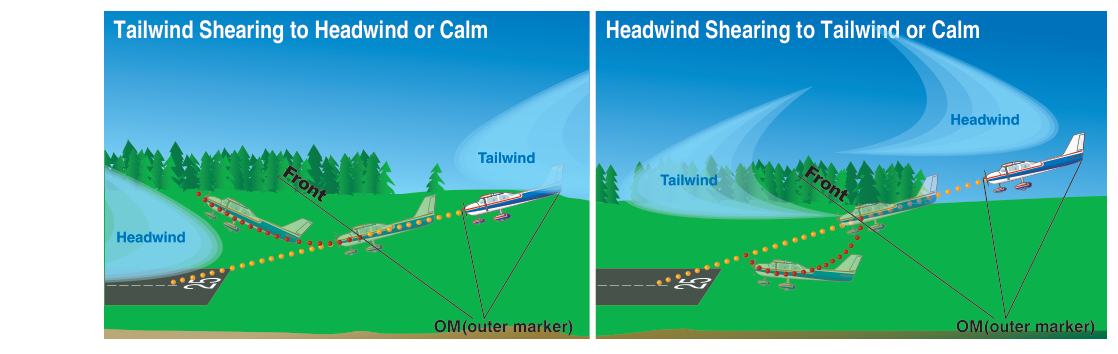
A microburst is one of the most lethal weather phenomena an airline crew will ever face. It is a small but violent downdraft that, upon striking the ground, spreads outward radially in all directions, creating a two-phase wind-shear environment that can overwhelm the performance capability of even a fully-rated transport-category aircraft in seconds. The FAA's Aviation Weather Handbook (FAA-H-8083-28) defines a microburst as a concentrated downdraft with a horizontal extent of less than 2.5 nautical miles and a total lifespan of about 5 to 15 minutes from initiation to dissipation, with peak intensity typically lasting only 2 to 5 minutes—yet within that brief window, the wind velocity change across the shear boundary can equal or exceed 45 knots. For context, many transport jets can sustain a maximum climb rate on the order of 1,500–2,500 feet per minute at low altitude and heavy weight. A microburst downdraft of that magnitude is not survivable without aggressive, immediate action.
What Generates a Microburst
Microbursts are produced by convective activity, but the triggering mechanism is more subtle than simply flying into a thunderstorm. Two primary microburst types are recognized in FAA training materials.
Wet Microbursts
Wet microbursts are accompanied by heavy precipitation at the surface. They are most common in humid, subtropical environments and are often visible on airborne weather radar as a classic high-reflectivity cell. The falling precipitation drags air downward; evaporative cooling within the column accelerates the downdraft further. Despite being detectable by radar, wet microbursts can still develop faster than a crew can react once an approach is committed.
Dry Microbursts
Dry microbursts occur when precipitation evaporates completely before reaching the ground—a phenomenon called virga. The evaporation produces intense cooling that drives a violent downdraft, yet little or no rain may be falling at the surface. The cloud base may appear benign, and airborne weather radar may show only weak or moderate returns. Dry microbursts are particularly dangerous precisely because they look innocuous. They are especially common over high-elevation, arid terrain such as the Intermountain West. The Aviation Weather Handbook specifically flags virga as a high-priority visual cue that demands immediate diversion consideration.
Detection Considerations
Some microbursts develop from convective clouds that produce only moderate radar returns yet rapidly intensify, which is why reflectivity alone cannot be relied upon to judge severity. Terminal Doppler Weather Radar (TDWR), operated by the FAA and co-located at many major airports, is specifically designed to detect the radial velocity divergence signature of a microburst outflow at low altitude—a capability that conventional ASR radar and most airborne systems lack. TDWR issues both Microburst Alerts (MBA) and Wind Shear Alerts (WSA) to ATC, which controllers are required to relay to pilots.
The Microburst Performance Sequence
Understanding the exact aerodynamic sequence of a microburst encounter during approach is essential for ATP knowledge testing and, more critically, for decision-making in the cockpit. The sequence has three distinct phases that unfold in rapid succession.
Phase 1 — The False Headwind
As the aircraft enters the leading edge of the microburst outflow, it flies into an increasing headwind component. This produces a momentary airspeed gain—typically 10 to 20 knots or more—accompanied by an apparent improvement in glidepath. The autothrottle may reduce thrust in response. This phase is deceptive. The crew may perceive conditions as improving, and without training, there is a powerful temptation to continue the approach. This is the trap that has contributed to multiple fatal accidents.
Phase 2 — The Downdraft Core
Within seconds, the aircraft crosses the outflow boundary and enters the downdraft core. Vertical velocity changes drive the aircraft toward terrain regardless of pitch attitude or thrust setting. The autothrottle advances to maximum, but the energy deficit may already exceed what is recoverable on a stabilized glidepath. Airspeed begins to decay rapidly as the headwind advantage disappears.
Phase 3 — The Tailwind Shear
Exiting the far side of the microburst, the aircraft now faces an outflow that has become a direct tailwind. The effective angle of attack drops, lift decreases, and indicated airspeed can fall 20 to 40 knots or more within seconds. The aircraft is simultaneously too low, too slow, and descending—with the threshold or terrain directly ahead. This phase is when the margin for recovery is smallest. The FAA's Aviation Weather Handbook and Risk Management Handbook (FAA-H-8083-2) both emphasize that the energy budget available to the crew at this point may be insufficient to prevent ground contact unless TOGA thrust was applied at the first unambiguous warning, not at confirmation of the tailwind phase.
Low-Level Wind Shear Beyond the Microburst
Low-level wind shear (LLWS) is the broader hazard category of which microbursts are the most extreme subset. LLWS can originate from temperature inversions, mountain wave activity, frontal boundaries passing through the terminal area, and the mechanical turbulence of strong surface winds around terrain features. The Low-Level Wind Shear Alert System (LLWAS), installed at many airports, uses a network of surface anemometers to detect divergent wind flows and issue alerts to ATC. Regardless of the source, LLWS below 1,000 feet AGL is particularly dangerous because altitude margins for recovery are thin and crew workload during approach or departure is high.
Recognition — Before and During Penetration
- TDWR Microburst Alert (MBA): Issued by TDWR when a microburst is detected within the terminal area surveillance domain near the airport. The alert includes the runway affected, the wind gain/loss in knots, and distance from the runway end. Alert magnitude and severity are conveyed by the specific wind loss/gain value reported, and crews should treat any TDWR microburst alert as an immediate go-around consideration.
- Wind Shear Alert (WSA): Issued when wind shear less than microburst intensity is detected; still warrants an immediate go-around decision.
- PIREPs: Pilot reports of significant airspeed fluctuations on final approach should prompt heightened caution and are commonly used by air carriers, per their own SOPs, as a go-around trigger.
- Predictive Wind Shear (PWS): Onboard forward-looking radar systems can detect the velocity divergence signature of a microburst outflow before the aircraft enters it, providing advance warning that can range roughly from 10 to 60 seconds depending on aircraft speed and system—enough time, in many cases, to initiate a go-around before penetration. FAA Advisory Circulars address crew response procedures for PWS alerts.
- Visual cues: Virga, a pronounced rain shaft with a flared or splayed base, a ring of blowing dust at the surface (the microburst outflow foot), a low arcus or shelf cloud, or a sudden onset of surface dust devils near the approach path.
- Reactive cockpit indicators: An unexplained airspeed increase of 10 knots or more that the autothrottle did not command, combined with a vertical deviation above glidepath, is Phase 1 of the performance sequence. Treat it as a microburst until proven otherwise.
Recovery — The Escape Maneuver
When inadvertent microburst penetration occurs on approach or during departure, the FAA and aircraft manufacturers prescribe a single, aggressive escape maneuver. The priority order is: maximum available thrust (TOGA), pitch to the recommended go-around or wind-shear escape attitude, and do not chase the airspeed or the glidepath. In most transport-category aircraft, the wind-shear escape pitch attitude is published in the quick-reference handbook and is typically several degrees higher than the normal go-around attitude to arrest the descent rate as rapidly as possible.
Attempting to hold glidepath by lowering the nose in a downdraft accelerates terrain closure. Altitude loss during the escape maneuver is expected and must be accepted—the objective is to stop the descent, not to maintain altitude. Flap retraction follows normal go-around procedures; landing gear retraction should be initiated only after a positive climb rate is confirmed on the altimeter or vertical-speed indicator. Declare an emergency if necessary to ensure priority handling and to alert ATCT that runway incursion protection may be needed.
Key Numbers and Rules
- Microburst horizontal extent: less than 2.5 nautical miles
- Total microburst lifespan: approximately 5 to 15 minutes, with peak intensity lasting about 2 to 5 minutes
- Wind velocity change across the boundary: 45 knots or more
- PIREP-based go-around triggers: vary by carrier SOP; not a single FAA-codified numeric threshold
- TDWR MBA: alerts are runway-specific and report the actual wind gain/loss value rather than a single universal severity threshold
- LLWAS anemometer network coverage: surface-level wind divergence detection only
Common Test Traps
- Microbursts require heavy rain at the surface. False. Dry microbursts and virga-associated microbursts produce little or no surface precipitation and may show weak radar returns.
- The initial airspeed increase signals improving conditions. This is the most dangerous misconception. The headwind spike is Phase 1 — the tailwind and downdraft are immediately behind it.
- A Microburst Alert covers the whole airport equally. TDWR MBAs are runway-specific, directional, and time-limited. Conditions on the parallel runway may be completely different.
- Reducing thrust and lowering pitch will recapture the glidepath in a downdraft. In any microburst encounter, the correct response is always maximum thrust and a positive pitch attitude. Glidepath is irrelevant; terrain separation is the only priority.
- PWS replaces the need for ATC weather advisories. Predictive systems enhance awareness but have detection limitations, especially for weak or rapidly forming microbursts. TDWR alerts, PIREPs, and crew visual scanning remain essential layers.