Class B airspace is the most tightly controlled airspace category in the United States national airspace system. Designed to protect the dense flow of airline and cargo traffic arriving and departing the country's busiest commercial airports, Class B creates an orderly, radar-positive control environment around major hubs. For the student pilot, understanding Class B is not just an exam requirement—it is a fundamental safety literacy skill. Getting it wrong can mean an airspace violation, a potential collision, or an enforcement action from the FAA.
Unlike some other airspace types where radio contact alone suffices, Class B has a hard, non-negotiable legal trigger: you must receive an explicit clearance from ATC before entering. This distinction trips up many students on the knowledge test and, more dangerously, in the actual cockpit. This article will walk through how Class B is structured, what the rules require, what equipment you need, and the specific traps the FAA loves to test.
Structure and Dimensions of Class B Airspace
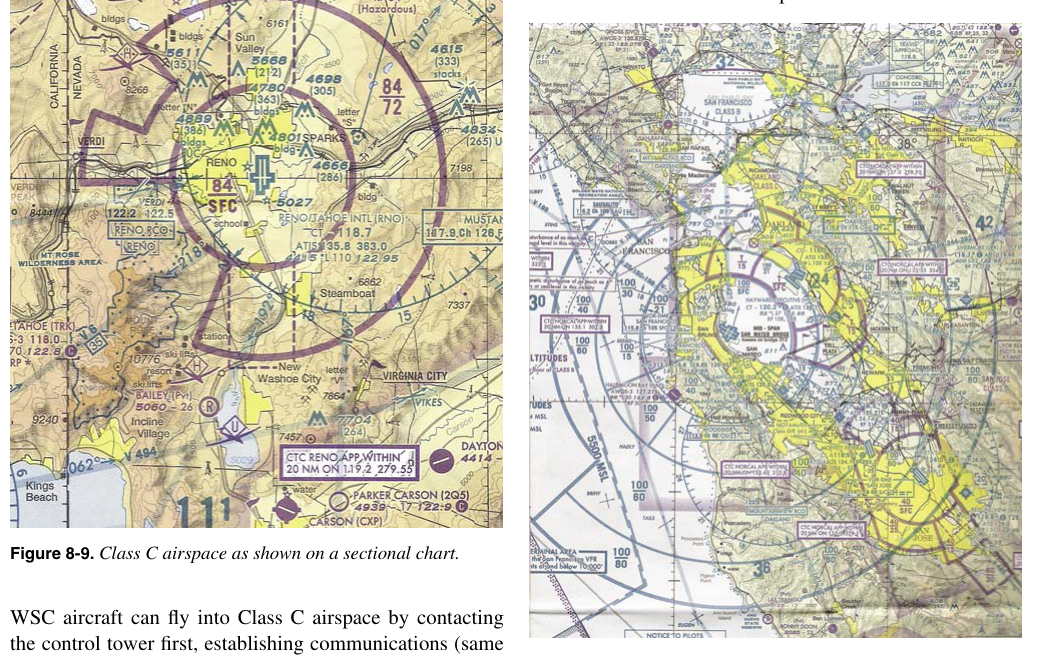
Class B airspace is depicted on sectional aeronautical charts as solid blue lines forming concentric rings or irregular arcs around a primary airport. The FAA describes it as resembling an upside-down wedding cake: it is widest at the top and narrower (or nonexistent) at lower altitudes near the airport's perimeter. This stepped design allows arriving and departing instrument traffic to remain inside controlled airspace throughout their entire approach or departure, while still giving VFR aircraft a practical path to fly underneath or around the area.
Each Class B area is custom-designed for its particular airport environment. The primary airport sits at the center. Around it, the FAA publishes a set of lateral and vertical boundaries that define each tier or "shelf." For example, a typical inner ring might extend from the surface up to 10,000 feet MSL, while an outer ring might begin at 3,000 feet MSL and extend up to 10,000 feet MSL. The specific floors and ceilings vary from location to location, so pilots must consult current sectional charts or Chart Supplements and must never assume a generic shape. On a sectional, the upper limit and lower limit of each shelf segment are printed in blue as a fraction: the number on top is the ceiling in hundreds of feet MSL, and the number on the bottom is the floor. A floor listed as "SFC" means the shelf extends all the way to the surface.
Class B always has a ceiling—it is not open-ended. The top of Class B airspace is typically 10,000 feet MSL, although some locations differ slightly. Above the ceiling, the airspace reverts to a different classification, usually Class E. Below each shelf, pilots may fly VFR without a clearance, though they must still observe VFR weather minimums appropriate to that underlying airspace.
The ATC Clearance Requirement — What It Really Means
Under 14 CFR Part 91.131, no person may operate an aircraft within Class B airspace unless that aircraft has received an ATC clearance from the controlling facility. This is critically different from simply establishing radio contact. In Class C and Class D airspace, the standard is radio contact before entry. In Class B, you must hear the words of a positive clearance—something along the lines of "Cessna 12345, cleared into the Class Bravo"—before you cross the boundary.
A common and dangerous misconception is that calling up approach control and receiving a response such as "Cessna 12345, standby" constitutes a clearance to enter. It does not. If the controller says "standby" or simply acknowledges your call without issuing a clearance, you must remain outside Class B until that explicit authorization is given. The FAA's own guidance reinforces this: an aircraft must not enter Class B until clearance is received. Standby is not a clearance; acknowledgment of your call sign alone is not a clearance.
Once cleared, you must comply with any instructions issued by ATC, including assigned altitudes, headings, and transponder codes. ATC may also issue a "Traffic Advisory" area or amend your clearance at any time. If communications are lost while inside Class B, pilots should follow the procedures outlined in the AIM and squawk 7600.
Equipment Requirements Inside Class B
Operating inside Class B airspace requires specific onboard equipment, as spelled out in 14 CFR Part 91.215 and Part 91.131:
- Two-way radio communications equipment capable of communicating with ATC on the designated frequency.
- An operable transponder with Mode C (altitude encoding capability). You must have Mode C not only inside Class B but also within 30 nautical miles of the primary Class B airport, from the surface up to 10,000 feet MSL. This 30-nautical-mile ring is often called the "Mode C veil."
- ADS-B Out is also required within Class B airspace and within the Mode C veil (30 nm radius, from the surface up to 10,000 feet MSL), under 14 CFR Part 91.225, which became fully effective January 1, 2020.
It is worth emphasizing that the Mode C veil extends well beyond the actual Class B lateral boundaries. An aircraft flying in uncontrolled airspace below Class B shelves but within 30 nm of the primary airport still needs a functioning Mode C transponder and ADS-B Out. The only exceptions are aircraft that were not originally equipped with an engine-driven electrical system and that remain below the Class B floor or below 10,000 feet MSL where the veil applies—a narrow and uncommon situation.
Pilot Certification and Student Pilot Limitations
Not every certificated pilot may simply request and receive a Class B clearance. 14 CFR Part 91.131 establishes that student pilots and recreational pilots are prohibited from operating within Class B airspace unless they have received ground and flight training specific to that Class B area and have obtained a logbook endorsement from an authorized instructor specifically for that airport's Class B. This endorsement is airport-specific: a student endorsed for operations in Chicago's Class B (O'Hare/Midway area) cannot use that endorsement to enter Atlanta's Class B (Hartsfield-Jackson area).
Additionally, student pilots are prohibited from landing at certain primary airports within Class B entirely—regardless of endorsement. The FAA publishes a list of these "primary airports" (sometimes called the "busy 12" or "Group 1" airports, including locations such as Atlanta Hartsfield, Chicago O'Hare, and Los Angeles International, among others) where student pilots cannot land or take off without a higher certification level. These restrictions exist because the traffic density and operational complexity at those specific airports are considered beyond the scope of student pilot experience.
VFR Weather Minimums Inside Class B
Once cleared into Class B, VFR weather minimums are 3 statute miles visibility and clear of clouds. This is uniquely simpler than the standard 1,000/500/2,000 ceiling and distance rule used in Class D and Class E airspace. The rationale is that inside Class B, ATC is providing radar separation to all participating traffic, so the primary collision risk is managed by positive control rather than by pilot see-and-avoid margins. However, visibility must still be at least 3 statute miles, and the pilot must remain clear of any cloud. Outside Class B but below its shelves—in Class E or Class G—the normal weather minimums for that airspace class apply.
Why Class B Matters — Real-World Safety Context
The design philosophy behind Class B is fundamentally protective. High-density terminal areas involve dozens of aircraft operating simultaneously, many of them heavy airliners flying IFR approaches. Without positive control over every aircraft in the area, the probability of a mid-air collision climbs sharply. The 1978 Pacific Southwest Airlines collision over San Diego—occurring within the San Diego Terminal Control Area (TCA), where a Cessna operating with radar traffic advisories failed to maintain separation from the airliner despite being inside controlled airspace—was a turning point that drove tighter terminal airspace controls nationwide. Class B replaced the old TCA (Terminal Control Area) designation in 1993 as part of the international ICAO-aligned airspace reclassification.
For general aviation pilots, situational awareness near Class B is critical. Many pilots fly inadvertently into Class B because they misread a sectional chart, misjudge their GPS position, or assume a squawk assignment from approach control also constitutes a clearance. Each of those errors can result not just in a violation but in a near-miss with a jet descending at 250 knots.
Key Numbers and Rules
- Explicit clearance required: Must receive a positive ATC clearance—contact alone is not sufficient (14 CFR 91.131).
- Mode C veil: Transponder with Mode C and ADS-B Out required within 30 nm of the primary Class B airport, surface to 10,000 feet MSL.
- VFR minimums inside Class B: 3 statute miles visibility, clear of clouds.
- Student/recreational pilot endorsement: Airport-specific endorsement required; certain primary airports are off-limits entirely for student pilots.
- Speed limit: Below 10,000 feet MSL the FAA imposes a 250-knot indicated airspeed limit; additionally, when operating beneath the lateral limits of Class B airspace or in a VFR corridor through Class B, no person may operate at more than 200 knots indicated airspeed (14 CFR 91.117(c)).
- Charted on sectionals as solid blue lines with altitudes shown as a fraction (ceiling over floor in hundreds of feet MSL).
Memory Aid
For the clearance distinction, students often use the phrase "B is for Blessing": you must receive a Blessing (explicit clearance) from ATC before entering Class B. In Class C and D, contact is the trigger; in Class B, only a positive clearance will do. Think of it this way—other controllers wave you through when they hear from you, but the Class B controller must personally hand you a written invitation.
Common Test Traps
- Contact vs. Clearance: The most frequently exploited trap. The FAA will describe a scenario where a pilot calls approach control, receives a response, and enters Class B. If no explicit clearance was issued, the pilot violated 14 CFR 91.131—regardless of whether they were talking to ATC.
- Mode C veil vs. Class B boundary: Students confuse the 30 nm Mode C/ADS-B veil with the actual Class B lateral limits. The veil is almost always much larger and begins at the surface below 10,000 feet MSL even outside the charted Class B shelves.
- VFR minimums inside Class B: Many students incorrectly apply the 1,000/500/2,000 cloud clearance rule inside Class B. The correct answer is 3 sm visibility and clear of clouds—no distance-from-cloud requirement.
- Student pilot endorsements are airport-specific: An endorsement for one Class B does not transfer to another. A test question may describe a student who has a valid Class B endorsement for one city flying into a different Class B—that is a violation.
- Standby is not a clearance: If a test scenario states that the controller replied "standby" and the pilot entered, that is an unauthorized entry into Class B, even though communications were established.