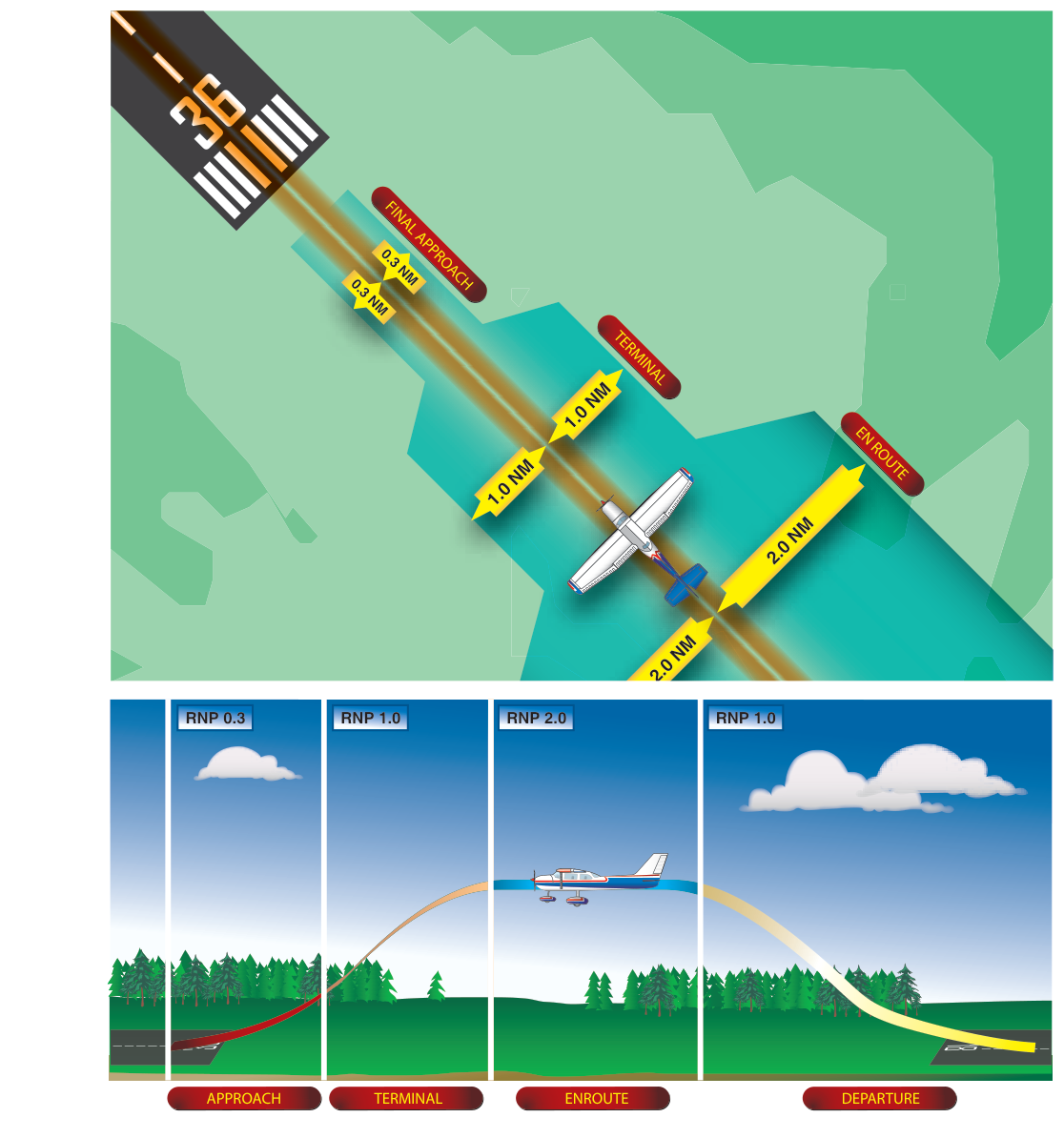
Required Navigation Performance Authorization Required (RNP AR) approaches represent one of the most sophisticated instrument approach procedures available in the National Airspace System. Unlike conventional RNAV approaches, RNP AR procedures can include radius-to-fix (RF) legs, extremely tight lateral accuracy requirements, and constant curved flight paths that allow aircraft to thread through terrain and obstacles that would otherwise make a runway unreachable by instrument procedures. The word "authorization required" in the name is not a bureaucratic formality — it reflects genuinely elevated demands on avionics, crew training, and airline operations programs that must be verified before an operator may fly these procedures.
This article unpacks how RNP AR works, what containment means in the context of these approaches, what FAA authorization entails, and why every detail matters from both a safety and a practical operational standpoint. The governing FAA document is Advisory Circular 90-101A, Approval Guidance for RNP Operations, which establishes the criteria operators must meet to receive approval and maintain currency for RNP AR flight operations.
How RNP AR Works
RNP, at its core, is a form of area navigation (RNAV) that includes an on-board performance monitoring and alerting (OPMA) capability. The aircraft's flight management system (FMS) continuously computes its estimated position error and compares it against the required navigation performance value for the current phase of flight. If the system cannot meet — or predict that it will meet — the required accuracy, it alerts the crew. This self-monitoring distinguishes RNP from basic RNAV, where the aircraft simply navigates without knowing whether its own accuracy is sufficient.
The accuracy requirement for an RNP operation is expressed as a single number: the total system error (TSE) must remain within the published RNP value 95% of the time. TSE encompasses navigation system error (NSE), flight technical error (FTE, the deviation of the aircraft from the computed path), and path definition error. For RNP AR approaches, the published RNP value can be as low as 0.1 nautical miles (NM) in the final approach segment, compared to 0.3 NM for a standard RNP approach (RNAV (GPS) with LNAV/VNAV) and 1.0 NM in the terminal environment.
Radius-to-Fix (RF) Legs
The most visually distinctive feature of many RNP AR procedures is the RF leg — a constant-radius arc between two fixes, centered on a defined geographic point. RF legs allow procedure designers to route the final approach course around a ridge line, a densely populated area, or conflicting traffic patterns in a way that a straight-line course could never accomplish. Flying an RF leg requires the FMS to continuously command bank angles that track the arc precisely; it is not a manually-flown maneuver at normal approach speeds. Not every aircraft FMS is certified for RF legs, which is one reason the "authorization required" label exists at all.
Containment and the Containment Value
Containment is the safety concept that answers the question: how far off the centerline could the aircraft get before it strikes an obstacle? FAA AC 90-101A and the underlying ICAO standards define two key boundaries:
- Total System Error (TSE) boundary (1x RNP): The aircraft must remain within this distance of the centerline at least 95% of the time.
- Containment boundary (2x RNP): The probability of exceeding twice the RNP value — the containment limit — must be no greater than 10-7 per approach (one in ten million). This is sometimes described as the boundary beyond which the aircraft must essentially never go.
Obstacle clearance surfaces and minimum altitudes published on RNP AR approach charts are designed around the containment boundary, not just the 95% TSE boundary. This means the 2x RNP corridor is the safety-critical envelope. For an RNP value of 0.1 NM, obstacles must be clear of a corridor only 0.2 NM wide on each side of the centerline — an extraordinarily precise channel. This is why avionics certification standards require the FMS and sensors (primarily GPS, often with SBAS or multi-sensor integration) to demonstrate extremely low probability of undetected large position errors (the "misleading information" case).
Authorization Requirements Under AC 90-101A
Because of these stringent requirements, operators cannot simply begin flying RNP AR approaches because their aircraft has GPS. AC 90-101A specifies a structured approval process with three principal components: aircraft eligibility, crew training, and operations program approval.
Aircraft and Avionics Eligibility
The aircraft must be equipped with an FMS that has been demonstrated and certified to RNP AR standards. This typically means the FMS software has received an Airplane Flight Manual (AFM) supplement or equivalent certification basis confirming it meets the accuracy, integrity, continuity, and availability requirements. Specific RNP AR values achievable (for example, 0.1 NM versus 0.3 NM) are documented in the AFM supplement; an operator may not fly to a lower RNP value than what the aircraft's certification supports. Additionally, the aircraft must have at least two independent navigation sources (commonly dual FMS with dual GPS/SBAS receivers), and automatic flight control (autopilot or flight director) capable of flying the procedure to within the required FTE limits. Single-sensor or single-FMS configurations are generally not approved for the lowest RNP AR values.
Crew Training and Qualification
AC 90-101A requires operators to establish training programs covering the theoretical basis of RNP, the specific avionics in use, normal and non-normal procedures (including degraded sensor scenarios), and currency requirements. Crews must understand how to interpret FMS performance alerts, recognize when UNABLE RNP must be declared, and brief RNP AR procedures correctly during preflight. Training must address RF leg flying, missed approach considerations unique to RNP AR (some missed approaches also use RF legs or tight RNP values), and crew coordination for the high-workload curved approach environment.
Operations Specifications (OpSpecs) or Letter of Authorization (LOA)
For Part 121 and Part 135 operators, approval is reflected in Operations Specifications (OpSpecs) paragraph B036 (or equivalent). Part 91 operators conducting RNP AR operations must obtain a Letter of Authorization (LOA) from the FAA. The OpSpec/LOA documents the specific RNP AR values approved, any aircraft-specific limitations, and any procedure-specific constraints. Without this authorization, no operator — regardless of how capable the aircraft is — may fly an RNP AR approach.
Why RNP AR Matters
The operational benefits of RNP AR are substantial. Airports that were previously limited to circling approaches, high MDAs, or no instrument approach at all because of surrounding terrain now have straight-in procedures with decision altitudes as low as 200 feet above the touchdown zone. This translates directly into fewer diversions, lower fuel burn, reduced noise over communities, and improved schedule reliability. Airlines operating in mountainous or terrain-challenged environments — Juneau, Alaska; Kathmandu, Nepal; Innsbruck, Austria — rely on RNP AR as an essential operational tool.
From a safety perspective, the OPMA requirement means the system itself catches navigation degradation that crews might not detect quickly enough on their own. The 10-7 containment integrity standard is consistent with the risk budget allocated to the approach phase of flight in aviation safety modeling, making RNP AR among the most rigorously safe approach categories defined.
Key Numbers and Rules
- Minimum RNP AR value: 0.1 NM in the final approach segment (aircraft-dependent)
- Standard RNP approach (non-AR) value: 0.3 NM final approach
- Terminal area RNP value: 1.0 NM
- TSE boundary: Must be met 95% of the time (1x RNP)
- Containment boundary: 2x RNP; probability of exceedance ≤ 10-7 per approach
- Dual FMS/GPS: Generally required for RNP values at or below 0.3 NM
- Authorization vehicle: OpSpecs B036 (Part 121/135) or LOA (Part 91)
- Governing AC: AC 90-101A, Approval Guidance for RNP Operations
Common Test Traps
- Confusing RNP with RNAV: All RNP is RNAV, but not all RNAV is RNP. The defining difference is OPMA — the aircraft must monitor and alert on its own performance. Basic RNAV (GPS) approaches do not have this requirement built into the certification standard.
- Assuming any GPS-equipped aircraft can fly RNP AR: Aircraft eligibility is determined by the AFM supplement and certification basis, not merely by having GPS installed. The FMS software and dual-sensor architecture must meet RNP AR standards.
- Misidentifying the containment limit: The 95% accuracy boundary is 1x RNP; the containment limit used for obstacle clearance design is 2x RNP. Examiners frequently test whether candidates know which value governs obstacle clearance.
- Overlooking the authorization requirement for Part 91: A Part 91 operator is not exempt from authorization. An LOA is required; simply owning a capable aircraft is insufficient.
- Forgetting that missed approaches may also be RNP AR: Some RNP AR missed approach procedures themselves have tight RNP requirements or include RF legs. Crews must brief and be prepared to fly the missed approach with the same precision as the approach itself.