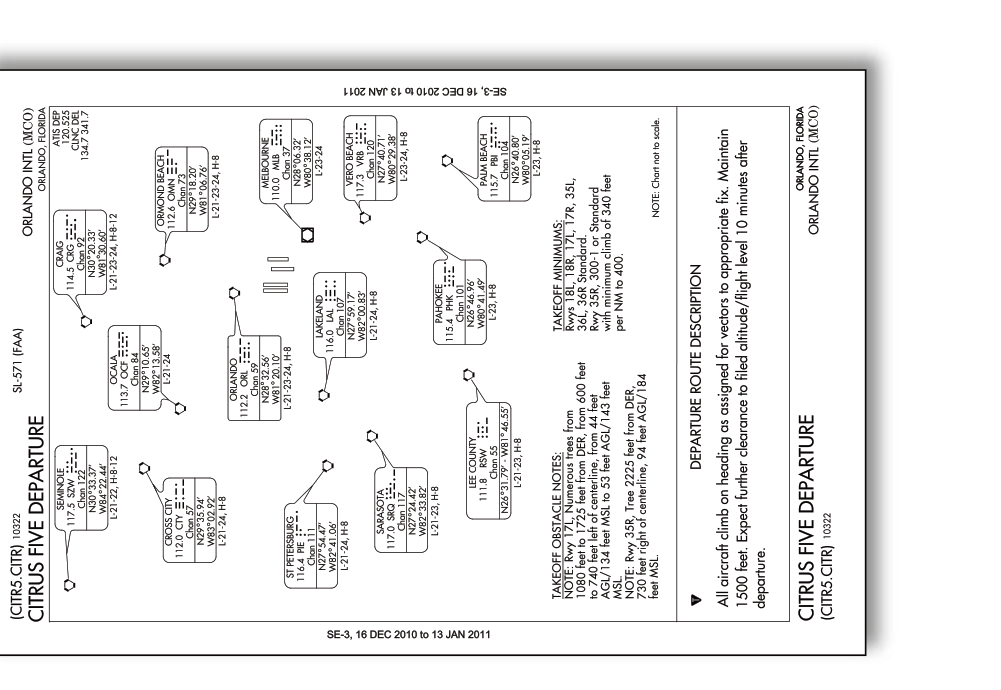
Every instrument flight begins with a departure, and that departure phase — from liftoff to the en route structure — is statistically among the most demanding segments of any flight. Jets, with their high climb performance but also their high speeds and momentum, must follow carefully engineered procedures to guarantee obstacle clearance, maintain predictable traffic flow, and integrate smoothly into the ATC system. Two procedure types govern this environment: Standard Instrument Departures (SIDs), also called Departure Procedures (DPs) of the RNAV or conventional variety, and Obstacle Departure Procedures (ODPs). Understanding the distinction, the underlying design criteria, and the operational requirements for each is essential knowledge for the Airline Transport Pilot (ATP) certificate and, more importantly, for safe jet operations every day.
The FAA codifies departure procedure design and pilot obligations in the Instrument Procedures Handbook (FAA-H-8083-16B), Chapter 1. That document forms the backbone of this article. Pilots who internalize this material will be equipped not only to pass the ATP knowledge test but to make sound go/no-go and routing decisions in the real departure environment.
The Two Types of Departure Procedures
The FAA divides Departure Procedures into two distinct categories, each serving a different primary purpose.
Obstacle Departure Procedures (ODPs) are designed with one overriding goal: obstacle clearance. They provide a flyable path that guarantees a standard climb gradient of 200 feet per nautical mile (ft/NM) above all obstacles in the departure corridor — a gradient built from the 40:1 (152 ft/NM) obstacle identification surface plus a 48 ft/NM required obstacle clearance (ROC) margin above it. ODPs may be textually described in the Chart Supplement (formerly the Airport/Facility Directory) or charted graphically. When an ODP is only text, it appears in the Chart Supplement under the airport's entry with the notation "Obstacle Departure Procedure." Charted ODPs carry the symbol "(OBSTACLE)" in their title so pilots can immediately distinguish them from ATC-preferred routing procedures.
Standard Instrument Departures (SIDs) — more formally called Departure Procedures of the "ATC" variety — are designed primarily for air traffic management and system efficiency. They reduce radio communication, standardize traffic flow out of busy terminals, and connect the departure airport seamlessly with the en route structure. SIDs always meet the same obstacle clearance criteria as ODPs (the 200 ft/NM minimum gradient), but they layer on top of that foundation a routing structure optimized for ATC purposes. SIDs are always charted; there is no textual-only SID. A SID title will include the procedure name and transition, such as "SHEAD TWO DEPARTURE" with a specific transition routing.
How Departure Procedure Design Works
The Obstacle Clearance Standard
Both ODPs and SIDs guarantee obstacle clearance using a departure obstacle identification surface (OIS). This imaginary surface slopes upward at 152 feet per nautical mile (a 40:1 slope) beginning at the departure end of runway (DER). Any obstacle that penetrates this surface must be addressed — either by routing around it or by requiring a climb gradient steeper than the standard. The standard required obstacle clearance (ROC) is a 48 feet per nautical mile margin above that 152 ft/NM OIS slope, which together produce the minimum standard climb gradient of 200 feet per nautical mile (approximately 3.3% or roughly 350 feet per minute at a ground speed of 100 knots — scale this for jet speeds accordingly).
When obstacles require a steeper climb, the procedure will specify a non-standard climb gradient, for example "Cross [fix] at or above [altitude]" or "Climb via runway heading to 3,000 feet before turning." These specifications are not suggestions — they are the minimum performance the aircraft must achieve to guarantee obstacle clearance, and jet crews must verify their aircraft's climb performance, considering weight, temperature, and pressure altitude, actually meets or exceeds the published gradient before departure.
Diverse Departure and Climb to 400 Feet AGL
A fundamental ODP design concept is the diverse departure. When no obstacles penetrate the 40:1 OIS in any direction, ATC or a procedure designer can authorize aircraft to depart in any direction (a diverse departure) without a specific procedure. However, when obstacles do penetrate the surface, a specific departure route is required. Departure procedure design standards are built around pilots climbing to 400 feet above the departure end of runway elevation before initiating any turns required by an ODP, SID, or other charted departure instruction. This 400-foot AGL benchmark underlies the obstacle-clearance assumptions built into procedure design; it is not a blanket regulatory requirement that applies to every turn on every IFR departure, since ATC-assigned headings or a diverse departure with no penetrating obstacles may permit turns before reaching 400 feet AGL. Where a procedure does specify or assume a turn, jets require positive obstacle clearance while still in the low-speed, gear-in-transit, flaps-extended configuration immediately after rotation, which is why this benchmark matters operationally.
Climb Gradients and Aircraft Performance
Published climb gradients on departure procedures require careful preflight analysis for jet operations. A published gradient such as "Climb at or above 300 ft/NM" means the aircraft must achieve at least that gradient from the DER until reaching the specified altitude or fix. For a jet at maximum takeoff weight on a hot, high-elevation airport, this analysis may result in a weight restriction or a requirement to use a lower flap setting, demonstrating exactly why this knowledge goes beyond academics into operational safety. Many airline Standard Operating Procedures (SOPs) specify that crews must brief the departure gradient and confirm the aircraft meets it during the performance portion of the departure briefing.
Pilot and Operational Requirements
Filing and Accepting a SID
When ATC issues a SID clearance, the crew must have the current charted procedure available — either on paper or in an approved electronic format. If a crew is unable or unwilling to accept a SID (for example, due to a navigation system limitation or company policy), they must advise ATC with the phrase "Unable SID" and ATC will provide an alternative clearance. Under 14 CFR Part 91.175 and associated IFR requirements, the pilot in command is responsible for complying with the departure procedure as cleared, including any climb gradients or crossing restrictions published thereon.
ODP — When It Applies Without an ATC Clearance
A critical operational nuance: ODPs are not automatically included in an ATC IFR clearance. An ATC clearance provides separation from other IFR traffic, but it does not inherently authorize deviation from the ODP routing. A pilot flying IFR who receives a clearance that conflicts with the ODP must understand that the ODP exists for obstacle clearance — not for ATC sequencing. If the clearance does not specifically address obstacle clearance (for example, ATC clears you "direct" to a fix that requires a turn before reaching 400 feet AGL), the pilot is responsible for ensuring terrain and obstacle clearance. Many operators require crews to fly the ODP unless ATC specifically vectors them clear of obstacles or provides an alternative departure instruction that accounts for obstacle clearance.
For Part 121 and Part 135 operators, Operations Specifications (OpSpecs) typically require compliance with published ODPs or the use of an approved alternative. Pilots operating under these certificates must know their company's specific policy.
RNAV SIDs and PBN Requirements
Modern airports increasingly use RNAV SIDs — procedures based on Performance-Based Navigation (PBN). These require GPS (GNSS) or DME/DME/IRU navigation. An RNAV SID will specify the required navigation specification in the procedure notes, such as "RNAV 1" (total system error must not exceed 1 NM for 95% of flight time). Jets equipped with FMS systems that meet the required navigation specification may fly RNAV SIDs; those without must advise ATC of their limitation. The PBN requirements are part of the broader shift in U.S. airspace toward satellite-based navigation, and the ATP candidate must be familiar with how RNAV SIDs differ from conventional VOR/DME-based departures.
Why It Matters for Jet Operations
The departure phase concentrates multiple high-risk factors simultaneously: maximum gross weight, engines at maximum power settings (and thus highest thermal stress), proximity to terrain, high airspeeds, and frequently congested airspace. Controlled Flight Into Terrain (CFIT) accidents during departures are a persistent cause of fatal accidents worldwide. Departure procedures exist specifically to mitigate this risk by providing a charted, verified, obstacle-clear path from runway to altitude.
For ATP pilots, the stakes are amplified by the aircraft performance envelope of jets. A jet departing at 150 knots covers roughly 2.5 nautical miles per minute. At that speed, a published climb gradient of 200 ft/NM equates to approximately 500 feet per minute — well within normal jet capability, but a non-standard gradient of 400 ft/NM (roughly 1,000 fpm at that speed) on a hot day at a high-elevation airport can challenge a heavily-loaded aircraft. Preflight performance analysis is not optional — it is a regulatory requirement and a professional standard.
Key Numbers and Rules
- 40:1 OIS slope: The obstacle identification surface — 152 feet per nautical mile — used to identify penetrating obstacles.
- 200 ft/NM minimum climb gradient: The standard required obstacle clearance for all departure procedures (ODPs and SIDs).
- 400 feet AGL: The benchmark altitude assumed in departure procedure design before initiating turns required by an ODP, SID, or other charted instruction.
- 48 ft/NM ROC: The required obstacle clearance margin above the 152 ft/NM OIS slope; combined with the OIS slope, it produces the 200 ft/NM standard gradient.
- RNAV 1: The most common PBN specification for RNAV SIDs — total system error not to exceed 1 NM (95% of flight time).
- "Unable SID": The correct phraseology when a crew cannot comply with an assigned SID.
- ODP availability: ODPs may be text-only (Chart Supplement) or charted; SIDs are always charted.
Common Test Traps
- Confusing primary purpose: ODPs exist for obstacle clearance; SIDs exist primarily for ATC traffic management. The exam tests this distinction repeatedly.
- Assuming ATC clearance covers obstacle clearance: An IFR clearance provides IFR separation — it does not guarantee the routing is free of terrain/obstacle conflicts. The pilot remains responsible for obstacle clearance, especially when no departure procedure is explicitly assigned.
- Missing the "(OBSTACLE)" notation: Charted ODPs include "(OBSTACLE)" in their title. Failure to recognize this and incorrectly treating it as a SID is a common knowledge-test error.
- Ignoring non-standard climb gradients: If the procedure publishes a climb gradient above 200 ft/NM, it is mandatory, not advisory. Many exam scenarios involve performance traps where the student must recognize the aircraft cannot legally or safely depart without meeting that gradient.
- Forgetting the 400-foot AGL turn restriction: Where a departure procedure requires or assumes a turn, that turn should not occur before 400 feet AGL above the DER elevation. Some questions present scenarios where early turns appear expedient — the correct answer is always to comply with the design standard.