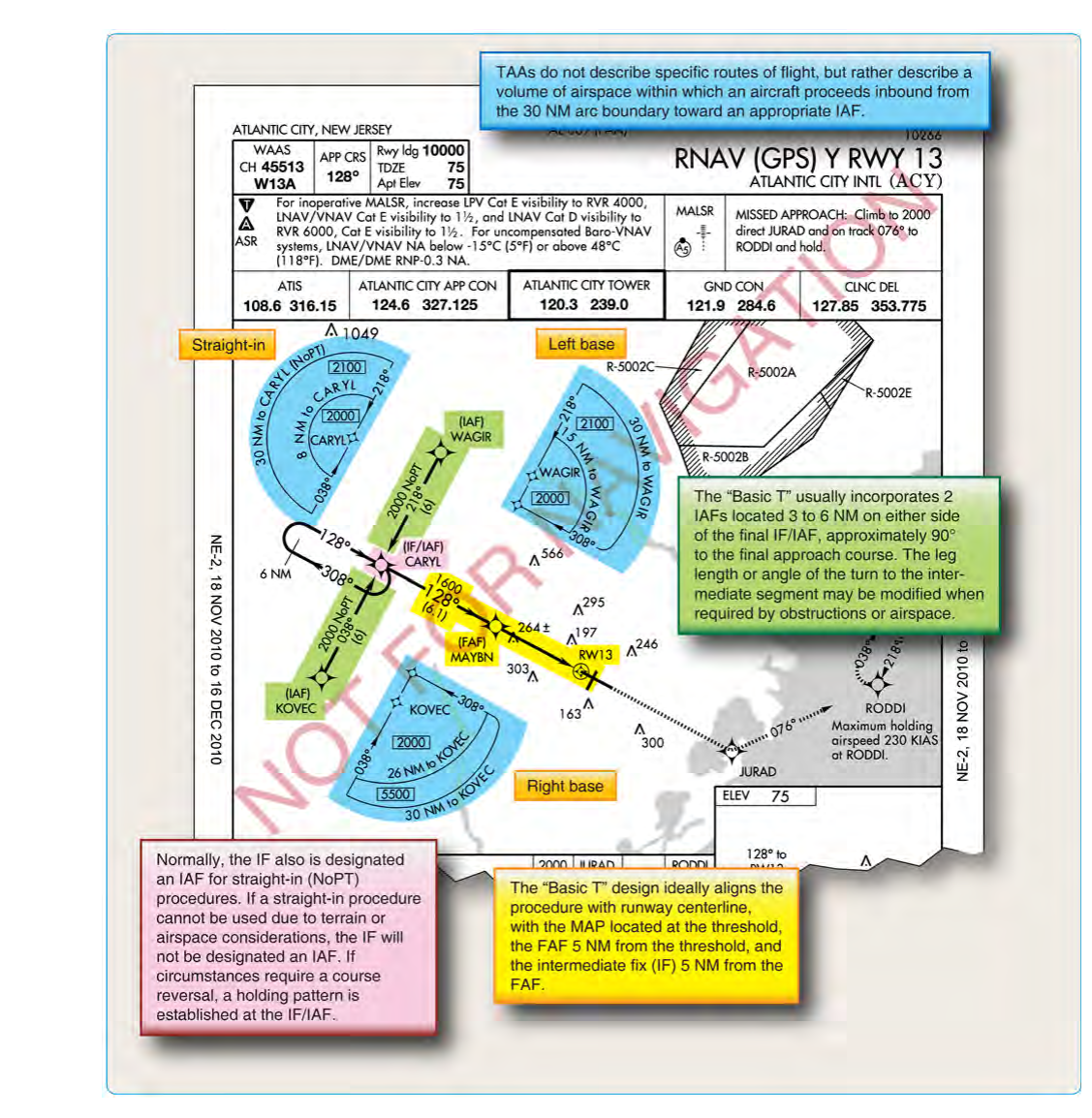
As RNAV and GPS approaches have replaced many traditional VOR and ILS procedures, the charted lateral and vertical structure surrounding these approaches has also evolved. Two concepts that every ATP candidate must thoroughly understand are Terminal Arrival Areas (TAAs) and DME arc transitions as they apply to RNAV approaches. Together, they define how an aircraft transitions from the en route or terminal environment to the final approach segment while remaining within protected airspace and meeting obstacle clearance standards.
Unlike older approach designs that relied exclusively on procedure turns or holding-in-lieu-of-procedure-turns (HILPT) to reverse course, RNAV approaches typically use the TAA concept to provide a structured, sector-based entry system that eliminates the need for a procedure turn in most situations. Understanding how to read a TAA, navigate its sectors, and execute DME arc legs is essential not only for the ATP written and oral exam, but for safe daily IFR operations.
What Is a Terminal Arrival Area?
A Terminal Arrival Area is a defined region of airspace associated with an RNAV (GPS) approach that provides obstacle clearance for aircraft transitioning from the en route structure to the initial approach fix (IAF). The TAA is anchored by the waypoints of the RNAV approach—specifically the initial approach fixes, the intermediate fix (IF), and the final approach fix (FAF)—and it is depicted on the approach chart as a series of sectors formed by the extension of the final approach course.
The standard TAA consists of three primary sectors: the straight-in sector (also called the center sector), the left base sector, and the right base sector. The straight-in sector is centered on the extended final approach course and normally spans approximately 60 degrees of azimuth (30 degrees on each side of the extended final approach course). Each base sector occupies roughly 100 degrees of azimuth from the IF, one on each side of the straight-in sector, so that the three sectors together span the full 360 degrees around the IF.
Each TAA sector has a defined minimum altitude, charted in MSL, that provides at least 1,000 feet of obstacle clearance in non-mountainous areas and 2,000 feet in designated mountainous terrain. These altitudes are printed inside each sector arc on the chart. Some sectors are further subdivided using additional arcs (inner arcs) when terrain or obstacles require different step-down altitudes at different distances from the IF. The outer boundary of the TAA is normally 30 nautical miles from the IF waypoint, though this may vary based on the specific approach design.
How the TAA Works in Practice
When an aircraft arrives in the terminal environment without a radar vector or published feeder route, the pilot determines which TAA sector the aircraft is currently in based on bearing and distance from the IF waypoint. The aircraft must be at or above the minimum altitude for that sector before proceeding inbound. This replaces the traditional procedure turn by ensuring the aircraft is already at a safe altitude and properly aligned (or will maneuver via the approach waypoints) before reaching the IF.
A critical rule: the TAA does not authorize a procedure turn. Once an aircraft enters a TAA and begins the approach, flying a procedure turn is not permitted. The lateral structure of the RNAV approach—with its defined IAF waypoints on both sides of the final course—handles course reversal for aircraft that need to reverse direction. An aircraft arriving from the right, for example, would be in the right base sector; it proceeds to the right-side IAF, then tracks inbound to the IF, and continues to the FAF. The GPS/FMS sequences through these waypoints automatically when the approach is properly loaded and activated.
If a TAA sector minimum altitude is higher than the aircraft's current altitude, the pilot may not descend into that sector below the sector's floor. This is an obstacle clearance floor, not a clearance to descend—ATC clearance to an altitude still governs. Additionally, ATC may assign the aircraft a vector or direct routing that bypasses the TAA structure; in that case, the TAA minimum altitudes may not apply, but obstacle clearance is ATC's responsibility on the vectored segment.
DME Arc Transitions on RNAV Approaches
Some RNAV approaches include DME arc transitions as a method of positioning the aircraft on the approach without requiring a course reversal. Rather than being a true arc flown around a DME ground station (as on a conventional VOR/DME arc approach), an RNAV DME arc is a curved path defined by a series of waypoints in the FMS/GPS database that approximate a circular arc at a specified radius from a reference fix.
The arc transition provides a smooth, continuous lateral path from the en route environment to an IAF or directly to the IF when arriving from a direction that would otherwise require a procedure turn. The pilot selects the arc transition in the FMS, which then sequences the aircraft along the defined curved path. Pilots must understand that the aircraft's ground track on an RNAV arc is managed by the FMS—unlike a traditional DME arc where the pilot manually adjusts heading every few degrees to track the arc. Modern LNAV/VNAV and LPV approaches with arc transitions require that the FMS be in approach mode (not terminal mode) for full angular course sensitivity.
During an RNAV DME arc transition, the pilot should monitor cross-track error on the CDI and ensure the FMS is properly sequencing waypoints. Activation of approach mode and the transition from terminal sensitivity (±1 NM full-scale) to approach sensitivity (±0.3 NM full-scale) typically occurs automatically 2 NM before the FAF, but some FMS designs activate it at a fixed point along the arc. Pilots must verify the mode transition has occurred and that RAIM (or equivalent integrity monitoring) is confirmed prior to the FAF.
Why This Matters for ATP Operations
The TAA and DME arc concepts have direct operational and safety implications. Aircraft operating under 14 CFR Part 121 and Part 135 routinely fly RNAV approaches, and flight crews must correctly interpret the charted TAA sectors to ensure obstacle clearance, particularly in mountainous terrain where the sector minimums may be substantially higher than the en route MEA. A failure to comply with TAA sector altitudes is effectively the same safety risk as busting a procedure turn altitude on a conventional approach.
Additionally, the elimination of the procedure turn within the TAA means that crews who are unfamiliar with RNAV approach structure may inadvertently attempt a procedure turn—a common and dangerous error. ATC and other traffic may not anticipate this maneuver, and the aircraft may depart the protected obstacle clearance area.
Dispatch and route planning must also account for TAA structure. If an aircraft arrives at an RNAV approach from an unusual direction (e.g., due to weather deviation), the crew must quickly determine which sector applies and whether they are at the appropriate altitude before commencing the approach.
Key Numbers and Rules
- 30 NM: Standard outer radius of a TAA sector from the IF waypoint (may vary).
- 1,000 ft / 2,000 ft: Minimum obstacle clearance in TAA sectors for non-mountainous and mountainous terrain, respectively.
- Three standard sectors: Straight-in (center, approximately 60 degrees), left base, and right base (each approximately 100 degrees) — together spanning 360 degrees around the IF.
- No procedure turn in a TAA: If the TAA is depicted, a procedure turn is not authorized unless specifically required by a note on the chart.
- Approach mode activation: RNAV approach sensitivity (±0.3 NM) must be confirmed prior to the FAF; terminal sensitivity is ±1 NM.
- RAIM check: Must be confirmed prior to the FAF on GPS approaches; for WAAS-based (LPV/LNAV+VNAV) approaches, WAAS integrity monitoring is continuous.
- Inner arc subdivisions: Additional altitude floors may exist within 17 NM (or another published radius) of the IF to address local terrain.
Common Test Traps
- Procedure turn confusion: Candidates often believe a procedure turn is always available. On RNAV approaches with a published TAA, the procedure turn is NOT authorized. The TAA structure replaces it.
- Sector identification: The TAA sectors are based on bearing to the IF waypoint, not to the airport or FAF. Candidates who measure bearing from the wrong fix will select the wrong sector minimum altitude.
- Ignoring inner arc altitudes: When a TAA has inner arcs (step-down sectors at shorter distances), the outer-arc altitude does not apply to the entire sector. Descending to the outer-arc minimum while still outside that inner arc boundary is a violation of obstacle clearance.
- Sensitivity transition timing: On RNAV arc transitions, candidates forget that approach-mode CDI sensitivity (±0.3 NM) must be verified before the FAF. Flying the arc in terminal mode with wider sensitivity may not detect dangerous course deviations.
- ATC vectors vs. TAA: When ATC provides radar vectors to final, the TAA sector altitudes do not govern—obstacle clearance is ATC's responsibility during the vectored segment. However, once established on the final approach course and cleared for the approach, the pilot resumes obstacle clearance responsibility.