Every aircraft system that carries hydraulic fluid, fuel, oil, oxygen, or pneumatic pressure depends on a network of rigid tubing routed through the airframe. Choosing the right tubing material is not merely a matter of engineering preference — it directly determines whether a line can withstand the pressures, temperatures, and vibration it will encounter in service. Aviation maintenance technicians (AMTs) must be able to identify aluminum alloy, steel, and titanium tubing by their markings, color codes, and physical characteristics, and they must understand which material is appropriate for each application. This knowledge is testable on the FAA AMT General knowledge exam and is foundational to safe aircraft maintenance practice.
Rigid fluid lines are distinct from flexible hoses. Where a flexible hose accommodates relative motion between components or absorbs vibration across short spans, rigid lines provide a stable, leak-resistant pathway through most of the aircraft's plumbing runs. The tubing must resist internal pressure, external mechanical damage, corrosion, and the effects of temperature extremes — requirements that have historically led to the use of three primary metallic materials: aluminum alloy, corrosion-resistant steel (CRES), and titanium alloy.
Aluminum Alloy Tubing
Aluminum alloy is by far the most widely used material for aircraft fluid lines. Its advantages include low weight, excellent corrosion resistance, ease of forming and flaring, and sufficient strength for the majority of general aviation and transport aircraft applications. The alloys most commonly specified are 1100, 3003, 5052, and 6061. Understanding the differences between these alloys is essential for selecting the correct replacement tube.
- 1100 and 3003 alloys are commercially pure or nearly pure aluminum with relatively low strength. They are soft enough to be easily bent and flared, but their low tensile strength limits them to low-pressure applications — typically below about 1,500 psi — such as fuel, oil, and instrument lines in light aircraft.
- 5052-O alloy (the "O" denotes annealed temper) provides significantly higher strength than 1100 or 3003 while retaining good formability. It is widely used for medium-pressure hydraulic and fuel lines and is the most common aluminum tubing alloy found in general aviation aircraft hydraulic systems.
- 6061-T6 alloy is a heat-treated, higher-strength aluminum used where greater mechanical strength is required without resorting to steel. It is harder to form and is less ductile than 5052, so it is less commonly flared in the field.
Aluminum tubing is identified by color-coded bands printed or stamped on the tube at intervals. The alloy designation and temper are also marked on the tube. When replacing aluminum tubing, the replacement must match the original alloy and temper specification exactly — substituting a weaker alloy in a higher-pressure line is a serious airworthiness hazard.
Steel Tubing
Where pressures exceed the capability of aluminum alloy, or where operating temperatures are high, corrosion-resistant steel (CRES) — commonly called stainless steel — is used. The most frequently encountered alloy in aircraft fluid lines is CRES 304 or 21-4N stainless steel, though various grades appear in different applications. Steel tubing is mandatory in several situations:
- High-pressure hydraulic systems, which may operate at 3,000 psi or higher in transport-category aircraft
- Engine compartment fuel and oil lines, where fire resistance is required
- Brake system lines subject to high pressure and heat
- Any location where aluminum would be too weak or susceptible to damage
Steel tubing is much harder to bend and flare than aluminum. Bending requires greater force and careful technique to avoid kinking or work-hardening the tube to the point of cracking. Flaring steel tubing requires special flaring tools and often single rather than double flares, depending on the wall thickness and specification. Despite the added difficulty, steel's higher tensile strength, elevated-temperature performance, and fire resistance make it the material of choice for demanding applications.
Steel tubing can be identified by its bright metallic or slightly gray appearance, its markings (which include the alloy designation), and — in many aircraft — by color-coded identification bands. Because steel tubing looks similar to titanium at first glance, the markings and documentation must be verified carefully before installation.
Titanium Alloy Tubing
Titanium tubing represents a newer and increasingly important category in aircraft fluid lines, particularly in high-performance military and transport-category aircraft. The primary titanium alloy used for fluid lines is 3Al-2.5V (3% aluminum, 2.5% vanadium). Titanium's remarkable combination of properties explains its growing use:
- Its strength-to-weight ratio exceeds both aluminum and steel — titanium tubing can replace steel tubing with a significant weight savings while maintaining equivalent pressure ratings.
- Titanium has excellent corrosion resistance, superior even to most stainless steels in many environments.
- It performs well across a wide temperature range.
However, titanium is not suitable for use in oxygen systems. Titanium can ignite in the presence of high-pressure oxygen, creating a dangerous fire hazard. This is a critical limitation that technicians must remember. Additionally, titanium must not be used in contact with certain other metals under some conditions due to galvanic corrosion concerns, and it requires specific, compatible fittings and installation procedures.
Titanium tubing is identified by its color markings and alloy designation stamped on the tube. Visually, bare titanium has a dull grayish appearance similar to stainless steel, which is why proper marking verification is essential before installation.
Tubing Identification: Color Codes and Markings
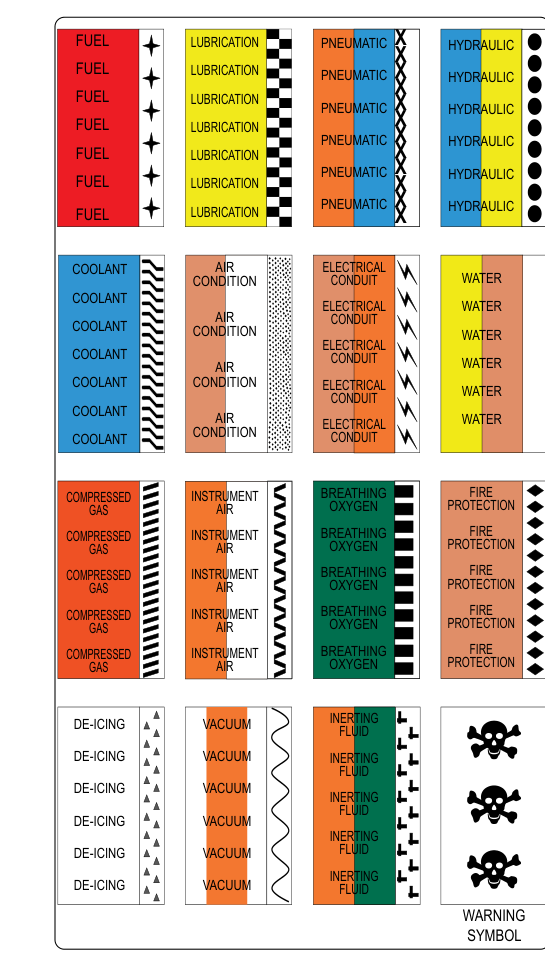
FAA-accepted practice requires that rigid tubing be permanently marked with its alloy designation, temper, and specification. In addition, many aircraft manufacturers and military specifications call for color-coded identification stripes printed circumferentially on the tube at regular intervals. These stripes identify both the material and, in some military systems, the fluid carried. The technician must always cross-reference the tube markings with the applicable aircraft maintenance manual and the parts catalog to confirm that a replacement tube is the correct specification. Relying on visual appearance alone — such as color or diameter — is insufficient and potentially dangerous.
Why Material Selection Matters
An incorrect tubing material can fail catastrophically under service conditions. A tube rated for low pressure installed in a high-pressure hydraulic line may burst. A tube without sufficient temperature resistance in an engine compartment can soften, crack, or become a fire hazard. Using the wrong alloy can also make flaring or forming difficult, resulting in defective flares that leak under pressure. The FAA's maintenance standards, including those described in the Aviation Maintenance Technician Handbook — General (FAA-H-8083-30), emphasize that replacement tubing must conform to the original specification in material, diameter, wall thickness, and temper.
Key Numbers and Rules
- 1100 / 3003 aluminum: Low-pressure applications only (generally below ~1,500 psi); fuel, oil, instrument air lines in light aircraft.
- 5052-O aluminum: Most common for general aviation hydraulic and fuel lines; medium-pressure service.
- 6061-T6 aluminum: Higher strength aluminum; used where greater mechanical strength is needed.
- Steel (CRES 304 / stainless): Required for high-pressure hydraulic lines (3,000 psi+), engine compartment lines, and brake lines.
- Titanium (3Al-2.5V): High strength-to-weight ratio; never use in oxygen systems — ignition hazard.
- Replacement tubing must match original material alloy, temper, OD, and wall thickness exactly.
- Aluminum tubing is identified by alloy markings and color-coded bands; always verify against the aircraft maintenance manual.
Common Test Traps
- Confusing alloy numbers with pressure ratings: The FAA exam may ask which aluminum alloy is appropriate for a given application. Remember that 1100 and 3003 are low-pressure only; 5052-O is the workhorse for general aviation hydraulics; 6061-T6 is stronger but less formable.
- Titanium in oxygen systems: A very commonly tested point — titanium must NEVER be used in oxygen systems because it can ignite in the presence of high-pressure oxygen. Steel or aluminum is specified for oxygen lines depending on pressure requirements.
- Assuming visual appearance is enough: Steel and titanium look similar. Always verify tubing by its stampings and maintenance manual documentation, not by appearance alone.
- Mixing alloy tempers: The temper designation (like "O" for annealed or "T6" for heat-treated) is part of the specification. Installing 6061-O when 5052-O is specified, or vice versa, is an airworthiness error even if the outside diameters match.
- Wall thickness and OD: Test questions may imply that matching only the material is sufficient for replacement. In reality, outside diameter AND wall thickness must also match, because these determine the tube's pressure rating and the fit of the fittings.