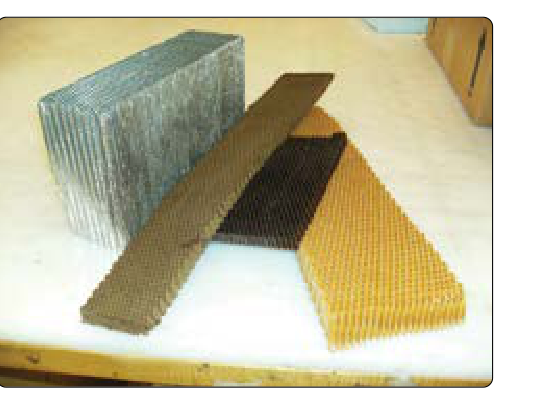
Modern aircraft rely heavily on sandwich-panel construction to achieve structures that are simultaneously lightweight and extremely rigid. At the heart of every sandwich panel is a core material—a low-density interior layer bonded between two thin, strong face sheets. The core's job is to keep those face sheets separated so that the panel behaves like a deep structural beam, dramatically increasing stiffness without adding much weight. Three families of core material dominate aviation manufacturing and repair: Nomex aramid fiber honeycomb, aluminum honeycomb, and rigid foam cores. Each has distinct properties, applications, and repair considerations that every AMT Airframe technician must understand.
This article covers the construction, characteristics, and practical use of all three core types, the engineering principles that make honeycomb geometry so effective, and the FAA-recognized inspection and repair procedures you will encounter on the AMT Airframe knowledge test and on the shop floor.
The Sandwich Structure Principle
Before diving into specific materials, it helps to understand why the sandwich concept works. Bending loads in a flat panel cause the outermost fibers to carry the highest tension and compression stresses while the interior material carries relatively low stress. In a solid panel, much of that interior material is therefore wasted weight. By replacing the solid interior with a low-density core, engineers preserve the critical separation of the face sheets—called the moment arm—while eliminating nearly all the unused mass. The result is a panel that can achieve a dramatic increase in bending stiffness compared to a solid skin of the same weight, with the exact gain depending heavily on core thickness and face sheet material. The face sheets, typically fiberglass, carbon fiber, or aluminum, carry the primary tension and compression loads. The core carries shear loads and stabilizes the face sheets against buckling.
Honeycomb Geometry: Why Hexagons?
The classic honeycomb cell is a regular hexagon, and that shape is not arbitrary. Among all regular polygon tessellations, the hexagon encloses the maximum area with the minimum total edge length—the same efficient geometry that bees evolved for wax combs. In structural terms, hexagonal cells distribute in-plane compressive loads along multiple wall directions simultaneously, so the core resists crushing forces from nearly any lateral direction with great efficiency. Cell size varies considerably by manufacturer and application, commonly ranging from about 1/8 inch up to 1 inch or more across the flat-to-flat dimension; smaller cells provide better face-sheet support and higher compressive strength, while larger cells are lighter and cheaper. Core thickness and cell wall thickness together determine the overall panel's bending stiffness and shear strength.
Nomex Honeycomb
Nomex is a registered trade name for an aromatic polyamide (aramid) paper manufactured by DuPont. To make Nomex honeycomb, sheets of this aramid paper are bonded together in a node pattern, then expanded into a honeycomb block, and finally impregnated with a phenolic resin that cures to give the cell walls rigidity and environmental resistance.
Nomex honeycomb has become the dominant core material in aircraft interior panels, control surfaces, fairings, floor panels, nacelle cowlings, and many secondary structural panels. Its popularity comes from a combination of properties that are difficult to match:
- Low density: Nomex cores are available across a range of densities that vary by manufacturer, commonly in roughly the 1.8 to 8 pounds per cubic foot range, making them among the lightest structural core options.
- Fire resistance: Aramid fibers do not melt or drip; they char and self-extinguish. This is critical for interior and engine-adjacent applications where FAA flammability standards apply.
- Corrosion immunity: Unlike aluminum, Nomex is a non-metallic material and will not corrode in the presence of moisture or dissimilar metals.
- Machinability: Nomex can be cut, drilled, and shaped with standard woodworking and composite tooling without the tool-dulling problems of metallic cores.
- Dielectric properties: Because it is non-conductive, Nomex honeycomb is used in radome structures where electromagnetic transparency is required.
The main limitations of Nomex are relatively low compressive strength compared to aluminum at equivalent density, and susceptibility to moisture absorption if the face sheets are breached. When water enters a damaged Nomex panel and is not repaired, freeze-thaw cycles can delaminate face sheets and degrade the core over time. On-aircraft inspection methods—tap testing, ultrasonic inspection, and thermographic imaging—are used to detect moisture ingress and core damage without disassembly.
Aluminum Honeycomb
Aluminum honeycomb is manufactured from thin aluminum foil (alloys such as 3003 or 5052 are common) that is corrugated and adhesively bonded or brazed into the honeycomb block, then sliced to the required thickness. Aluminum honeycomb offers a different set of trade-offs compared to Nomex.
- Higher strength and stiffness: For a given density, aluminum honeycomb provides significantly higher compressive and shear strength than Nomex, making it preferred for primary structural floors, bulkheads, and heavily loaded panels.
- Thermal and electrical conductivity: Aluminum honeycomb dissipates heat effectively and provides electrical bonding continuity through the structure—useful in some electromagnetic shielding applications.
- Formability: Aluminum honeycomb can be formed into curved shapes by a process called flexicore or over-expanded geometry, though it has limits compared to foam cores.
The significant limitation of aluminum honeycomb is corrosion. When aluminum core is bonded to graphite (carbon fiber) face sheets, the galvanic potential difference is large, and if moisture bridges the two materials, accelerated corrosion can occur rapidly. Proper surface treatment, barrier plies, and sealants must be used to prevent galvanic attack. Additionally, both Nomex and aluminum honeycomb repairs can require elevated-temperature cure per the applicable SRM instructions; portable heat blankets and hot bonders are commonly used in the field for both material types, so aluminum honeycomb is not uniquely dependent on autoclave curing, though achieving full strength restoration still demands careful adherence to specified cure schedules and pressure.
Foam Core Materials
Rigid foam cores represent a third distinct family. Common foam types used in aviation include polyurethane, polyvinyl chloride (PVC), polymethacrylimide (PMI, sold commercially as Rohacell), and polystyrene foams. Rather than a cellular wall geometry like honeycomb, foams are closed-cell or open-cell porous solids. Their structural performance is generally lower than honeycomb at equivalent density, but they offer unique advantages:
- Complex contour conformance: Foam cores can be carved, sanded, or thermoformed into compound curves and intricate shapes that would be impractical with rigid honeycomb blocks.
- No edge fill required: Honeycomb panels require potting compound or edge inserts at cut-outs and boundaries to prevent the open cells from crushing. Solid foam eliminates this manufacturing step.
- Wet layup compatibility: Many foam cores are compatible with hand lay-up fabrication where prepreg and autoclave processes are not available, making them popular in general aviation and experimental aircraft manufacturing.
- Closed-cell moisture resistance: High-quality closed-cell foams such as PMI resist water absorption better than open honeycomb cells at unprotected edges.
PMI (Rohacell) foam is particularly notable in aerospace because it can withstand standard autoclave cure pressures and temperatures that would crush less robust foam types, though other high-temperature foam formulations can also tolerate autoclave conditions depending on their specific composition. Polyurethane and polystyrene foams have lower temperature and pressure limits and are generally restricted to lower-performance applications or pre-cured panel construction. PVC foam (such as Divinycell) is widely used in boat and light aircraft structures and offers good toughness and moisture resistance at moderate cost.
Why It Matters for Airframe Technicians
Understanding core material type is not academic—it directly governs how a technician may legally and safely repair a damaged structure. The aircraft manufacturer's Structural Repair Manual (SRM) and the applicable FAA Advisory Circulars (particularly AC 43.13-1B for general aviation repairs) specify acceptable core replacement materials, adhesive systems, and cure procedures for each application. Substituting a foam core repair in a panel designed for Nomex honeycomb, or replacing aluminum honeycomb with a lighter Nomex core, can reduce load-carrying capacity below certification limits even if the repair looks cosmetically identical.
Core splicing, potting compound installation, film adhesive application, and cocure versus secondary bond procedures are all core-specific processes. Technicians must also recognize the visual and tactile difference between core types during disassembly, because damaged panels may not be labeled, and correct identification drives every subsequent repair decision.
Key Numbers and Rules
- Nomex honeycomb density varies by manufacturer, commonly in roughly the 1.8 to 8 lb/ft³ range; most aircraft interior panels use cores in the 3–4 lb/ft³ range.
- Aluminum honeycomb alloys commonly used: 3003 and 5052 series.
- Cell sizes vary by manufacturer and application, commonly from about 1/8 in up to 1 in or more across flats; smaller cells = higher compressive strength.
- PMI foam is a foam commonly rated for standard autoclave cure pressures (typically in the 85–100 psi range) used in primary composite structures, though other high-temperature foam formulations may also tolerate autoclave conditions.
- Galvanic corrosion risk is highest when aluminum core contacts carbon fiber face sheets in the presence of moisture—always verify barrier provisions in the SRM.
- Tap testing (coin tap or electronic tap hammer) is an approved method per AC 43.13-1B to detect delamination and core disbond in sandwich structures.
- Moisture in honeycomb core is detected by weight gain checks, tap test, or thermographic (infrared) imaging.
Common Test Traps
- Confusing Nomex with fiberglass: Nomex is an aramid paper product, not a fiberglass or carbon fiber material. Face sheets may be fiberglass, but the core itself is aramid-based.
- Assuming all foam cores are autoclave-compatible: Only high-temperature foams like PMI (Rohacell) reliably tolerate standard autoclave pressures and temperatures. Most polyurethane and polystyrene foams will crush or melt.
- Overlooking galvanic corrosion in aluminum core panels: Test questions often feature a scenario where aluminum honeycomb is bonded to carbon fiber face sheets without a barrier—this is a recognized corrosion risk that technicians must identify and address.
- Thinking foam cores need no edge treatment: While foam eliminates the potting compound requirement at interior cut-outs, panel edges and fastener holes in foam still require reinforcement or inserts depending on load paths defined in the SRM.
- Interchanging core types in repairs: The FAA knowledge test may present a scenario asking whether a technician may substitute one core type for another. The correct answer is that core material must match the SRM specification—no unauthorized substitution is permissible on certificated aircraft structures.