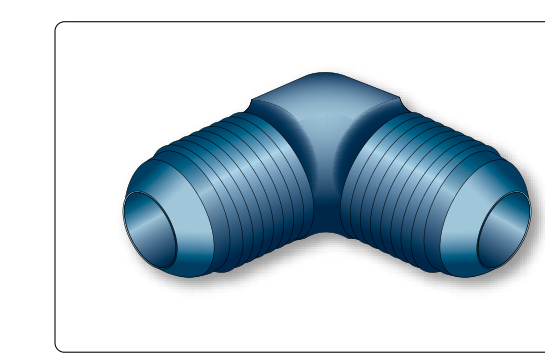
Aircraft fluid systems depend on thousands of individual connections to move fuel, hydraulic fluid, oil, and pressurized air reliably through miles of tubing. Two of the most important standardized fitting families used in these systems are the AN (Army-Navy) and MS (Military Standard) flareless fittings. Unlike their flared-tube counterparts, flareless fittings grip the outside of a tube without requiring the tube end to be shaped into a cone or flare. The result is a strong, vibration-resistant, leak-proof connection that is especially well-suited to high-pressure hydraulic circuits and locations where flaring tools cannot easily be used.
For AMT General knowledge-test candidates, flareless fittings appear frequently in questions about installation procedures, torque values, and acceptable tubing materials. More importantly, understanding these fittings thoroughly helps prevent the kind of installation errors that can cause catastrophic fluid loss in flight.
Standards Background: AN vs. MS
The AN (Army-Navy) specification system was developed jointly by the U.S. Army and Navy during World War II to standardize parts across manufacturers and services. The MS (Military Standard) system followed as a broader standardization effort, covering many of the same part families with revised or updated specifications. In practice, AN and MS flareless fittings share the same basic design principle and are interchangeable in many applications, but it is critical to verify that mating parts share the same specification before mixing them. The FAA's Aviation Maintenance Handbook — Airframe (FAA-H-8083-31) notes that AN and MS fittings are designed so that dimensions, threads, and sealing surfaces conform to documented standards, ensuring interchangeability only within the same specification family.
How Flareless Fittings Work
A flareless fitting assembly consists of three main components: the body, the sleeve (ferrule), and the nut. The body has a machined seat inside its opening. The sleeve — a short cylindrical collar — slides over the tube before assembly. When the nut is threaded onto the body and tightened, it drives the sleeve forward and inward. The leading edge of the sleeve bites into the outer surface of the tube, creating a mechanical grip and a metal-to-metal seal against the body seat. No flaring of the tube end is needed; the sleeve does all the work.
This gripping action has two effects simultaneously. First, it locks the tube against axial pull-out. Second, it creates a pressure-tight seal that can withstand the high pressures found in aircraft hydraulic systems — commonly around 3,000 psi, with some modern systems operating at 5,000 psi. The integrity of that seal depends almost entirely on correct presetting of the sleeve during initial installation, which is why the presetting procedure is strictly defined.
Presetting the Sleeve
Before a flareless fitting is installed in an aircraft system, the sleeve must be preset onto the tube using a presetting tool or a spare fitting body dedicated to that purpose. The procedure is straightforward but must be followed exactly. The nut and sleeve are placed on the cut and deburred tube end. The tube is then inserted into the presetting tool (or spare body) until it bottoms out on the internal stop. The nut is tightened by hand until resistance is felt — this is the point at which the sleeve just begins to contact the body seat. From this snug point, the nut is advanced an additional fraction of a turn as specified by the applicable fitting specification (the exact fraction and any size-based adjustments vary by specification) to cold-form the sleeve's cutting edge into the tube wall, creating the preset bite. Always consult the specification (such as the applicable MS or AND standard) for the exact turn count for the tubing size and material being used.
After presetting, the assembly is removed from the tool and inspected. The sleeve should be slightly swaged (compressed) and should show a visible ring impression around the tube. The sleeve must not rotate freely on the tube — slight resistance to rotation confirms an adequate grip. The tube end and sleeve are then ready to be connected to the actual system fitting.
Tubing Materials Compatible with Flareless Fittings
Flareless fittings are designed to work with rigid metallic tubing. Common materials include aluminum alloy (such as 5052-O and 6061-T6) and corrosion-resistant steel (CRES/stainless), with other alloys used in specific higher-pressure or temperature-critical applications per the aircraft manufacturer's data. Softer materials like pure copper or plastic tubing are generally not used with standard AN/MS flareless fittings because they cannot sustain the proper bite geometry or withstand the associated system pressures. Flexible hose connections use entirely different end fittings and are not part of the flareless family.
The outside diameter of the tubing must match the fitting dash number exactly. AN and MS flareless fittings use a dash number system where the number typically represents the tube outside diameter in sixteenths of an inch (e.g., a -6 fitting accepts 6/16 = 3/8-inch OD tubing). Always verify the dash number, the material specification, and the pressure rating against the aircraft manufacturer's maintenance manual or the applicable Illustrated Parts Catalog before installation.
Why Flareless Fittings Matter for Safety
The appeal of flareless fittings in aviation is not just convenience — it is reliability under vibration and pressure cycling. Flared fittings, if improperly made, can crack at the flare cone, especially in aluminum, leading to sudden fluid loss. Flareless fittings distribute stress differently: the sleeve grips the tube body rather than relying on a thin cone of material. This makes them especially popular in hydraulic systems where pressure pulses are constant and vibration from engines, control surfaces, and turbulence never stops.
A flareless fitting that is improperly preset or over-torqued, however, can actually cut through the tube wall entirely, resulting in immediate failure. This is why the FAA stresses that the presetting step must never be skipped and that final installation torque must follow the applicable specification table rather than being estimated by feel. Over-tightening in service is one of the most common errors, and it typically destroys the sleeve and tube simultaneously.
Key Numbers and Rules
- Sleeve preset rotation: Tighten hand-snug, then advance the nut the additional fraction of a turn called for by the applicable fitting specification — always verify the exact figure for the tubing size and material rather than assuming a single universal number.
- Dash number = tube OD in 1/16-inch increments (e.g., -8 = 1/2-inch OD tubing).
- Sleeve rotation check: After presetting, the sleeve should resist rotation on the tube but should allow very slight movement — it must not spin freely (insufficient bite) or be impossible to move at all (over-pressed).
- Do not re-use a preset sleeve on a different tube — the cold-formed bite is tube-specific; once preset, the sleeve is matched to that tube section.
- Do not mix AN and MS fittings on the same connection unless confirmed dimensionally identical by the applicable specification.
- Tube end must be cut square and deburred before presetting — any burr or angle on the cut end prevents the tube from seating properly in the body and will cause a leak or structural weakness.
- Final torque: After presetting, the fitting is installed in the system and the nut tightened to the torque value specified in the aircraft maintenance manual or the applicable AN/MS standard. There is no generic turn-count shortcut for final torque — always defer to the published torque table.
Common Test Traps
- Skipping the presetting step: Test questions sometimes describe installing a flareless fitting directly onto tubing without presetting. This is incorrect — presetting is mandatory and must be done before the fitting is placed in service.
- Confusing the turn count: The exact preset turn count varies by specification and tubing size — never apply a single number to all sizes without checking the applicable specification.
- Reusing a sleeve: Questions may ask whether a removed sleeve can be reinstalled on a different section of tubing. The answer is no — sleeves are considered single-use once preset to a specific tube.
- Mixing AN and MS fittings blindly: Because both families look similar and use the same thread forms in many sizes, technicians may assume they are fully interchangeable. Always verify by specification number, not appearance alone.
- Over-torquing during final installation: Some test questions imply that tighter is always better for leak prevention. Over-tightening a flareless fitting deforms the sleeve past its design limit, potentially cutting through the tube wall and creating an immediate leak path rather than preventing one.
Mastering flareless fitting procedures is not just about passing the AMT written exam — it is about building the habits that keep aircraft hydraulic, fuel, and pneumatic systems working safely every flight. The standardization embodied in the AN and MS specifications exists precisely so that any qualified technician, anywhere, can install a fitting correctly and confidently the first time.